Osteopathic Family Physician Kathleen White Joins USA Health Clinic in Mobile
Kathleen White, D.O., a board-certified family medicine physician who trained in Virginia and served as residency core faculty there, has joined USA Health and will see patients at the Family Medicine Center on Gordon Smith Drive. She also takes an assistant professor appointment at the Whiddon College of Medicine.
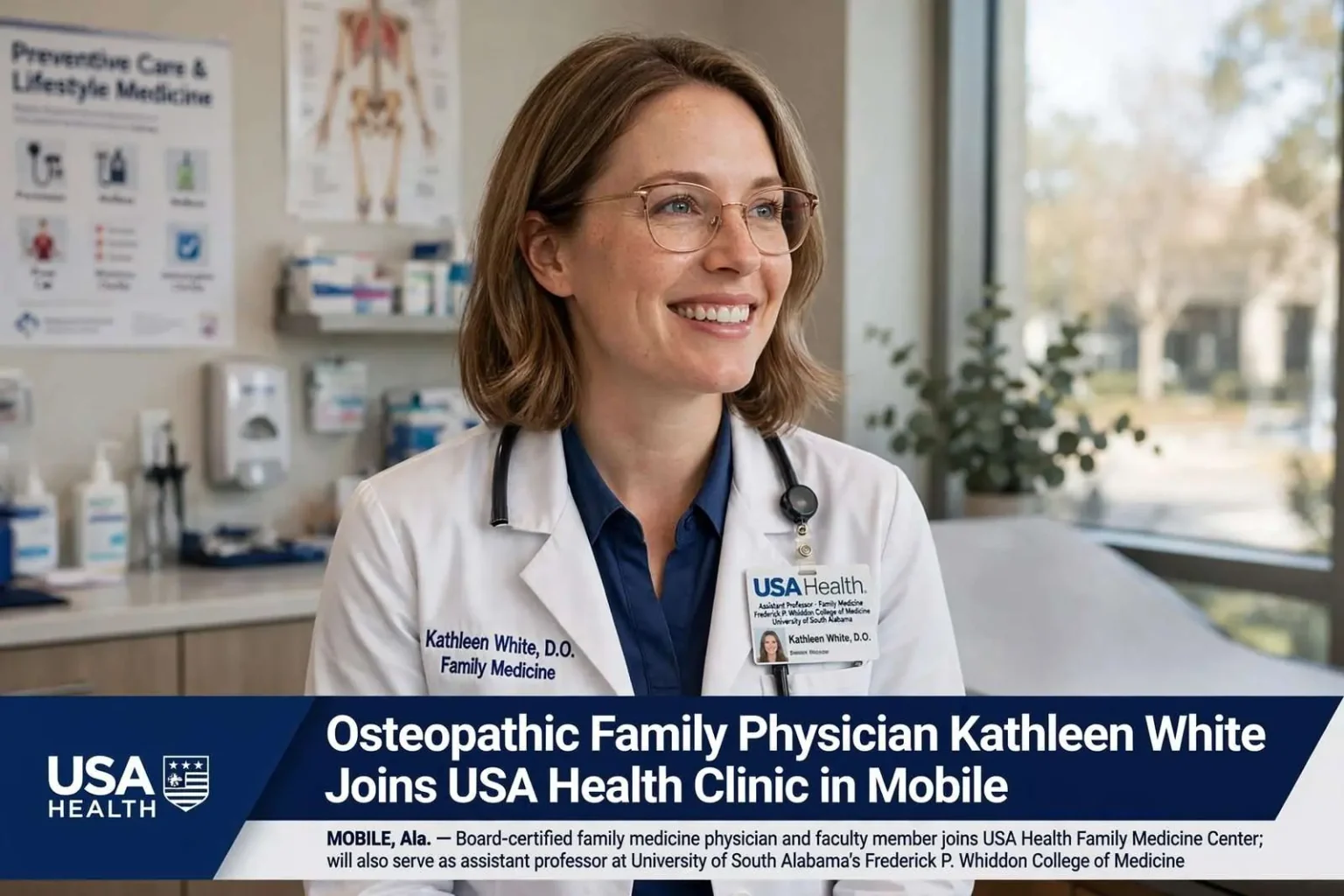
MOBILE, Ala. — USA Health has added a board-certified family medicine physician with a background in residency teaching to its primary care roster, bringing on Kathleen White, D.O., who will see patients at the USA Health Family Medicine Center in Mobile while also holding a faculty appointment at the University of South Alabama’s Frederick P. Whiddon College of Medicine.
White comes to the Gulf Coast after several years in Virginia, where she trained as a family medicine resident, served as chief resident and then stayed in academic medicine as a core faculty member at a separate residency program. Her arrival adds another physician to a clinic that functions simultaneously as a neighborhood doctor’s office and as a classroom for residents and medical students.
“I was drawn to family medicine because of the unique opportunity to build long-term relationships with patients and care for individuals and families throughout their lives,” White said. “I enjoy the breadth of the specialty and the ability to address a wide variety of medical concerns.”
That breadth is the defining feature of the specialty. Family medicine physicians are trained to care for patients at every stage of life rather than limiting their practice to a single organ system, age group or procedure. In a typical week, a family physician may manage chronic conditions such as high blood pressure and diabetes, handle acute complaints, perform preventive screenings, counsel patients on lifestyle changes and coordinate referrals to subspecialists. Board certification signals that a physician has completed an accredited residency in the specialty and passed a standardized examination assessing that broad body of knowledge.
What it means that White is an osteopathic physician
White holds a Doctor of Osteopathic Medicine degree rather than a Doctor of Medicine degree, and the announcement notes that as an osteopathic physician she received additional training in the musculoskeletal system as well as hands-on diagnostic and treatment techniques.
The distinction is one patients in Mobile and Baldwin counties may encounter more often than they realize, and it is frequently misunderstood. D.O.s and M.D.s are both fully licensed physicians in Alabama and in every other state. They complete four years of medical school, enter the same residency training system, sit for board certification and practice across the same range of specialties, from family medicine to surgery. The principal curricular difference is that osteopathic medical schools add coursework in the structure and function of the musculoskeletal system and train students in osteopathic manipulative treatment, generally abbreviated OMT.
OMT is a set of hands-on techniques in which a physician uses their hands to evaluate and treat restricted motion, muscle tension and joint dysfunction. It is one of White’s listed clinical interests, alongside preventative and lifestyle medicine and the education of residents and medical students. For a family medicine clinic, that skill set is a practical addition: a meaningful share of primary care visits involve back pain, neck pain, joint complaints and other musculoskeletal problems, and a physician trained in manual evaluation has an additional tool for assessing them.
Her interest in preventative and lifestyle medicine points in a related direction. Preventive care is the part of primary care aimed at problems that have not happened yet — immunizations, cancer screenings, blood pressure and cholesterol management, counseling on diet, activity, sleep, alcohol and tobacco. It is unglamorous work, and it is also the part of medicine where a long-term relationship with one physician tends to matter most, because the payoff accumulates over years rather than appearing in a single visit.
From Baylor to Dothan to Newport News
White earned a bachelor’s degree in psychology from Baylor University before entering the Alabama College of Osteopathic Medicine in Dothan, from which she received her Doctor of Osteopathic Medicine degree in 2020. The Dothan connection means her medical training began in Alabama, and her appointment at USA Health represents a return to the state after her postgraduate years out of region.
She completed her family medicine residency at the Virginia Commonwealth University/Riverside Family Medicine Residency Program in Newport News, Virginia. During her final year she served as chief resident, a role that combines continued clinical training with administrative and teaching responsibility. Chief residents typically build call schedules, organize educational conferences, mediate between residents and program leadership, and take on a share of the day-to-day supervision of junior colleagues. It is one of the earliest formal leadership positions available to a young physician, and programs generally select for residents who have shown both clinical competence and the ability to teach.
Her teaching drew formal recognition during training. In 2022 she received her program’s Humanism and Excellence in Teaching Award, and she participated in the American Academy of Family Physicians’ Chief Resident Leadership Development Program — a national offering aimed at preparing chief residents for the management and communication demands of the role.
A core faculty role in Virginia
After finishing residency, White joined the Mary Washington Family Medicine Residency in Fredericksburg, Virginia, as a core faculty member. In that position she supervised family medicine residents, transitional-year interns and medical students in both outpatient and inpatient settings while continuing to see her own patients. She also helped develop and implement educational curricula, took part in simulations and procedural skills workshops, mentored residents and contributed to resident recruitment and program development.
The phrase “core faculty” carries specific weight in graduate medical education. A residency program is required to maintain a group of physicians who devote substantial time to the program beyond ordinary clinical duties — teaching, evaluating residents, sitting on program committees and helping shape the curriculum. Core faculty are the people who write the milestone evaluations, sit in on difficult conversations about a struggling trainee and decide what a rotation should actually cover. The role means a physician’s day is split between patient care and the slower, less visible work of building the next class of doctors.
The specific mix White describes — outpatient clinic supervision, inpatient rounding, procedural skills workshops, simulation exercises and recruitment — is a fairly complete tour of what residency faculty do. Simulation, for instance, allows trainees to practice high-stakes situations such as an obstetric emergency or an advanced cardiac life support scenario in a controlled setting before encountering them at a bedside. Procedural workshops cover the practical skills family physicians are expected to have, from joint injections to skin biopsies.
Why she chose an academic health system
White’s experience in academic medicine was a key factor in her decision to come to USA Health, where she serves as an assistant professor of family medicine at the Frederick P. Whiddon College of Medicine.
“I chose to practice in an academic health system because it combines my passions for patient care, teaching, and lifelong learning,” White said. “Academic medicine provides the opportunity to care for patients while also training the next generation of physicians.”
An academic health system differs from a community hospital or an independent clinic in that it carries three missions at once rather than one. It delivers patient care; it teaches medical students, residents and fellows; and it conducts research. Those missions reinforce one another in practice. Teaching hospitals tend to take on complex cases because they have the subspecialty depth to handle them. Trainees ask questions that force attending physicians to justify their reasoning. Research questions often arise from problems noticed at the bedside.
They also compete for the same hours. A physician who teaches is a physician who sees somewhat fewer patients in a given afternoon, because supervising a resident’s visit takes longer than conducting one alone. Health systems that commit to the academic model accept that trade in exchange for a pipeline of physicians, many of whom stay in the region where they trained. For Mobile and Baldwin counties, where recruiting primary care physicians is a persistent challenge across much of the rural South, that pipeline argument is not abstract.
Faculty development, quality improvement and current projects
White is pursuing additional training through the Society of Teachers of Family Medicine Residency Faculty Certificate Program, with an emphasis on teaching strategies, assessment and program development. Faculty development programs of this kind exist because clinical expertise and teaching skill are separate competencies: knowing how to manage heart failure does not automatically confer the ability to explain it, evaluate a learner fairly or design a curriculum that builds knowledge in a sensible order.
She has also served on graduate medical education committees and taken part in quality-improvement initiatives aimed at improving patient care. Her scholarly interests center on practice and quality improvement, including work on screening and management of unhealthy alcohol use among patients with multiple chronic conditions — a population for whom alcohol use can complicate medication regimens and disease control.
Her past quality-improvement work has addressed congestive heart failure management and inpatient glycemic control, meaning the management of blood sugar in hospitalized patients. Her current projects involve statin utilization in patients with diabetes, pneumococcal vaccination and microalbuminuria screening.
Each of those is a recognizable primary care measure. Statins are cholesterol-lowering medications widely used to reduce cardiovascular risk, and patients with diabetes carry elevated risk. Pneumococcal vaccination protects against a bacterium that causes pneumonia and other serious infections, particularly in older adults and people with chronic conditions. Microalbuminuria screening is a urine test that detects small amounts of protein, one of the earliest signals of kidney damage in patients with diabetes or high blood pressure. Quality-improvement work on measures like these is essentially a search for the gap between what a clinic knows it should do and what it actually does, followed by a systematic effort to close it.
A month at Kijabe Hospital in Kenya
During residency, White completed a monthlong international rotation at Kijabe Hospital in Kenya. There she worked as a rounding inpatient hospitalist, helped oversee junior residents, cared for complex patients in a resource-limited setting and took part in daily medical education.
International rotations are a common but optional component of residency training, and their value tends to lie in the constraints. Practicing where imaging, laboratory testing and specialist consultation are limited pushes a physician back toward history-taking and physical examination as primary diagnostic tools. That habit does not disappear on returning home.
Where to find her, and what the announcement establishes
White will see patients at the USA Health Family Medicine Center, located at 2419 Gordon Smith Dr. in Mobile.
It is worth being precise about what this kind of announcement does and does not tell the public. It establishes White’s credentials, her training history, her academic appointment and her practice location. It does not address appointment availability, insurance participation, whether she is accepting new patients or how her arrival affects wait times at the Family Medicine Center — questions residents of Mobile and Baldwin counties would reasonably want answered and which prospective patients would need to take up with the clinic directly.
What is visible in the record is a physician whose stated priorities point toward continuity: long-term relationships, prevention, and the training of physicians who may practice in this region for decades. That last piece is the quiet argument behind faculty hires at teaching institutions. Every core faculty appointment is also a bet on the residents that faculty member will help produce.
“My goal is to create meaningful partnerships with patients, empowering them to take an active role in their health and well-being,” White said.