USA Health launches urology residency program in Mobile
USA Health and the Whiddon College of Medicine have received accreditation for a new urology residency program beginning in July 2023.
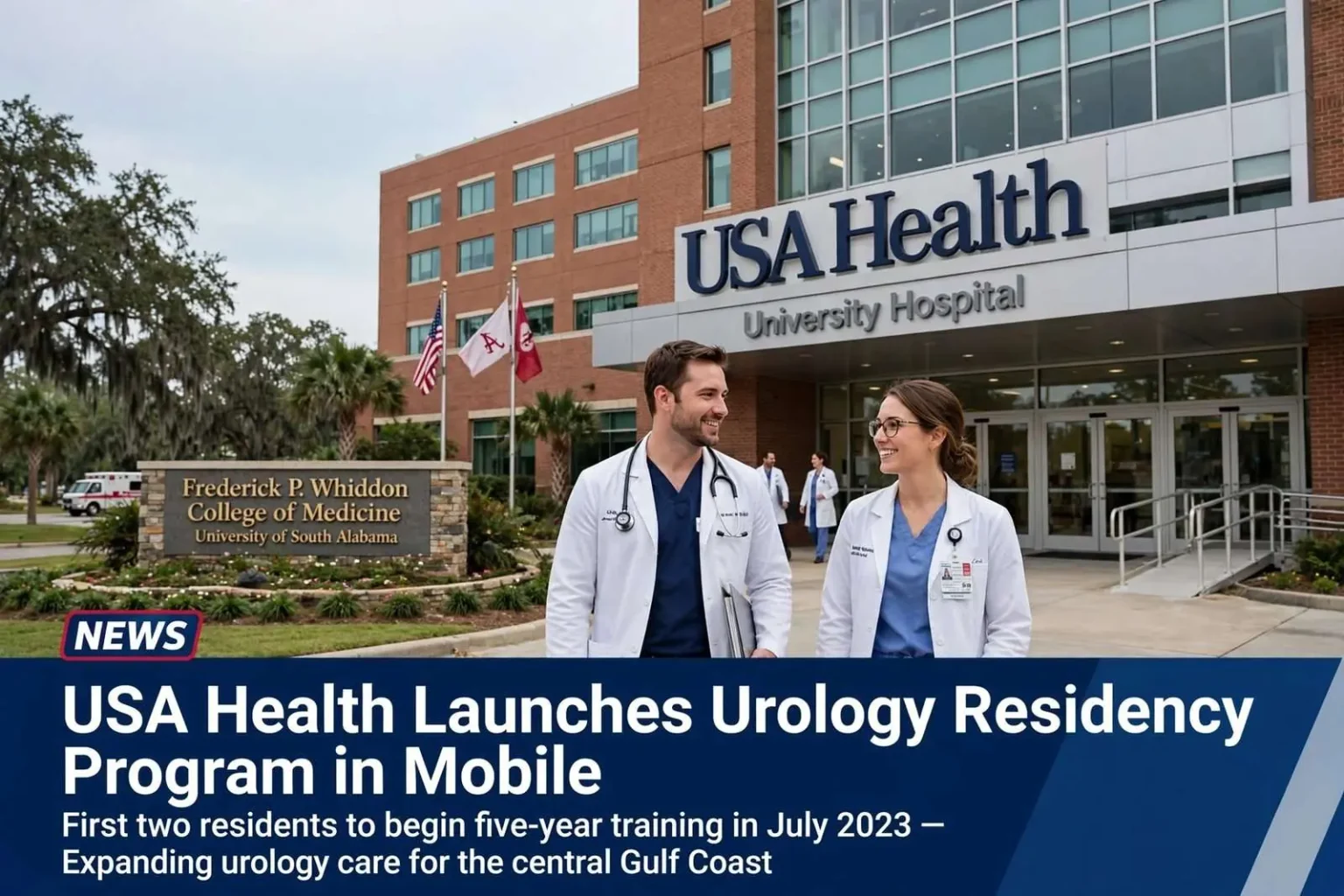
MOBILE, Ala. — USA Health and the Frederick P. Whiddon College of Medicine are launching a urology residency program, with the first residents set to begin in July 2023. The program marks a significant addition to specialty medical training along the central Gulf Coast, where patients have often traveled out of the region for advanced urologic care.
The Office of Graduate Medical Education received approval from the Accreditation Council for Graduate Medical Education, the national body that sets and enforces standards for physician training programs across the country. Two residents have already been accepted and will form the program’s inaugural class when they begin their training next summer.
Earning ACGME accreditation is a demanding, multi-stage process that requires an institution to demonstrate the faculty, case volume, facilities and educational infrastructure needed to train physicians in a given specialty. Approval means USA Health can now recruit residents nationally through the annual Match, the system that pairs graduating medical students with residency programs nationwide.
How the five-year program is structured
The five-year program begins with an intern year that includes general surgery training, giving new physicians a broad foundation in operative care, patient management and the realities of surgical practice. That first year is followed by four years of urologic specialty work spanning general urology and surgery, robotics, pediatric urology, female pelvic medicine and reconstructive surgery, and trauma and urologic oncology.
That range covers the full breadth of modern urologic practice. Urologists treat conditions of the urinary tract in men and women and the male reproductive system — everything from kidney stones and urinary infections to cancers of the kidney, bladder and prostate, along with complex congenital and reconstructive cases.
The subspecialty exposure is a deliberate part of the design. Robotic surgery has transformed urology over the past two decades, becoming the standard approach for many prostate and kidney procedures, and programs that train residents in robotic techniques position their graduates for practice in virtually any market. Pediatric urology and female pelvic medicine, meanwhile, are fields where subspecialists remain in short supply across much of the Southeast.
The residency will accept one new resident each year, meaning that at full strength the program will train a small cohort of five residents at different stages of progression. That one-per-year model is typical of newer and smaller residency programs, which grow carefully to ensure each trainee receives adequate operative experience and faculty supervision.
What it means for the Mobile region
For USA Health, the University of South Alabama’s health system, the residency expands a graduate medical education enterprise that already trains physicians in multiple specialties across its hospitals and clinics. Academic medical centers use residency programs to sustain their specialist workforce, staff their clinics and keep advanced care close to home for the communities they serve.
Mobile has long served as the major medical hub for southwest Alabama, drawing patients from the surrounding counties and from the Mississippi and Florida state lines. The Whiddon College of Medicine, named for the University of South Alabama’s founding president, has been training physicians in Mobile since the 1970s, and its graduates form a substantial share of the region’s practicing doctors.
Residency training carries particular weight in physician workforce studies, which consistently find that doctors tend to settle and practice near where they complete their training. A urology residency based in Mobile gives the region a pipeline of urologists who become familiar with the area’s hospitals, its patients and its practice environment — and who are likely to consider staying.
The demand for urologists is real and growing
The specialty’s expansion in Mobile comes against a backdrop of national and statewide need. Urology is among the more competitive specialties in the residency Match, with a limited number of training positions relative to applicants, and Alabama — like much of the rural Southeast — has long faced challenges recruiting and retaining specialists outside its major cities.
The demand is tied to demographics. The population of southwest Alabama, like the nation’s, is aging, and conditions that urologists treat — prostate disease, urinary tract cancers, kidney stones, incontinence — become more common with age. Training more urologists is one of the few levers health systems have to keep pace with that need.
Residents also bring energy and capacity to the health system itself. A new residency adds supervised physicians to hospital services and clinics, expands access to appointments and follow-up care, and creates teaching opportunities that keep attending surgeons current with the latest techniques and research.
What prospective residents can expect
The two residents already accepted will arrive in July 2023 as the program’s foundation class, a position that carries both opportunity and responsibility. Early residents in any new program work closely with program leadership to shape the rotation schedule, refine the curriculum and establish the culture that future classes will inherit.
For medical students weighing their options, a brand-new program offers small-cohort mentoring and heavy faculty contact, though it lacks the long track record of established programs. Programs that begin with ACGME accreditation from the outset, as this one has, offer the essential assurance that the training will meet national standards and lead to board eligibility.
The path to a seat in the program runs through the Match. Applicants submit rankings of programs, programs rank applicants, and a national algorithm pairs them each March. Urology operates with one of the most selective matches in medicine, so a program accepting even a single resident each year will draw interest from across the country.
A broader investment in Gulf Coast medicine
Launches like this one reflect a wider strategy among academic health systems in the Gulf South: grow the next generation of physicians locally rather than competing for a limited pool of established specialists. Every residency position represents years of care delivered to local patients by a physician in training, under the supervision of experienced faculty.
The economic footprint matters as well. Graduate medical education brings federal support, draws young physicians and their families to the community, and strengthens the case for expanding other subspecialty programs in the future. Programs that succeed often become the seed for additional residencies and fellowships in related fields.
For patients across Mobile, Baldwin and the surrounding counties, the most tangible effect will appear gradually — more urology clinic availability, more access to robotic and subspecialty procedures close to home, and a new generation of urologic surgeons trained on the Gulf Coast. The first of those physicians will walk into USA Health’s hospitals in July 2023 to begin that work.
Between now and then, program leaders will finalize rotations, orient faculty and prepare the curriculum that will guide the inaugural class through five years of training — the start, health system officials hope, of a lasting pipeline of urologic expertise for the central Gulf Coast.
Where the training will happen
USA Health’s clinical network gives the new program its working ground. Residents will rotate through the health system’s facilities in Mobile, including its university hospital and its children’s and women’s hospital, where pediatric urology cases provide experience with congenital conditions and surgical care for young patients. Exposure to cancer care through the health system’s oncology programs supports the urologic oncology component of the curriculum.
Rotations in an academic urology residency typically move residents across operative suites, clinics and inpatient services. A resident might spend one block performing robotic prostatectomies and kidney procedures, another managing kidney stone patients in the emergency setting, and another running clinic follow-ups — the deliberate repetition that turns a medical school graduate into an independent surgeon over five years.
Call responsibilities are part of that growth. Urology residents handle urgent consultations from emergency departments — trauma to the urinary tract, obstructing stones, serious infections — and learn to make operative decisions under pressure with faculty backup. The trauma component named in the program’s curriculum reflects the reality that University Hospital serves as a regional referral point for serious injuries in southwest Alabama.
A signal for specialty care on the Gulf Coast
Health system leaders described the program as an expansion of specialty surgical training in the Mobile region, and the timing matters. Across the country, academic centers are racing to add training positions in surgical specialties as an aging physician workforce retires faster than new specialists graduate. Programs like this one are how a region answers that math.
There is a competitive dimension as well. Mobile’s academic health system operates in a regional landscape that includes larger university centers in Birmingham, New Orleans and Pensacola. Adding an accredited urology residency strengthens USA Health’s standing when recruiting both faculty and future residents, and it keeps more patients from having to leave the area for advanced urologic surgery.
The program’s first class will not complete training until the latter half of the decade, a reminder of how long the physician pipeline runs — five years of residency following four years of medical school. But the benefits begin well before graduation day: each resident added to the system expands clinic capacity and brings current surgical techniques into daily practice from the start.
With accreditation secured, two residents accepted and a July 2023 start date on the calendar, USA Health and the Whiddon College of Medicine have set the program in motion. The one-resident-per-year structure may look modest from the outside, but for the patients who will be treated by these physicians — in Mobile and, in many cases, in the region for decades afterward — it is a meaningful expansion of care.