University of South Alabama Mobile
USA Voice Students Bring Smetana’s Comic Opera “The Bartered Bride” to Laidlaw Recital Hall
University of South Alabama voice students perform Smetana's comic opera "The Bartered Bride" April 25-27 at Laidlaw Recital Hall. Tickets start at $5.
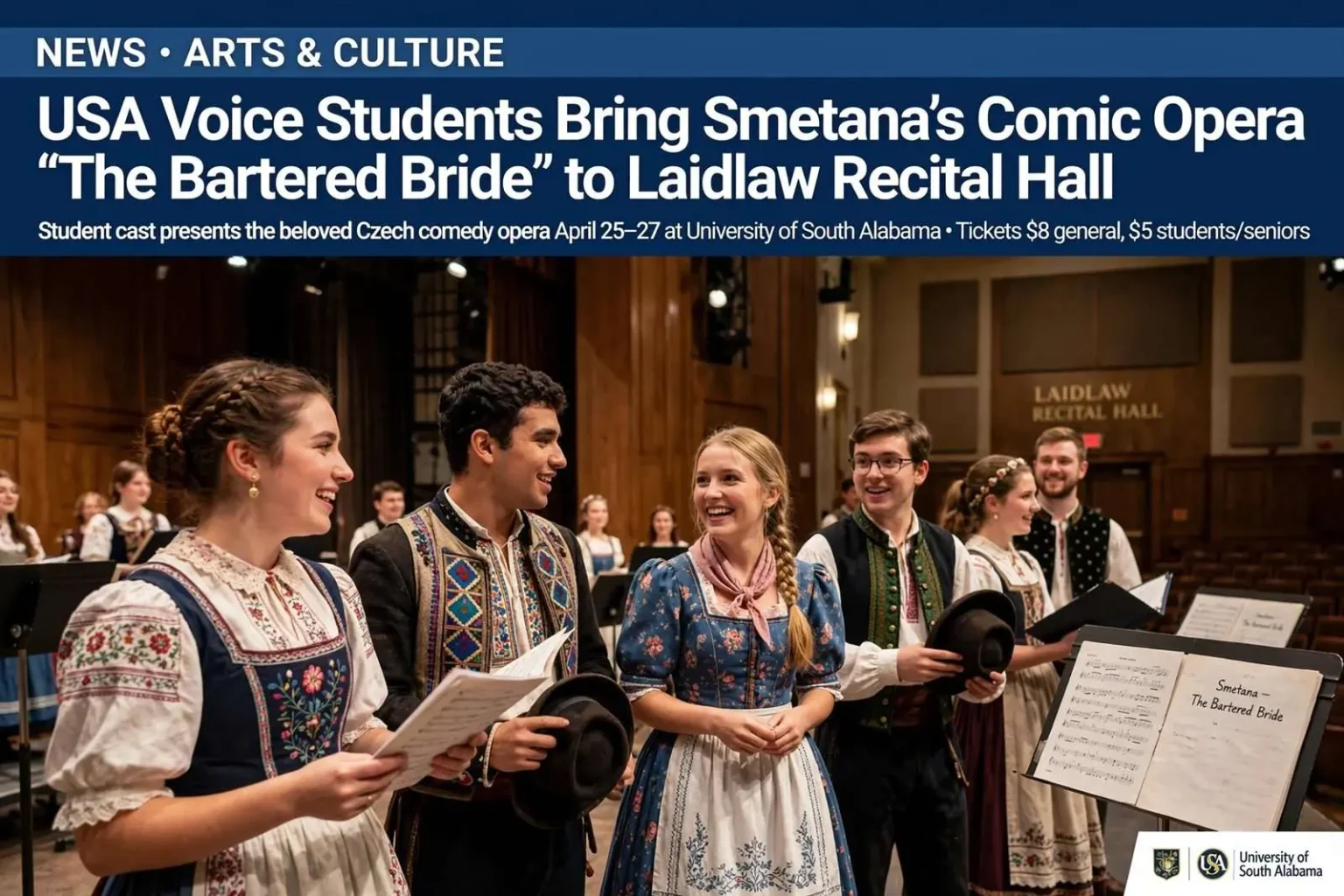
University of South Alabama voice students are taking the stage this month for a production of “The Bartered Bride,” the beloved comic opera by Czech composer Bedřich Smetana, at Laidlaw Recital Hall on the USA campus. The production gives the university’s young singers a full-scale operatic centerpiece — a work beloved across the operatic world for its humor, its melodies and its deep roots in Czech musical tradition, and one that has remained a staple of opera companies and conservatory stages for more than a century and a half.
Smetana wrote the opera in the 1860s, weaving together a tangled comic tale of matchmaking schemes and unexpected romance set against rustic Czech village life. The plot turns on the machinations surrounding a village couple’s love — parents, brokers and scheming suitors each pulling the strings — before the entanglements resolve in the happy ending the genre demands. Comedy on the opera stage requires a particular set of skills from its performers: comic timing, character acting and vocal agility all at once, which is precisely what makes the work such a valuable training ground for student singers.
The work leans heavily on folk-inspired melodies and dance rhythms that reflect Czech heritage, and it has long been considered one of the clearest expressions of the composer’s national spirit. Smetana was the founding figure of Czech national music, a composer who insisted that his country’s stories, dances and dialects belonged on the opera and concert stage alongside the German and Italian traditions that dominated the era. “The Bartered Bride” is the most popular fruit of that conviction — its dances and tunes sound unmistakably Czech, even to listeners who have never heard another note of Bohemian music, and its overture ranks among the most famous in the repertoire.
A difficult birth
Getting there wasn’t easy. Smetana assembled the libretto and score in pieces, a process that made it difficult to settle on a consistent flow for the story. He ended up reworking the opera over roughly four years before it found the cohesion that helped it become one of his most enduring works. The piecemeal creation shows in the work’s history: revisions, added numbers and structural adjustments across its early productions before Smetana arrived at the version audiences know today.
That backstory resonates for a student production in particular. Operas arrive on the Laidlaw stage the way all mature works do — through revision, adjustment and problem-solving — and “The Bartered Bride” is a work whose very existence depended on its composer’s willingness to keep reworking it until the whole cohered. The young cast that takes on the current run inherits a finished masterpiece, but its compositional history is a reminder that the polished version audiences hear was once a work in progress, refined through performance exactly as student productions refine their singers.
The production and the hall
For the USA production, director Thomas Rowell leads a cast of young voices through the piece. Rowell, a longtime figure in the university’s voice and opera program, has shaped the department’s stage productions across seasons of opera workshop and full productions, guiding students through the dual demands of the form: singing at a professional standard while sustaining a living, believable character in front of an audience.
Laidlaw Recital Hall, known for its strong acoustics, gives the student performers a chance to test their range in a setting built for vocal music. The hall’s intimacy and clarity of sound are suited to operatic voices at the student level, where projection and diction are skills still being developed; a room that flatters the voice while remaining honest about it is the ideal training environment. For audiences, the same qualities make the production accessible — unamplified voices in a room designed to carry them, at a distance where every comic aside and ensemble line lands.
Performance schedule
Performances are scheduled for Friday and Saturday, April 25 and 26, with curtain at 7:30 p.m., and a Sunday matinee on April 27 at 3 p.m. The three-performance weekend format gives the cast the stability of a run — the second and third performances typically find a production fully settled, with opening-night nerves burned off — while offering audiences a choice of evening or matinee attendance. The Sunday 3 p.m. slot in particular opens the show to families and to students with weekend commitments who cannot make an evening curtain.
The production takes place at Laidlaw Recital Hall, 5751 USA Drive South, on the University of South Alabama campus. The address places the hall in the heart of the university’s performance corridor, convenient to campus parking and an easy drive from western Mobile and the airport corridors.
Tickets are $8 for the general public and $5 for USA faculty, staff, students, youths under 18 and senior citizens. The box office accepts cash or checks only. The pricing follows the university’s standard performance model — an accessible evening out by the pricing of professional opera, made deliberately reachable for students and families — and the cash-or-check policy at the box office is worth noting for attendees planning a door purchase.
For more information, call 251-460-6136 or visit southalabama.edu/music. The music department’s phone line and website carry the season’s details, including any updates to performance times and program information.
Why Smetana, why here
The choice of “The Bartered Bride” for a university opera program is a considered one. The opera demands a large ensemble cast — principals, featured comprimario roles and a chorus of villagers — which spreads meaningful stage time across the entire voice studio rather than concentrating it in a handful of leading parts. Its vocal writing sits within reach of developing voices while still demanding real technique: the soprano lead’s arias, the tenor’s ensembles, and the famous ensemble numbers all push young singers to blend agility with characterization.
The opera’s dance element adds another dimension. Productions of the work traditionally showcase its folk-dance numbers, which give the production visual energy and give student performers exposure to the movement demands that comic opera carries. Staging a comedy with music this famous and plot machinery this busy is, in short, one of the most complete educations an opera program can offer its students.
For Mobile audiences, the weekend offers what university opera does best: a beloved work of the repertoire performed with the energy of singers for whom every performance is a milestone, in an acoustically excellent hall, at ticket prices that make opera an easy experiment for anyone who has never attended one. The curtain rises at 7:30 p.m. on Friday and Saturday, April 25 and 26, and at 3 p.m. Sunday, April 27, at Laidlaw Recital Hall, 5751 USA Drive South.
Smetana’s place in music
Understanding what “The Bartered Bride” means in the operatic canon helps explain the production’s significance for the university. Smetana, born in 1824, was the first composer to build a lasting national school of Czech music, and he did it against considerable odds — largely deaf by his fifties, working in a German-dominated musical world, and writing operas in the Czech language at a time when that choice was itself a cultural statement. His cycle of symphonic poems “Má vlast” — with its beloved “Vltava” (known to most listeners as “The Moldau”) — and his operas established a model that composers across Europe would follow: find your nation’s folk idioms, stories and dances, and build art music from them.
“The Bartered Bride” became that program’s most successful single work. Its overture, a whirlwind fugato built on the opera’s themes, has long been a concert-hall staple independent of the full opera, and its arias and ensembles — including the famous aria of the soprano lead and the exuberant circus-acrobatics ensemble of the third act — appear on recital programs the world over. When USA’s students perform the work, they are performing a piece whose melodies are among the most recognizable in nineteenth-century opera.
Opera in Mobile’s cultural landscape
The production also slots into Mobile’s broader operatic life, which runs on a mix of professional, semi-professional and university forces. The city’s opera-going public has long depended on the university’s programs to keep the art form visible between professional engagements, and student productions at Laidlaw have historically drawn a mix of campus regulars, music teachers, area singers and curious first-timers. A comic opera like this one — sung in the language of its performance with accessible comedy and instantly appealing melodies — is among the best introductions the form offers.
For the university’s voice students, the April weekend is the culmination of a semester’s work: coaching sessions, staging rehearsals, chorus calls, costume and set preparation, all converging on three performances. The skills it exercises — musicianship, languages, stagecraft, ensemble discipline — are the professional foundations for any singer, whether the path leads to graduate study, church music, teaching or the stage itself. And the audiences that fill Laidlaw Recital Hall for those three evenings will hear the result: a 150-year-old Czech comedy, alive in south Alabama, performed by singers putting their training to the test.
Performances run April 25 and 26 at 7:30 p.m. and April 27 at 3 p.m. at Laidlaw Recital Hall, 5751 USA Drive South. Tickets are $8 general admission and $5 for USA faculty, staff and students, youths under 18 and senior citizens, with the box office accepting cash or checks only; details are available at 251-460-6136 or southalabama.edu/music.