UWF offers pass/fail grading option for Spring 2020
The University of West Florida is offering a pass/fail grading option for Spring 2020 students in response to COVID-19 disruptions.
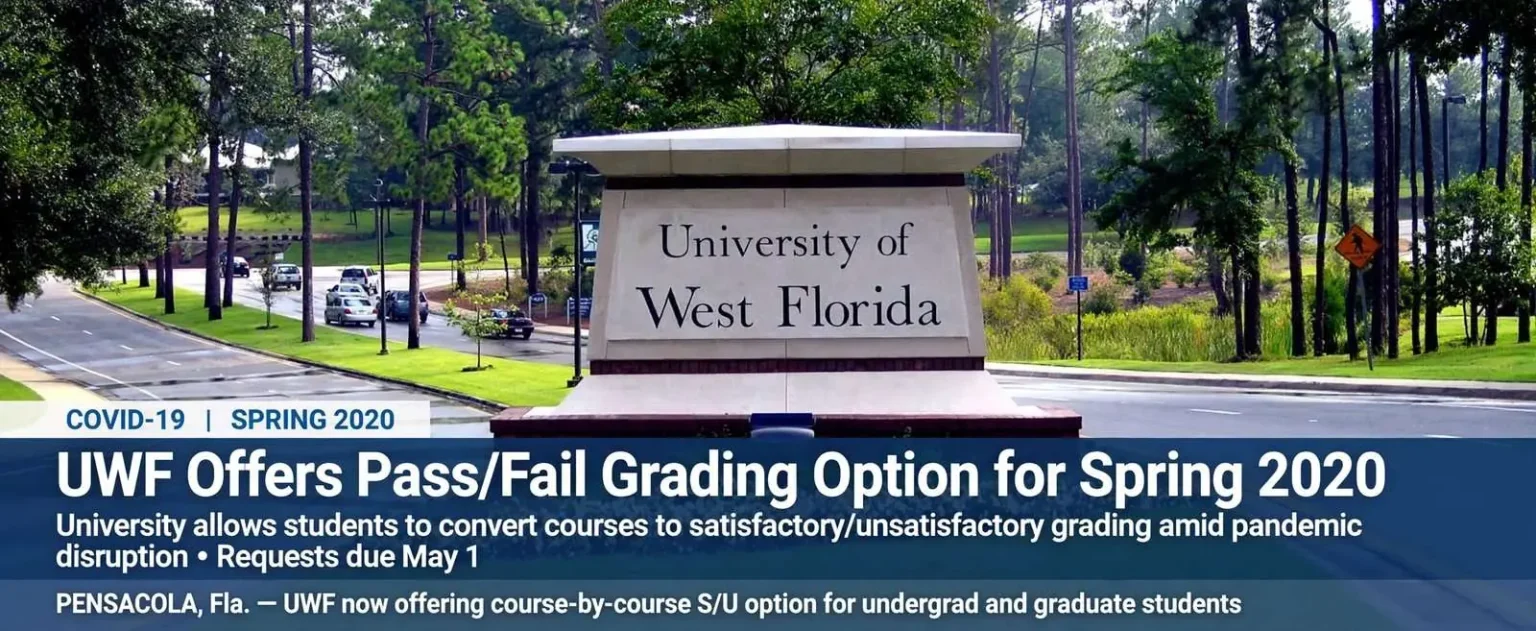
PENSACOLA, Fla. — The University of West Florida will let students convert their Spring 2020 courses to satisfactory/unsatisfactory, or pass/fail, grading as the campus continues to respond to the disruption caused by the COVID-19 pandemic. The exception gives students a way to protect their grade point averages in a semester upended by the rapid shift to remote instruction, while still earning credit that counts toward their degrees.
Under the policy, all undergraduate and graduate students may choose the S/U option on a course-by-course basis, with no limit on the number of courses a student can convert. Courses receiving satisfactory grades will count toward degree requirements. Students who want to keep their standard letter grades need to take no action at all; their coursework will be graded exactly as it would have been in a normal semester. Those who do want to convert must submit a Grade Mode Change Request form by Friday, May 1, with submissions opening Friday, April 3.
The decision follows a wave of similar moves at universities across the country after the coronavirus outbreak forced campuses to abandon in-person classes in March 2020. Institutions large and small adopted emergency grading policies as students grappled with unreliable internet access, displaced living arrangements, family illness and the general upheaval of a semester that suddenly moved from lecture halls to laptop screens. UWF’s approach, letting students pick course by course rather than defaulting everyone to pass/fail, mirrors the model adopted by many peer institutions in the state university system and nationwide.
A campus upended in mid-semester
The University of West Florida, part of the State University System of Florida, enrolls students in Pensacola and across a network of regional sites in the Panhandle. Like universities everywhere, it moved its courses online in March 2020 as the pandemic spread, cutting the spring semester in half and sending students home mid-semester. Faculty had to retool syllabi, exams and labs on the fly, and students had to adapt to new formats with little warning. For some, the disruption meant returning to family homes without reliable broadband, or taking on caregiving responsibilities while trying to finish coursework.
Grading policies became one of the most closely watched questions of the emergency. A letter grade earned in a hastily converted online course, students and faculty argued, might not reflect what a student actually learned over the full term. Pass/fail options offered a compromise: students could still complete their courses, earn their credits and advance toward graduation, without a substandard grade permanently damaging a transcript built over years. Many universities also adjusted withdrawal deadlines and extended other academic deadlines in the same spirit.
UWF said the exception followed consultation with the Faculty Senate, the Student Government Association, the Office of the Registrar and university leadership. That range of input reflected the competing concerns such policies raise. Faculty bodies worried about academic standards and the integrity of degree requirements, student governments pushed for maximum flexibility, and registrars faced the technical challenge of reworking grading workflows at mid-year while a semester was still in progress.
How the S/U option works
The mechanics of the policy are straightforward but require action from students who want it. A satisfactory grade counts toward degree requirements but typically does not carry quality points, so it neither raises nor lowers a GPA; an unsatisfactory grade likewise generally leaves the GPA untouched while producing no credit. That asymmetry is the appeal for students whose spring performance might suffer through no fault of their own, and it is also the reason registrars and advisors caution that the option is not automatically the right call for everyone.
The university advised students to speak with an academic advisor, a department chair or a faculty advisor before deciding. The reason is that a pass/fail grade can interact in complicated ways with requirements beyond a single course. Some degree programs require minimum letter grades in specific courses, particularly in majors with accreditation requirements such as nursing, education, engineering and business. Professional schools evaluating applications sometimes treat non-letter grades in prerequisite courses differently, or expect applicants to explain them. A course converted to S/U in the major itself could raise questions later that a quick advising conversation would surface now.
Financial aid adds another layer. UWF specifically advised students who receive financial aid to consult a financial aid counselor about the possible implications of converting courses. Federal aid programs tie continued eligibility to satisfactory academic progress standards, which measure both the pace of credit accumulation and grade-based completion rates. Converting a course to an unsatisfactory grade, for example, produces attempted hours without earned hours, which can chip away at completion-rate thresholds. Scholarships with GPA renewal requirements may be unaffected by an S grade, but rules vary by donor and program, and students were urged to confirm before the deadline rather than discover a problem after grades posted.
For graduate students, the stakes can differ again. Assistantships, progress-toward-degree benchmarks and program-specific grade requirements may treat satisfactory grades differently than undergraduate policies do. UWF’s decision to open the option to graduate as well as undergraduate students, on the same course-by-course basis, was notably broad; many institutions restricted pass/fail conversions to undergraduates or capped the number of eligible courses. UWF placed no such cap, leaving the choice entirely to each student across their full spring schedule.
Deadlines and process
The window for requesting a conversion opened Friday, April 3, giving students roughly a month to decide before the Friday, May 1 deadline. The Grade Mode Change Request form is the required mechanism; a student’s preference expressed to an instructor or advisor does not change the grade mode on its own. Registrar offices at universities that adopted similar policies in spring 2020 generally processed these requests in bulk after the semester ended, converting grades at the point of final grade posting.
Students choosing to do nothing needed to do exactly that. Letter grades for unconverted courses will post as usual, counting for both credit and GPA. That default was deliberate: by requiring an affirmative request, the university avoided imposing pass/fail grading on students who earned strong spring grades and wanted them on their transcripts, a particular concern for students near graduation, on probation, or pursuing competitive applications to graduate or professional school where a high GPA matters.
The spring 2020 semester will be remembered as the one that tested higher education’s capacity to change overnight. For UWF, the S/U option was one piece of a broader response that included moving thousands of course sections online, reworking student services for remote delivery and managing the public health guidance that governed the Pensacola campus. The grading exception acknowledged a simple reality: students were finishing a semester that bore little resemblance to the one they signed up for in January, and their records should not bear the full weight of a global disruption. Students with questions about their specific situation were directed to academic advisors and the Office of the Registrar before the May 1 deadline.
What the semester looked like from the classroom
The shift to remote instruction changed the texture of every course in different ways. Lecture classes converted to video sessions and discussion boards. Studio courses, clinical rotations and laboratory sciences, where hands-on work is the point, were the hardest to translate, and instructors improvised with filmed demonstrations, simulation software and delayed in-person components. Students in workforce-oriented programs faced the added uncertainty of internships and student-teaching placements that were suspended or restructured as the schools and hospitals that host them closed their doors to visitors.
Faculty members spent the weeks after the transition rewriting assessments on the fly. Take-home exams replaced closed-book tests, papers replaced presentations, and many instructors dropped the lowest grades or reweighted assignments to account for the chaos students were navigating. The S/U policy complemented those accommodations from the other direction, giving students a formal mechanism to neutralize a grade that even a sympathetic instructor’s adjustments could not fully rescue. Together, the two approaches aimed to keep the semester from becoming a casualty of the crisis.
The timing of the decision mattered as well. Announcing the option in late March, with a request window opening April 3, gave students several weeks of remote instruction experience before they had to commit. A student who feared a chemistry course was slipping could wait to see how midterm-adjusted grades landed, talk through options with an advisor, and still file the form comfortably before the May 1 cutoff. That breathing room was a deliberate contrast to institutions that set short deadlines, which left students gambling on grades they had not yet seen.
A precedent for future disruptions
Emergency grading policies from spring 2020 became a reference point in higher education long after the semester ended. Admissions offices and employers learned to read transcripts from that term with context in mind, and graduate programs grew accustomed to seeing clusters of S grades and “pass” marks across applicants’ spring coursework. Registrars flagged the term in institutional records so that future readers would understand why an otherwise unusual transcript pattern appeared. For students at UWF, the Grade Mode Change Request form was a small document, but it captured the university’s answer to an unprecedented question about fairness in a broken semester.