‘Vape a Vet’ Booth at Mobile Convention Center Aims to Help Veterans Quit Smoking
A nonprofit called Vape a Vet showcased free e-cigarette starter kits for veterans at a vaping trade show inside the Mobile Convention Center.
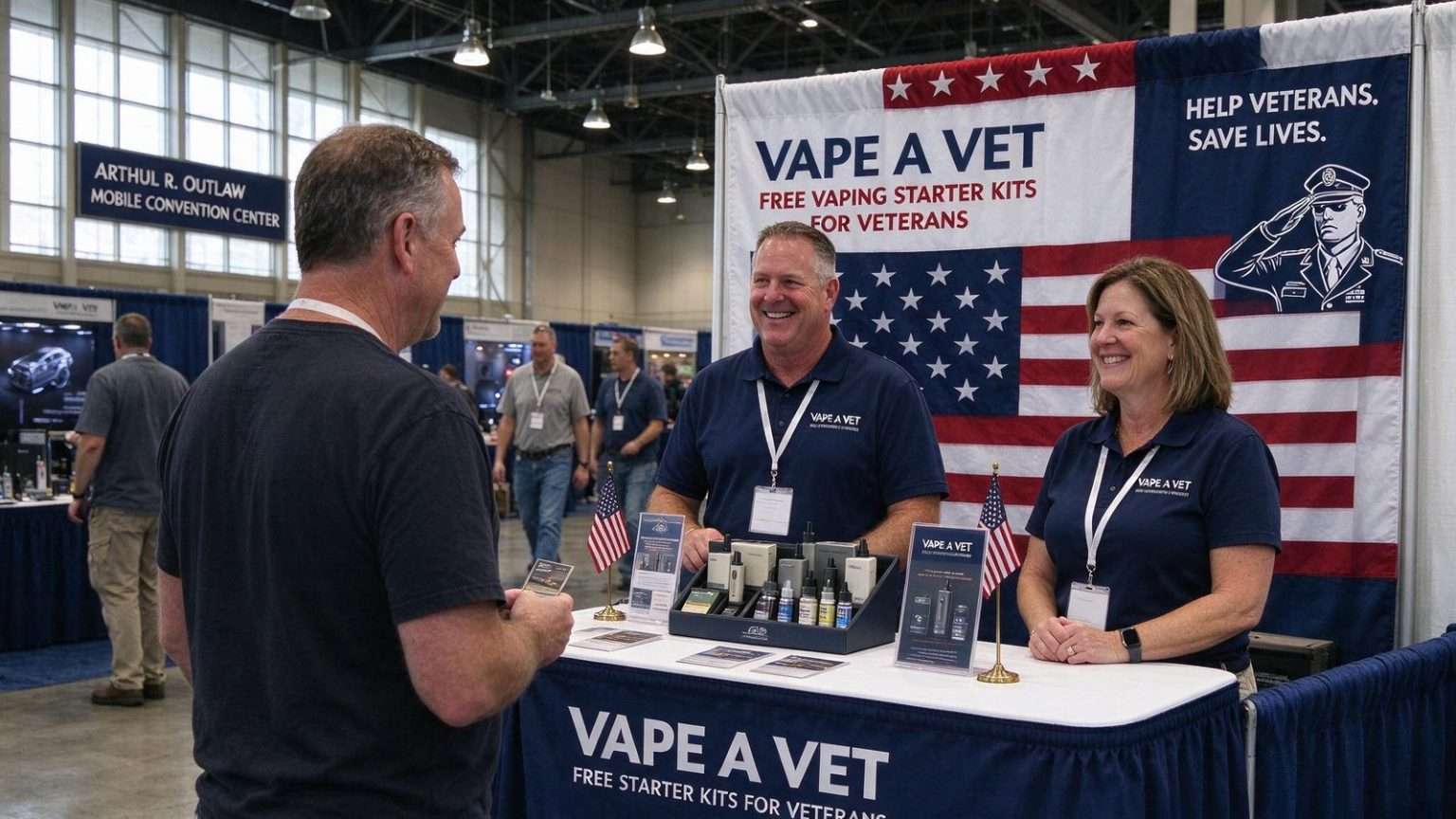
Among the rows of vendor booths set up inside the Arthur R. Outlaw Mobile Convention Center for a multi-day vaping industry trade show, one stood out for its focus on a specific audience: military veterans looking for help kicking a cigarette habit. While surrounding exhibitors rolled out new hardware and flavored e-liquids for retail buyers, the nonprofit Vape a Vet used its space on the convention floor to talk about smoking cessation, veteran health and the gap between the two.
The booth belonged to Vape a Vet, a nonprofit organization that grew out of its founder Will Cohen’s earlier career in public service. Cohen spent time working with the city of Phoenix on workforce development programs aimed at veterans, helping former service members prepare for civilian employment. During those employment-preparation sessions, he noticed how often the smell of cigarette smoke lingered on veterans heading into job interviews — a detail career counselors routinely warn can leave a bad first impression on prospective employers before a candidate says a word.
That observation planted the seed for a program that, by the time it reached the Mobile convention floor, had already sent starter kits to more than 1,500 veterans nationwide since launching two years earlier. What began as a practical fix for one job-readiness program in Arizona had grown into a national effort built around a simple offer: a free path from combustible cigarettes to vaping for any service member or veteran who wants it.
Free Kits for Those Who Served
The kits are provided at no charge to active-duty and former service members who want to transition away from combustible cigarettes toward vaping, which researchers have said carries fewer of the carcinogens associated with traditional smoke. Each kit is designed to give a recipient everything needed to make the switch immediately, removing the trial-and-error spending that keeps many smokers tethered to a habit they already want to break.
The organization’s leadership is careful to frame the program as harm reduction rather than a medical treatment. Vaping remains a subject of ongoing debate among public health researchers, but the nonprofit’s position rests on the widely reported finding that e-cigarettes eliminate the combustion process that produces the most dangerous byproducts of smoking. For veterans who have tried and failed with patches, gum or counseling, the kits represent one more option — one that comes with no bill attached.
The Numbers Behind the Mission
The numbers cited by organizers point to a real gap in veteran health outcomes. Federal data shows that roughly 36 percent of male veterans between the ages of 45 and 54 identify as smokers, compared with about 24 percent of non-veterans in that same age bracket. Researchers have linked the disparity to stress, deployment culture and limited access to cessation resources — factors that follow service members home long after their tours end.
That twelve-point gap translates into thousands of veterans across the Gulf Coast and the nation who smoke at rates well above their civilian peers, with the associated risks of heart disease, cancer and respiratory illness. Organizations that work with veterans in Alabama and across the country have repeatedly identified tobacco use as one of the most persistent health burdens facing the community, one that outlasts the more visible challenges of transition to civilian life.
From Donations to a Sustainable Model
Vape a Vet initially ran on donations alone, an approach that limited how many kits the organization could ship and how far ahead it could plan. Cohen said the addition of a companion retail product line — custom-flavored e-liquid sold under a separate brand — gave the nonprofit a sustainable way to fund the free kits without relying solely on fundraising drives.
Proceeds from each bottle sold, including the bottles on display at the Mobile show, are funneled back into covering the cost of starter kits shipped to veterans around the country. The model links the industry’s commercial side directly to its outreach: every retail purchase under the companion brand underwrites another kit for a veteran, allowing the organization to scale its giveaway program as the brand grows.
The Real Barrier: Upfront Cost
According to Cohen, the biggest hurdle the program faces is not skepticism about vaping’s safety profile so much as the upfront cost of trying it. Quality starter equipment can represent a significant expense for someone used to buying cigarettes a pack at a time, and many veterans, he said, default back to a familiar pack rather than risk spending money on vaping equipment that might not work for them.
That cost hurdle is exactly what the free starter kits are designed to remove. By shipping equipment directly to applicants at no charge, the program eliminates the financial gamble that keeps many smokers from ever attempting the switch, replacing it with a zero-cost trial that requires only the willingness to fill out a form.
How the Program Works
Veterans interested in the program simply fill out a short application and submit proof of service before a kit is mailed to them at no cost. The verification step keeps the program focused on its intended audience while keeping the administrative burden light — no doctor’s referral, no waiting list, no income requirement beyond the service verification itself.
That streamlined process matters for a population that researchers say often underuses available health services. Traditional cessation routes — physician referrals, pharmacy programs, structured counseling — can involve appointments, copays and repeated trips that compete with work and family obligations. A mail-out kit compresses all of that into a single envelope.
The Mobile Trade Show Setting
The Mobile stop was one stage of a broader vaping industry gathering drawing exhibitors and attendees to the Gulf Coast for a weekend focused on new products and public health conversations surrounding e-cigarettes. Trade shows of this kind serve as the industry’s meeting ground, where manufacturers, liquid makers, retail shop owners and advocacy organizations compare products, track regulatory developments and debate how the category should present itself to the public.
The Arthur R. Outlaw Mobile Convention Center, sitting on the city’s riverfront downtown, has hosted a wide range of conventions, trade shows and public events, and the vaping industry gathering brought visiting buyers and exhibitors into the downtown district during their stay. For the nonprofit, the venue put its booth in front of exactly the crowd that shapes how veterans encounter vaping: shop owners who might refer customers, manufacturers whose products end up in starter kits, and attendees who carry the program’s message home to their own communities.
Veteran Health on the Gulf Coast
The program’s visit to Mobile comes in a region with a deep military footprint. Alabama is home to a substantial veteran population, and Gulf Coast communities from Mobile to Pensacola are shaped by bases, training centers and the national guardsmen and reservists who cycle through them. Veteran service organizations across the region regularly host health-focused events, and smoking cessation remains one of the most common topics in veteran wellness outreach.
For local veterans who stopped by the booth during the show, the pitch was straightforward: the organization ships nationwide, the kits are free, and the application takes minutes. Organizers said connecting face to face with veterans — and with the shop owners and industry figures who can amplify the message — is a central reason the nonprofit exhibits at trade shows rather than operating purely online.
A Model Other Outreach Programs Are Watching
The Vape a Vet approach — pairing a retail brand with a nonprofit giveaway — reflects a broader pattern among cause-driven organizations that have sought funding streams more reliable than donation drives. By tying each bottle sold to the cost of a starter kit, the program makes its impact arithmetic visible to customers and gives retailers a concrete story to tell about the products on their shelves.
As the trade show wrapped up its Mobile weekend, the nonprofit’s representatives packed up alongside the industry’s retailers and manufacturers, leaving behind application cards and a simple offer for the Gulf Coast’s veteran community: proof of service, a short form, and a kit on the way — no charge, and no pack of cigarettes required to get started.
What Veterans Should Know About Applying
Veterans and active-duty service members who want to request a kit can expect the process Cohen described at the booth: a short application, proof of service, and a starter kit mailed to their door. The organization asks for verification rather than payment, keeping the barrier to entry as low as possible for a population it says is already underserved by mainstream cessation options.
Applicants do not need to have prior experience with vaping products, and the kits are intended for smokers who want to move away from combustible cigarettes rather than for current vapers looking for free equipment. That distinction is central to how the nonprofit presents itself — as a cessation-oriented outreach program that happens to operate within the vaping industry, not a giveaway arm of a retail business.
The Broader Conversation About Smoking and Service
The elevated smoking rates among veterans highlighted by the program’s organizers have drawn attention from health researchers for years, with studies repeatedly pointing to the role of military culture in initiation and the stresses of deployment in maintaining the habit. Cessation resources exist through veterans’ health services, but outreach organizations argue that the first step — convincing a long-time smoker to attempt a switch — often happens outside clinical settings.
Programs that meet veterans where they already are, whether at job-preparation workshops, community events or industry trade shows, fill that gap. The Phoenix job programs where Cohen first noticed the smell of smoke on interview-bound veterans were not health events at all, and yet that setting proved to be where the need was most visible — a reminder that the path to better health outcomes for veterans often starts in unexpected places.
Looking Ahead From Mobile
The Mobile convention stop gave the organization a Gulf Coast audience it had not reached before, and the visit underscored how far the program has traveled from its Phoenix origins — from a single observation in a workforce development class to more than 1,500 kits shipped across the country in two years.
For the veterans of southwest Alabama, the organization’s message was the same one it carries to every stop on the trade show circuit: the disparity in smoking rates between veterans and civilians is real, the tools to close it are available, and the cost of trying them no longer has to fall on the veteran. Whether the program’s next chapter brings its kit counts into the tens of thousands will depend on the same formula it showcased in Mobile — a retail brand funding a free kit, one bottle at a time.