
Vehicle Strikes Oil Change Business on Airport Boulevard; No Injuries Reported
A car hit a Take 5 Oil Change on Airport Boulevard in Mobile. Police say no one was injured and the business sustained no visible damage.
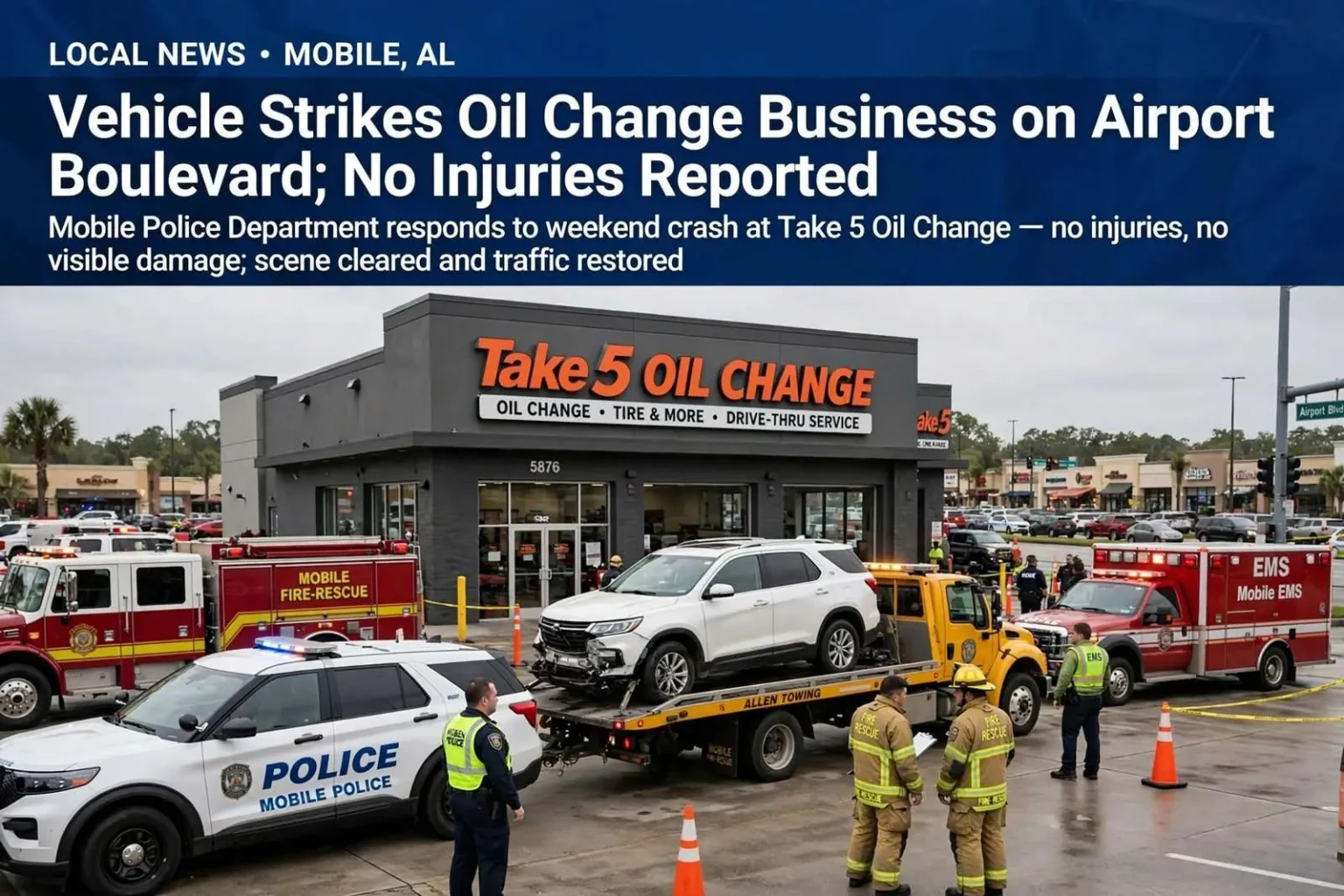
A car struck an oil change business on Airport Boulevard in Mobile over the weekend, according to the Mobile Police Department, sending emergency crews to a storefront along one of the city’s busiest commercial corridors. Police, fire rescue, and EMS units responded to the scene at Take 5 Oil Change, where a vehicle had left the roadway and hit the business.
Police confirmed that no one was hurt in the crash. Despite the impact, no visible damage could be seen to the business itself, and the incident ended without the injuries or structural destruction that similar crashes along the corridor have sometimes produced.
What Happened at the Scene
Emergency crews including police, fire rescue, and EMS responded to the scene after the vehicle struck the Take 5 Oil Change location. Responders evaluated those involved, checked the building for damage, and worked to clear the vehicle from the storefront. A tow truck later hauled the vehicle away from the scene, restoring the storefront to its normal appearance.
Details about what caused the driver to leave the roadway have not been released. Police have not said whether a citation was issued or whether any charges are anticipated, and the investigation remained in its early stages as crews worked the scene over the weekend.
A Busy Corridor Disrupted
Airport Boulevard carries some of the heaviest traffic in Mobile, running east to west through a stretch of the city lined with restaurants, retail shops, service businesses, and office parks. The incident closed off part of the busy corridor while crews worked the scene, slowing weekend traffic for drivers passing through the area. Once the vehicle was removed, traffic returned to normal along the roadway.
Crashes into commercial buildings are not rare along multi-lane urban corridors like Airport Boulevard. A driver’s foot slipping from the brake to the gas pedal, a medical emergency, or simple distraction can send a vehicle across a parking lot and into a storefront in seconds, which is why many businesses along such roads install bollards, curbing, or other protective barriers between parking areas and their entrances.
How Responders Handle a Structure Crash
When a vehicle strikes an occupied business, responders follow a set sequence. Fire rescue units check the structure for damage that could compromise the building, look for fuel leaks or other hazards, and assess anyone inside the vehicle and the building. EMS evaluates drivers, passengers, employees, and any customers who might have been near the point of impact. Police secure the scene, document evidence, and manage traffic until the roadway is clear.
Only after those checks come back clean can the scene be handed over for cleanup and towing. In this case, responders found no injuries and no visible damage to the building, allowing the incident to wrap up without road closures extending through the day. The tow truck’s removal of the vehicle marked the practical end of the response.
Take 5’s Business Model and the Local Retail Landscape
Take 5 Oil Change operates locations across the Gulf South, offering drive-through oil changes that keep customers in their vehicles while technicians work. The Airport Boulevard store sits among a dense cluster of automotive service businesses along the corridor, a stretch where drivers can find several quick-lube shops, tire stores, and auto parts retailers within a few minutes of one another.
The business was able to keep operating after the incident given the lack of visible damage. Storefront crashes more often leave businesses closed for days or weeks while engineers evaluate structural damage and repairs are made, so the weekend’s outcome was about as benign as such incidents get.
What Drivers Should Know
Police urge drivers along commercial corridors to stay alert in parking areas and drive-throughs, where pedestrians, employees, and vehicles move in ways that highway driving rarely requires. Incidents like the one at Take 5 Oil Change are a reminder that the transition from road to parking lot is among the most common settings for low-speed but high-consequence crashes.
Motorists who witness a vehicle striking a building are encouraged to call 911 immediately, even if the driver and building appear undamaged, since structural issues and injuries are not always visible from the outside. For the Airport Boulevard corridor, the weekend incident ended with no injuries, no visible damage, and traffic back to normal — a quiet resolution to a crash that could easily have been worse.
Weekend Traffic and the Airport Boulevard Corridor
Airport Boulevard functions as one of Mobile’s main commercial arteries, connecting the city’s core with the retail districts farther west and feeding traffic toward the airport area that gives the road its name. Weekend traffic along the corridor mixes errands, diners, and travelers, and any incident that blocks a lane or two quickly backs up vehicles through adjacent intersections. That is what made the temporary closure while crews worked the scene noticeable, and the return to normal traffic once the vehicle was towed a relief for weekend drivers.
The corridor has seen its share of traffic incidents over the years, from rear-end collisions at busy signals to vehicles leaving the roadway near the numerous curb cuts that serve the strip shopping centers and standalone businesses lining both sides of the street. Traffic engineers generally identify frequent driveways as a factor in crash rates on roads like Airport Boulevard, because each entrance and exit introduces crossing and turning movements into what would otherwise be through traffic.
When Vehicles Hit Buildings
Nationally, vehicles strike commercial buildings thousands of times each year, and storefront crashes have become a field of study unto themselves for safety engineers and insurers. The common causes include pedal misapplication, medical events behind the wheel, parking errors, and — less often — intentional acts. The consequences range from cosmetic scrapes to full structural failures, and buildings with glass fronts and unprotected entrances absorb the worst of the damage.
Retailers along busy roads have increasingly responded with protective design: concrete bollards, raised curbs, and parking layouts that angle vehicles away from entrances. Those measures cost comparatively little during construction and can prevent the injuries that storefront crashes too often cause to customers and employees standing just inside the glass. In the Take 5 incident, the lack of visible damage to the building suggests the vehicle struck at low speed or contacted the structure in a way the facade could absorb.
The Role of Mobile Fire Rescue and EMS
Mobile Fire-Rescue and EMS units respond alongside police to crashes throughout the city, and their presence at a business crash serves specific purposes. Firefighters check for compromised fuel systems, fluid leaks, and any structural instability before allowing anyone to approach the vehicle or the building. EMS crews evaluate everyone involved, since injuries from even low-speed crashes can be hidden — airbag deployment, seatbelt bruising, or the delayed symptoms of a medical event that caused the crash in the first place.
The multi-agency response to the Take 5 crash followed that playbook, and the fact that no injuries were reported meant the scene could be cleared quickly rather than becoming a prolonged investigation. Weekend staffing levels across the city’s emergency services are built to handle exactly this kind of incident while maintaining coverage for the rest of the city.
After the Tow Truck Leaves
Once the vehicle was hauled away and traffic returned to normal, the remaining steps fell to the businesses and agencies behind the scenes. Police compile the crash report that documents the scene, the parties involved, and any preliminary findings, a record that insurers rely on when claims are filed. The driver’s insurance carrier handles any damage to the storefront or vehicle, and, if a medical issue or citation is involved, those determinations follow through their own processes.
For Take 5 Oil Change, the weekend proceeded with business essentially uninterrupted. For Mobile drivers, the incident passed with a brief slowdown and a reminder of how quickly an ordinary errand can turn into an emergency scene — and how cleanly it can resolve when crews respond fast and no one is hurt.
Lessons for Drivers and Businesses Alike
Incidents like the one on Airport Boulevard tend to prompt two kinds of reflection. For drivers, the lesson is about care in the final seconds of a trip: slowing down in parking lots, checking pedal placement, avoiding phone use at low speeds, and taking medical symptoms seriously before getting behind the wheel. Most storefront crashes happen at low speed, which means most are preventable with the kind of attention that drivers routinely give at highway speed but often relax in the last hundred feet of a drive.
For businesses, the lesson is about design. Retailers that front busy corridors can review their parking layouts, entrance protection, and signage to reduce the chance that an errant vehicle reaches the building. Industry groups that study storefront crashes recommend barrier protection wherever customers park close to a facade, and many national chains have retrofitted older stores with bollards and curbing as locations are updated.
Mobile’s Weekend Response in Perspective
The weekend response on Airport Boulevard showed the city’s emergency system working as designed. A crash was reported, police and fire rescue and EMS arrived, the scene was checked and secured, and a tow truck cleared the vehicle without any injuries to complicate the picture. The portion of the corridor that had been closed reopened, and traffic returned to normal along one of Mobile’s busiest streets.
Police have not released the driver’s name or the cause of the crash, and no further information about citations or charges was available. The Mobile Police Department’s crash investigation records the outcome, and anyone with information about the incident can contact the department. For the neighborhood around Take 5 Oil Change, the weekend ended with nothing worse than a story — a car, a storefront, and a corridor back to its usual pace.


