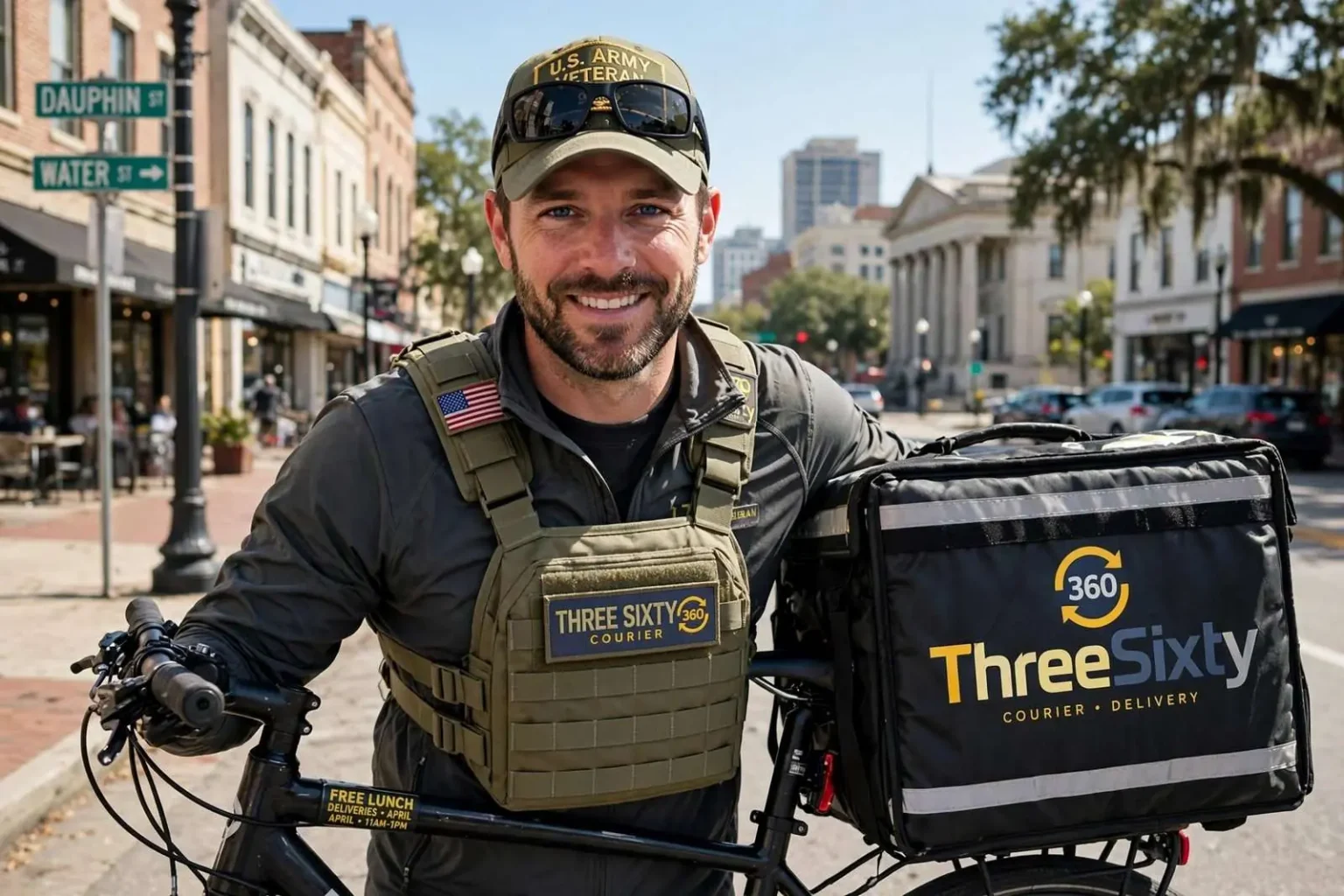
A new bicycle delivery service is pedaling for customers across Mobile. ThreeSixty, founded by Paul Smith, a Georgia-born Army veteran who moved to the city last summer after stints in Portland, Oregon and New Mexico, offers courier runs from downtown to West Mobile — and its owner is promoting it with free lunchtime deliveries throughout April.
Smith says he started the business because he enjoys cycling and wants to give local businesses a cheaper, faster way to move documents, food and small packages. He is also pitching it as a community builder, with an eye toward a more bike-friendly city.
The service is aimed squarely at the daily rhythms of the city: the law office that needs a contract across downtown before a deadline, the restaurant hoping to reach a lunch customer across town, the shop owner with a part that has to get to a customer before closing. For errands like those, a courier on a bicycle can thread through traffic, skip the hunt for parking, and often beat a car door to door.
How the Service Works
ThreeSixty divides Mobile into three coverage zones: downtown from Water Street to Broad Street; Broad Street out to Interstate 65; and I-65 westward to Schillinger Road and the regional airport. The zones function as distance tiers — the farther a delivery travels from the city’s core, the more it costs — and rates are posted on the company’s website so customers can price a run before they book it.
Every delivery is guaranteed — if it doesn’t arrive on time, it’s free. The promise puts pressure on the operation’s own logistics, and Smith says the bicycle gives him the margin to make it: a courier who never waits for a parking space or a traffic light cycle can hold a schedule that cars in cross-town traffic frequently cannot.
The zone map tracks the geography of Mobile’s daily business. The downtown zone, bracketed by the riverfront at Water Street and the Broad Street corridor, is the densest cluster of offices, courthouses, banks, and government buildings in the region — the natural habitat of document runs. The middle zone reaches into Midtown’s commercial strips, and the outer zone stretches across West Mobile’s sprawl all the way to Schillinger Road and Mobile Regional Airport, covering the miles where a bicycle delivery represents the biggest advantage over a car stuck on Airport Boulevard.
Customers book through the company, and Smith handles the pedaling himself for now — a one-man operation with ambitions to grow as word spreads through the downtown business community.
An Unusual Path to Mobile
Smith’s route to Mobile runs through some of the most bicycle-oriented places in America. After a career in the Army that took the Georgia native to assignments far from home, he lived in Portland, Oregon — a city whose courier culture and cycling infrastructure are nationally known — and spent time in New Mexico before moving to Mobile last summer.
Portland’s bike economy gave Smith a front-row view of what urban delivery on two wheels can look like when a city builds for it. Courier services there are woven into the business day, moving everything from legal documents to restaurant orders, and the city’s network of bike lanes and neighborhood greenways makes cross-town runs routine. Bringing that model to a Southern city with a different street grid and a hotter climate was the experiment he chose to run in Mobile.
Veterans launching small businesses has become a familiar story in the region, and Smith’s military background shows in the way he talks about the operation: defined zones, posted rates, a delivery guarantee. The discipline of a service commitment made good on schedule is the sales pitch as much as the bicycle itself.
The April Promotions
To mark Earth Month and introduce himself to Mobilians, Smith is staging a downtown hide-and-seek game every Friday in April and offering free runs from 11 a.m. to 1 p.m. all month — aimed at office workers who can’t leave their desks, delivering errands, lunches or coffee at no charge.
The free lunchtime window targets the daily bottleneck downtown, when offices break for lunch, parking garages fill, and restaurants within walking distance develop lines out the door. For a worker who cannot get away from the desk, a courier who will fetch a sandwich or a coffee and bring it upstairs solves a small but persistent problem — and the fact that it costs nothing during April makes it easy to try.
The Friday hide-and-seek game is the marketing hook. Smith hides somewhere downtown and posts clues, sending followers through the streets on foot; the format doubles as a tour of the district where ThreeSixty does most of its work, and it builds the social media following that a word-of-mouth business depends on in its early months.
The free runs continue through the end of April; standard courier rates apply afterward. By then, Smith says, the goal is simple: enough downtown offices and businesses will have tried a bicycle delivery to see what it replaces — the parking meter, the drive across town, the errand that eats a lunch hour — and enough of them will keep calling.
Couriers and the Changing Business of Delivery
ThreeSixty arrives as delivery itself has been remade across the country. The apps that dominate food delivery operate on a fleet model, dispatching drivers by algorithm, while the traditional courier business — the kind that carries a signed document or a set of keys across town on a moment’s notice — has thinned in most cities. Smith is betting that a personal, local operator can carve out the niche the national players leave open: same-hour delivery, priced by distance, handled by someone a customer can actually reach.
The bicycle advantage is greatest in the zone where ThreeSixty starts: downtown Mobile. The district’s blocks are compact, its parking is priced and policed, and its heaviest traffic moves at speeds a fit cyclist can match or beat. A run from Water Street to a courthouse on the other side of the core can take a car fifteen minutes once parking is counted; by bicycle it is minutes, door to door.
The economics are the other half of the pitch. A courier service carries no vehicle payment, no fuel bill, and no commercial parking costs, and those savings can show up in rates that undercut per-mile delivery charges. For small businesses watching margins, a cheaper recurring errand option matters — especially restaurants and shops that make multiple small deliveries a day within a couple of miles.
A Bike-Friendly Mobile?
Smith’s talk of a more bike-friendly city touches a live conversation in Mobile. The city has made incremental strides — painted lanes, shared-use paths, and planning documents that call for a more connected network — but riders still describe a system of fragments: a stretch of stripe here, a gap there, and arterials where cycling takes nerve. Downtown’s grid, by contrast, is naturally rideable, with low speeds on most blocks and short distances between destinations.
Advocates for cycling infrastructure point to the broader benefits when ridership grows: reduced parking pressure, quieter streets, and the retention of young professionals who rank transportation options when choosing where to live. Every delivery a bicycle makes instead of a car is also a small step toward the air-quality goals that campaigns like Earth Month promote — which is precisely the point Smith is making with his April launch.
Whether ThreeSixty grows into a multi-rider operation or stays a one-man service, its founder has already made the case he set out to make: that Mobile is dense enough, and downtown busy enough, for a bicycle to be a serious business tool. The free lunchtime runs in April are his proof of concept — one delivery, and one office worker’s surprise, at a time.
Veteran Entrepreneurs on the Gulf Coast
Smith’s launch fits a broader pattern on the Gulf Coast, where veterans leaving active duty have increasingly chosen to build small businesses rather than join corporate payrolls. Federal and state programs offer training, financing guidance, and certification advantages for veteran-owned firms, and Mobile’s growing downtown business community has proven receptive to new services that fill gaps left by national chains.
The Army background shows up in more than the marketing. Former service members launching service businesses tend to arrive with operating habits — clear pricing, defined service areas, promises kept to the letter — that translate directly into customer trust. For a courier, whose entire product is a delivery arriving when promised, that reputation is the business.
Smith’s own timetable reflects the same discipline: moved to Mobile last summer, learned the city’s streets and business districts, launched in April with a month of free runs to build a customer list, and plans to convert that list into paying accounts when May arrives. It is a patient strategy for a one-man operation — grow only as fast as the deliveries stay on time.
For now, Mobilians who spot a courier clipping through downtown with a insulated bag on his back are seeing the pitch in motion: a veteran, a bicycle, and a bet that this city’s business runs can be done better on two wheels than four.