
Veteran Rowing Team Fight Oar Die Holds Causeway Fundraiser in Mobile
The Fight Oar Die veteran rowing team hosted a pancake breakfast at Ed's Seafood Shed on the Mobile Bay Causeway, raising awareness of PTSD and veteran.
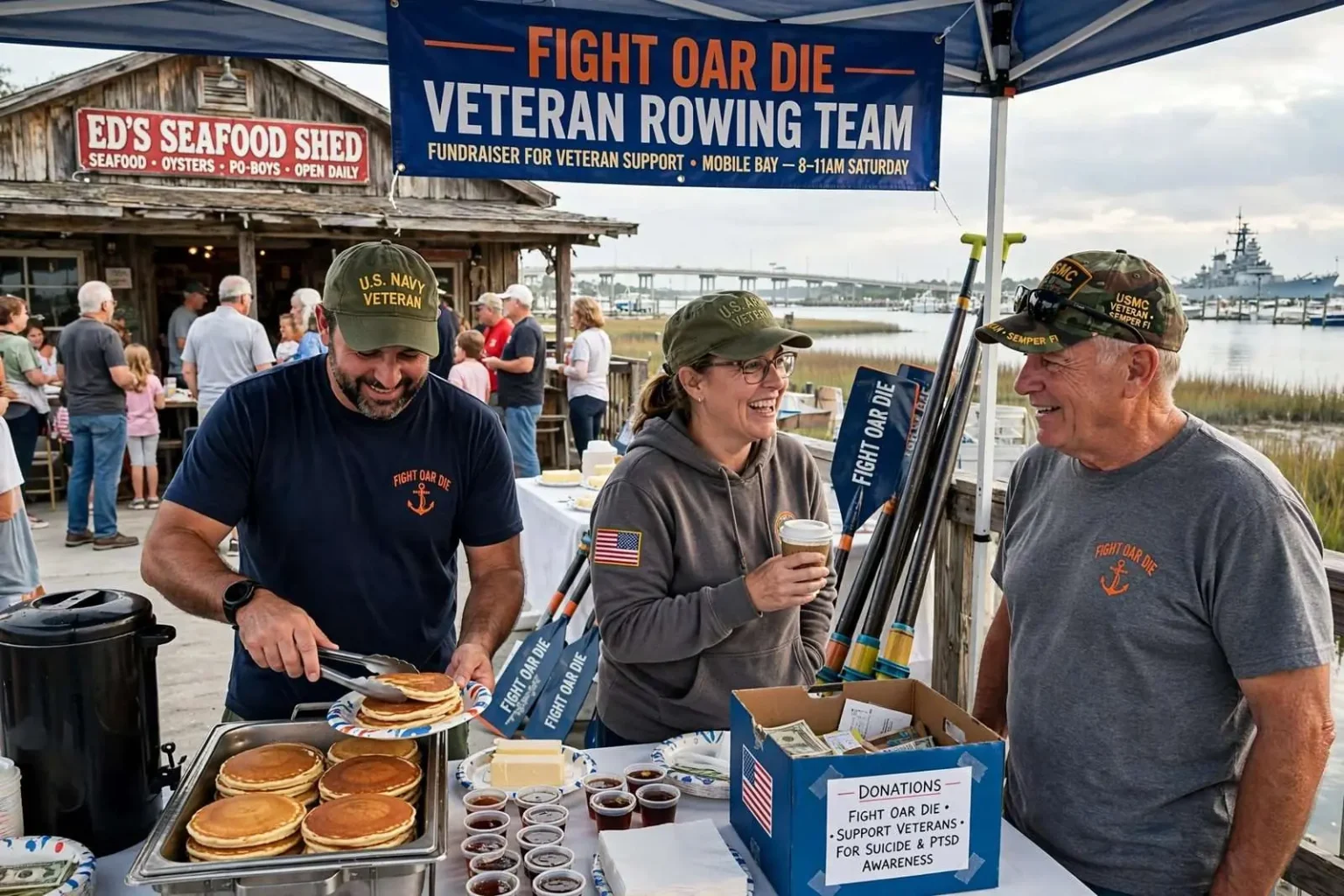
A pancake breakfast along the Mobile Bay Causeway helped raise money for “Fight Oar Die,” a veteran rowing team drawing attention to the struggles many former service members face, including PTSD and suicide. The fundraiser ran from 8 to 11 a.m. Saturday at Ed’s Seafood Shed on the Causeway, drawing supporters from across the Mobile area for a meal and a cause.
The breakfast gave residents a chance to meet the team, hear its story and contribute to its mission before the rowers take on one of the most demanding endurance challenges in the world. Members of the group were on hand at the waterfront restaurant during the morning hours, serving plates and talking with visitors about why they plan to row an ocean.
Who They Are
Fight Oar Die is a veteran rowing team built around a blunt premise: that the physical and mental battles many former service members face after their service — including post-traumatic stress disorder and suicide — deserve public attention, and that an undertaking of extraordinary difficulty can bring that attention. The team’s name itself signals the stakes its members are rowing against. Suicide among veterans remains one of the most persistent crises facing the military community, and organizations that connect struggling veterans with support have multiplied across the country in response.
Teams like Fight Oar Die use endurance events as both a message and a mechanism. The message is one of visibility — putting veterans’ struggles in front of communities that might otherwise never engage with the issue. The mechanism is fundraising and connection, turning donations and event attendance into resources that can reach veterans who are struggling before a crisis does.
The rowing format carries its own symbolism. Rowing demands synchronized effort, endurance through pain and trust in the people pulling alongside — qualities that veterans learned in service and that the team argues are also the foundations of surviving the transition home. Members train together for months, and the shared preparation becomes part of the support network the organization exists to build.
Training on Mobile Bay
The team arrived in Mobile earlier in the month to begin training for what is billed as “The World’s Toughest Ocean Row” — an attempt to row across the Atlantic Ocean. Mobile Bay and the waters along the Causeway have become the team’s training ground, where members can build the seamanship, physical conditioning and teamwork the crossing will demand before they ever reach open ocean.
Rowing across the Atlantic is an undertaking attempted by only a small number of crews. Ocean rowing boats are self-contained vessels equipped with sleeping cabins, navigation equipment and desalination gear, and crews typically row in shifts around the clock for weeks at a time. The route exposes rowers to open-sea weather, salt sores, sleep deprivation and the mental strain of weeks without land — conditions that make the challenge a fitting expression of the team’s message about endurance.
The grueling crossing serves as the group’s platform for raising awareness of veterans’ issues and connecting struggling veterans with support. Sponsors, donors and event attendees fund the expedition and the organization’s work behind it, and every public appearance along the way — like the Saturday breakfast at Ed’s Seafood Shed — doubles as an outreach event where veterans and their families can learn about available resources.
The Causeway Setting
The Mobile Bay Causeway, officially the Battleship Parkway, stretches across the northern reaches of Mobile Bay and has long been a gathering place for civic rides, fishing tournaments, charity runs and waterfront fundraisers. Ed’s Seafood Shed, a restaurant on the Causeway with views across the bay, is a familiar stop for travelers on the old highway between Mobile and the Eastern Shore, making it a natural venue for a community breakfast built around a visiting team.
The Causeway corridor also carries symbolic weight for a rowing team. With the bay on either side and the USS Alabama Battleship Memorial Park nearby, the setting ties the team’s training waters to one of the region’s most visible military landmarks. Veterans’ organizations throughout the Mobile area regularly use the Causeway and its venues for events, and the area’s large veteran population — drawn by the region’s military installations and retiree community — gives causes like this one a ready audience.
The Saturday morning format reflected the event’s purpose: a family-friendly meal, a chance for children and grandparents alike to meet the rowers, and a low-barrier way for people to contribute. Pancake breakfasts have long been a staple of Gulf Coast fundraising, hosted by fire departments, churches, schools and service organizations, and the familiar format helps draw crowds who might not otherwise encounter the cause.
Veterans’ Struggles Behind the Mission
The issues the team highlights are well documented among those who work with former service members. Post-traumatic stress disorder affects a substantial share of veterans returning from combat deployments, and the transition to civilian life can bring isolation, unemployment and strained relationships. The most devastating outcome is suicide, which has claimed veterans at rates consistently higher than the general population and which the Department of Veterans Affairs, nonprofit organizations and community groups have made a central focus of prevention efforts.
Advocates emphasize that the most important moments often come long before crisis: a veteran connected to peers, purpose and support is far less likely to reach the breaking point. That is the logic behind organizations built around shared challenges — from team rowing to long-distance runs to wilderness programs — where the activity itself creates bonds and the visibility of the effort reaches veterans who are suffering quietly.
For the Mobile area, whose population includes active-duty personnel, retirees and veterans from every branch, the team’s stop on the Causeway was an invitation to that kind of connection. Organizers pointed those wanting more information to the event’s Facebook page for details on the breakfast and the team’s mission, where the group posts updates on training, the row and ways to support or join the effort.
Ocean Rowing’s Growing Tradition
Though it remains a niche pursuit, ocean rowing has grown into an organized endurance sport over the past two decades, with sanctioned routes across the Atlantic, Pacific and Indian Oceans and support companies that manage logistics, safety and weather routing for independent crews. Crossings can take anywhere from about a month to several months depending on the route, the crew size and the conditions. Crews row in rotations, grab sleep in short shifts, and live aboard boats barely larger than the rowing stations they power.
The physical toll is matched by the mental one. Rows measure their experiences in storms survived, equipment repaired at sea and the discipline of rowing another shift when exhaustion argues for stopping. For a team of veterans, those conditions are not incidental to the mission — they are the point, a shared hardship that mirrors the endurance their cause asks of veterans facing PTSD and the long transition home.
Teams undertaking such crossings typically spend the preceding months raising funds, securing boats and equipment, and logging training rows on protected waters. The team’s decision to train on Mobile Bay gives local residents an unusually close view of that preparation, from practice rows along the Causeway to the public events that fund the expedition.
What the Breakfast Supported
Proceeds from the Saturday breakfast support the team’s expedition and its broader mission of connecting struggling veterans with help. Fundraising events like this one cover the practical costs of an ocean row — equipment, transport, safety gear and training — while also funding the outreach work that gives the crossing its purpose. Attendees at Ed’s Seafood Shed got a direct look at where their donations go: a team training on local waters for a challenge that will carry their message far beyond the bay.
Organizers used the morning to spread the word about the resources the organization highlights for veterans and their families, and to encourage attendees to follow the team’s progress as the row approaches. For those who missed the breakfast, the group’s Facebook page remains the central hub for information on the mission, upcoming events and ways to contribute or get involved.
The Causeway event also fit into a broader pattern of community support for veterans’ causes across the Gulf Coast, where fundraisers, awareness rides and benefit events fill the calendar year-round. For the rowers of Fight Oar Die, each one is a chance to reach one more veteran before the boat ever leaves shore — which, the team would say, is where the real fight is won.
Those seeking more information about Fight Oar Die, the pancake breakfast or the team’s Atlantic crossing can find updates on the event’s Facebook page, where the organization posts details on its mission and its training progress on Mobile Bay.


