More Than $7,000 in Unpaid Band Dues Kept Vigor’s Band Off the Field. The Community Is Covering It.
Vigor High School band members were held out of a Friday night football game over more than $7,000 in unpaid dues. Alumni, a former band director and a Mobile County school board member have raised close to $4,000 so far, with a first delivery planned for Wednesday.
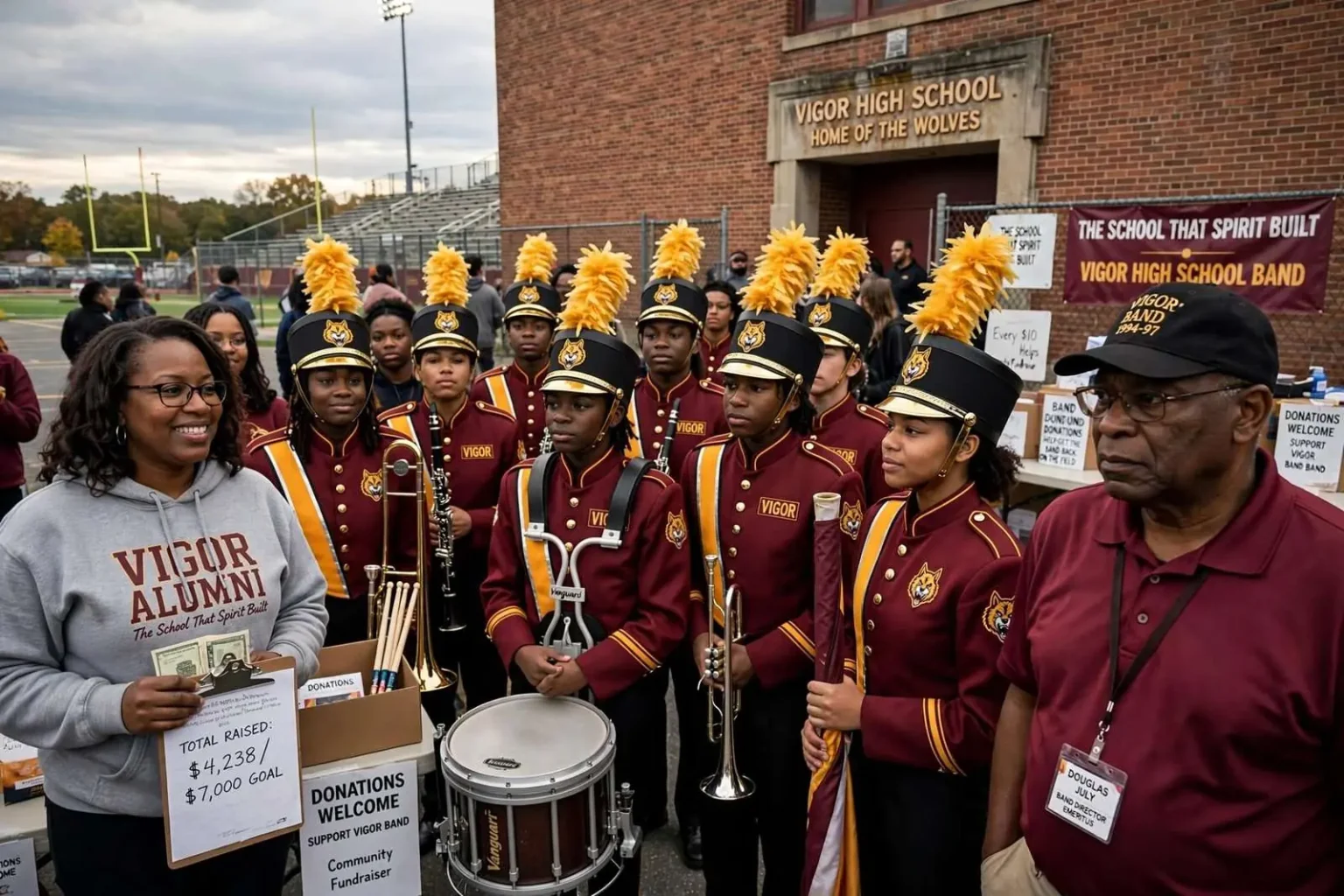
For dozens of Vigor High School students, Friday night football is more than a game. It is the drum line echoing off the stands, the horns, the marching, and the pride of representing a school whose motto is built around exactly that.
Last week, all of it was missing.
“We are just the school that spirit built, so that sparked a lot of controversy,” Vigor alum DeLondon Kyles said. “We know our football team and supporters, they thrive off the band, and after speaking with some of the auxiliary members, and band parents, it was brought to my attention the principal did not allow them to march because fees hadn’t been paid.”
The amount owed is more than $7,000.
‘I Just Felt So Bad for the Babies’
For the students who sat out, the disappointment went past a single missed performance.
“I just felt so bad for the babies,” Kyles said. “Band keeps a lot of people off the streets. I played the trumpet for four years right here at Vigor so it just really touched me because I didn’t want the kids to have to suffer because of the hardships their family may be dealing with.”
That last clause is the heart of the matter. Band dues are assessed per student, but they are paid by households, and a student whose family cannot cover the fee has no mechanism of their own to fix it.
When word spread, Vigor alumni and dozens of other community members decided not to watch from the sidelines.
“I said listen, I have a lot of Facebook friends, if everybody donated $10 we could possibly help out, so it started from there,” Kyles said.
She said she received dozens of messages online, which turned into an effort to raise the outstanding dues and get the students back into the stands and onto the field.
A Former Director Weighs In
Douglas July led the Vigor band from 1994 through 1997 and later served as an assistant principal. For him, the issue is not confined to one school.
“I want to make a plea that this is not just for Vigor, I wish all band alumni from every school will support the band program as we do the athletics,” July said. “Because when the band isn’t at the game, we complain, so we need to support them.”
It is a pointed observation. High school athletic programs in most districts have booster clubs with established fundraising machinery, alumni networks and, frequently, gate revenue. Band programs are expected to produce a comparable public product — they perform at every home game, at competitions and at community events — on a fraction of that infrastructure.
What Band Dues Actually Cover
To someone outside a band program, a four-figure shortfall for a single school can be hard to place. The costs are real and they are mostly unavoidable.
A marching band’s recurring expenses typically include uniform cleaning and repair, and eventual replacement on a multi-year cycle at a cost that runs into the hundreds of dollars per student; shoes, gloves, garment bags and other individual items; instrument maintenance for school-owned horns and percussion, plus reeds, valve oil, sticks, mallets and drum heads that are consumed continuously; sheet music and arranging fees, since competitive shows are frequently custom-arranged; color guard equipment such as flags, rifles and sabres; transportation, including bus charter for away games and competitions; entry fees for festivals and competitions; and instructional staff beyond the director, such as percussion and guard technicians.
Water, ice and medical supplies for a band rehearsing outdoors in an Alabama August are not a trivial line item either.
Some of that is covered by the school system. A significant share, in most districts, is covered by dues.
The Policy Question Underneath
Holding a student out of a performance over unpaid fees raises a question that districts across the country have wrestled with, and it has a name: pay-to-play.
The argument for enforcement is straightforward. If a program depends on dues, and dues are optional in practice, the program cannot budget. Directors who do not collect find themselves personally absorbing costs or cutting the season short, and families who do pay reasonably object to subsidizing those who do not.
The argument against is equally straightforward, and it is the one Kyles made. The student who is removed did nothing wrong. The consequence for a household’s financial circumstance lands on a teenager, in public, in front of the whole stadium. And the students most likely to be affected are frequently the ones for whom the program is doing the most good.
Most districts that have addressed this have landed on some version of a middle position: fees remain, but with a documented hardship waiver, a payment plan, a fee-assistance fund seeded by boosters, or a rule that no student is excluded from a performance for nonpayment. The mechanism matters less than its existence. What creates situations like the one at Vigor is usually not a hard-hearted policy but the absence of any policy at all — leaving a principal to make a call in the days before a game with no established alternative.
The Money Is Coming In
District 3 Mobile County school board member Reginald Crenshaw said he is putting his own budget toward the bill.
“It’s important those kids have extracurricular activities, i.e., the band so they’ll be motivated to participate, work hard at it,” Crenshaw said. “It’s a great community effort. We will raise the money.”
So far, Kyles, July and an alum of Mattie T. Blount High School have collectively raised close to $4,000 of the amount owed. They planned to deliver the first round of donations to the school Wednesday.
The Blount connection is worth noting. Blount and Vigor are separate Prichard-area schools with a long athletic rivalry, and a Blount graduate contributing to a Vigor band fund is not the expected direction of travel.
‘The School That Spirit Built’
Vigor High School has produced generations of musicians, athletes and graduates who stayed in the area, and its alumni network is the kind that mobilizes quickly when something happens. The phrase Kyles used — the school that spirit built — is not marketing language locally. It is the identity, and it is precisely why the empty band section registered as it did.
Decades separate July’s tenure from the students sitting out last Friday. The instruments have changed, the arrangements have changed, the students have changed. What has not changed is what the program is for.
For alumni, it is a tradition. For the students, it is an opportunity — and for the moment, a community is making sure a bill does not take it away.
How to Help
Organizers of the effort have been coordinating largely through social media and directly with the school. Anyone wanting to contribute toward the outstanding band dues, or to support the Vigor band program generally, can contact the school directly. Alumni of other Mobile County schools looking to do something similar for their own programs will find that most band boosters maintain a fee-assistance fund, or would start one if asked.
What a Fee-Assistance Fund Looks Like
The situation at Vigor is the kind that resolves permanently only if the resolution outlasts the news cycle. Communities that have addressed this durably have generally built one of a few mechanisms, and none of them is complicated.
A booster-held scholarship fund. The most common approach. Boosters raise money specifically earmarked for students who cannot pay dues, and the director or a small committee allocates it confidentially. The confidentiality is the important part: a fund that requires a student to be publicly identified as needing help will go unused by the students who most need it.
A sponsorship model. Local businesses or individual alumni sponsor a student’s participation for a season, sometimes without knowing which student. This tends to raise more money than general appeals because donors can see exactly what their contribution buys.
Work-based offsets. Programs that allow families to offset dues through concession stand shifts, equipment maintenance or fundraising participation. This preserves the reciprocity that makes dues collection sustainable while removing cash as the barrier.
A sliding scale. Dues assessed against a household’s circumstances rather than at a flat rate, frequently tied to the same eligibility determinations a district already makes for other purposes.
What each of these has in common is that it is decided in advance, in writing, rather than in the week before a game.
Why Band Participation Is Worth Protecting
Kyles made the case in plain terms: band keeps people off the streets. The research literature on structured extracurricular participation supports the broader version of that claim, though with the usual caveats about correlation and causation.
Students who participate in sustained, adult-supervised extracurricular activities show higher attendance, higher graduation rates and lower rates of disciplinary incidents than otherwise comparable peers who do not. Music programs specifically involve daily practice toward a public performance with a fixed deadline, collective accountability in which an individual’s preparation affects everyone, and a structure in which improvement is measurable and visible.
Marching band adds a physical component — hours of outdoor rehearsal, memorized drill, coordinated movement under load — that resembles athletic training more than most people outside the activity realize.
The students most affected by a fee barrier are, statistically, the ones for whom these effects matter most. That is the argument Kyles was making when she said she did not want children to suffer because of hardships their families are dealing with.
How the Money Is Coming Together
The current effort has drawn from three directions at once, which is unusual and probably why it has moved quickly.
Alumni organized through personal social media networks, using the small-donation model Kyles described — ten dollars from enough people adds up. A former director with decades of standing in the local music education community lent credibility and made a broader appeal on behalf of band programs generally. And an elected school board member committed funds from his own district budget, which is the only one of the three that can move institutional money.
The contribution from a Mattie T. Blount High School alum is worth another mention, because it illustrates something about how these networks actually function. Rivalry between Prichard-area schools is genuine on a Friday night. It evidently does not extend to letting another school’s band sit in the stands.
Kyles, July and the Blount alum had raised close to $4,000 of the more than $7,000 owed, with the first round of donations scheduled for delivery to the school Wednesday.
Update: More Than $4,200 Raised, and a Question About Where It Goes
The community fundraiser launched after Vigor High School’s band did not perform at last week’s football game has brought in $4,238, according to organizer De London Kyles.
Kyles, a Vigor alumna, said she first learned of the situation from a Facebook post reporting that the band had not marched. She later found out the issue involved unpaid school and band fees, which prompted her to ask the community for help.
“Between me, the two other collectors and another person that posted their receipt on social media, we are at $4,238 raised to help the band students pay their band dues,” Kyles said.
Donations and messages of support began arriving over the weekend. Kyles said she is grateful both to those who gave and to those who wanted to help but could not afford to.
“It does feel good to know that my platform was used to help,” Kyles said. “Not only because this is my alma mater, but just students in general who needed help.”
She Wants Answers Before She Hands Over the Money
Kyles had planned to meet Tuesday with school officials, but said the meeting was canceled after something came up. She said she hopes to speak with Vigor’s band director and school leadership before donating the funds, so she can confirm exactly how the money will be used and whether it will actually put students back on the field.
“The purpose of the donation money was to be able to see those kids back on the field,” Kyles said. “I do have some follow-up questions, and I do want to make sure that we have what’s needed for them to be able to march. This is not just a transaction.”
She said she does not yet know whether $4,238 will be enough to cover the outstanding fees. Vigor High School’s principal was out of the office Tuesday.
A Broader Point
Kyles said she hopes the effort serves as a reminder that students across the area need community backing, and not only at her own alma mater.
“It is so important to support our community — not just Vigor, but all of the high schools, no matter what district they are in,” Kyles said. “When those kids have a need, it’s up to the community and the alumni to help keep it going.”