Virginia’s Trongone Band Bringing Southern Rock Sound to Mobile’s Callaghan’s
The Trongone Band, a Richmond, Virginia, Southern rock outfit fronted by brothers Andrew and Johnny Trongone, plays Callaghan's Irish Social Club in Mobile's Oakleigh Garden District on Sunday, Nov. 3.
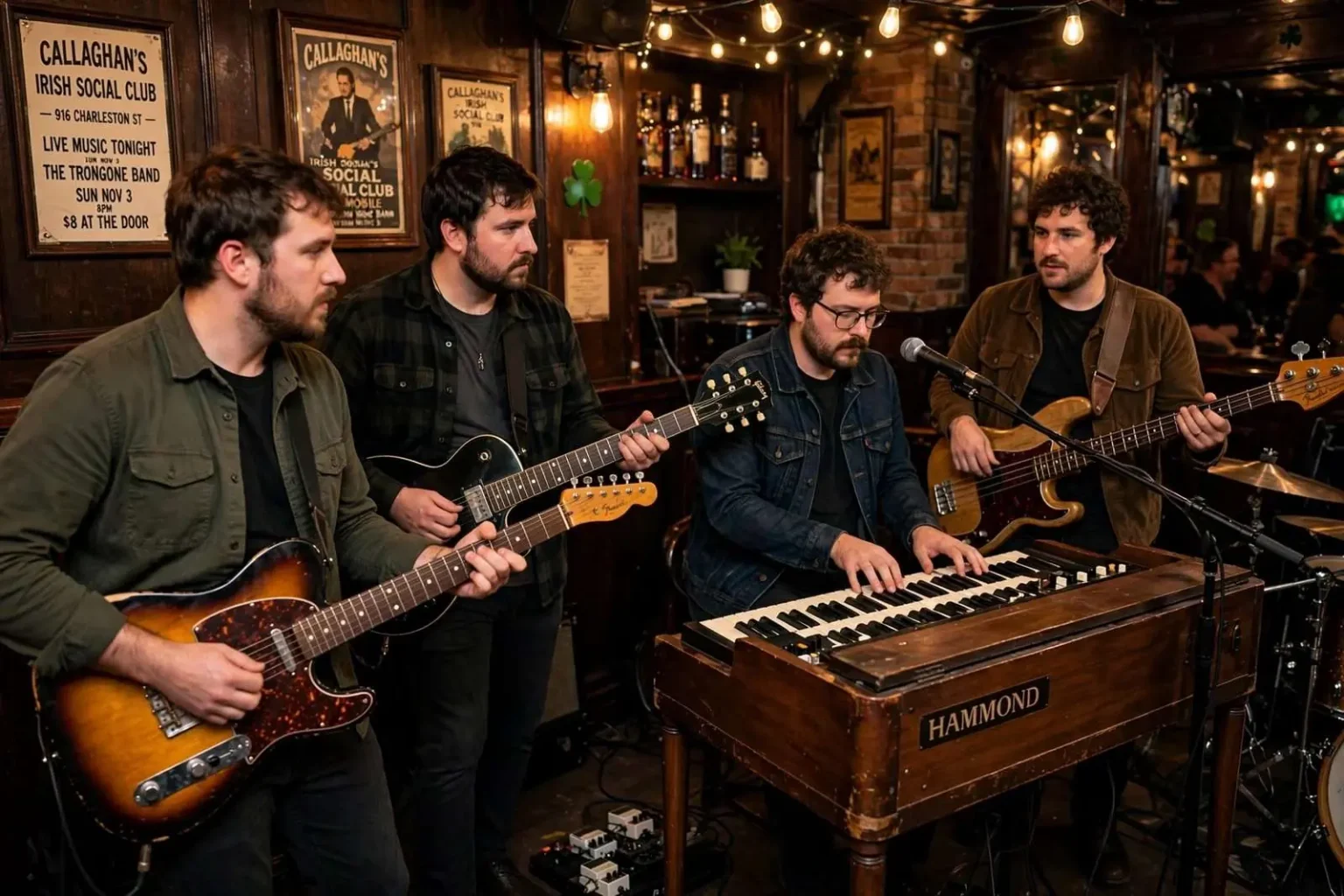
Fans of Southern rock and roots music will have a chance to catch a touring band from Richmond, Virginia, when The Trongone Band takes the stage at Callaghan’s Irish Social Club in Mobile’s Oakleigh Garden District on Sunday, Nov. 3, at 8 p.m. Tickets are $8 at the door for the show at the neighborhood venue, located at 916 Charleston St.
The booking continues a steady pipeline of national touring acts through one of Mobile’s most intimate music rooms, where audiences can sit within a few feet of the stage and hear a band’s arrangements the way the musicians themselves do — unamplified by arena theatrics, unfiltered by a large room’s acoustics.
The Trongone Band got its start as a family project, with brothers Andrew and Johnny Trongone playing alongside their father before the group evolved into its current lineup. That family origin still shapes the band’s identity, and it is a familiar story in Southern music, where family bands have long served as the apprenticeship system through which younger players absorb the genre’s traditions before carrying them somewhere new.
Today the band pairs the Trongone brothers with keyboardist Ben “Wolfe” White and bassist Chip Hale, a configuration that has allowed the group to sharpen a sound rooted in classic Southern rock while adding its own layers of keyboard-driven texture. The four-piece setup — two guitars, keys and bass, with drums anchoring the back line — gives the band flexibility that strictly guitar-led combos lack, letting arrangements breathe between riff-heavy rock and organ-soaked soul.
That sound draws heavily on influences such as The Allman Brothers Band and The Black Crowes, acts whose blend of blues, rock and soul helped define the genre for generations of Southern musicians. Both bands built their reputations on live performance as much as on records, and that emphasis on extended, conversational playing is audible in the way modern Southern rock acts structure their shows and their songbooks.
A Sound Rooted in the South
The Trongone Band’s approach leans into sweeping arrangements and warm, soulful vocals, aiming for a full-band sound built around interplay between guitar and keys rather than a single dominant lead voice. It is an approach that rewards listening across the whole stage: when the keyboard pads swell under a guitar figure, or the two string players trade phrases over a rolling bass line, the music behaves more like a dialogue than a showcase.
The lineage the band draws on runs deep in the region’s musical history. The Allman Brothers Band, formed in Jacksonville, Florida, in 1969, fused blues, jazz improvisation and country textures into a style that made dual lead guitars and extended jam passages a Southern rock signature. The Black Crowes, emerging from Atlanta two decades later, reconnected that sound to gritty 1970s rock and roll and the gospel-tinged vocals of the era’s soul records.
For a young band from Richmond — a city whose own scene has produced rock and roll with a distinctly Southern accent despite sitting in the Upper South — those influences provide both a foundation and a challenge. Playing music that descended from the Allmans means competing, at least in listeners’ minds, with some of the most celebrated live bands in American history, and the groups that endure tend to be the ones that treat the tradition as a starting point rather than a boundary.
The Trongone Band’s keyboard emphasis is one way it marks that distinction. Where the classic Southern rock template put two guitars at the center, the band’s arrangements frequently hand the harmonic weight to the organ and electric piano, coloring the music with the church- and soul-influenced textures that ran through the work of the Crowes and through the wider Southern canon.
From Richmond to a Debut Record
Earlier this year the band released its debut full-length album, “Keys to the House,” recorded at Richmond’s Montrose Recording studio. Recording a first album in the band’s hometown studio scene gave the group a chance to translate its live arrangements into fixed performances, an adjustment for any act built around improvisational interplay.
The record was produced by Dave Schools, the longtime bassist for jam-rock stalwarts Widespread Panic, who helped shape an album critics and fans have compared to the rich, horn-and-organ-inflected sound of The Black Crowes’ landmark record “Southern Harmony and Musical Companion.” Schools’ involvement placed the band alongside a lineage of Athens, Georgia-bred Southern jamband royalty, and gave the young group the benefit of a producer who has spent three decades on stages where Southern rock and jam-band improvisation intersect.
Widespread Panic, which Schools co-founded in Athens in the mid-1980s, built one of the most devoted touring followings in American rock without heavy radio support, relying instead on constant road work and a reputation made show by show. That career model — earning audiences city by city in rooms exactly the size of Callaghan’s — is the same path the Trongone Band is walking on its own tours.
The comparison to “Southern Harmony and Musical Companion,” the 1992 album that produced the Crowes’ biggest hits and showcased their fattest, most soulful studio sound, says something about the band’s ambitions. The record’s blend of honky-tonk piano, churchy organ, twin guitars and blues-shouted vocals became a touchstone for the revivalist wing of Southern rock, and any album that draws the comparison is staking a claim in that tradition.
For the band, the album also serves as a calling card on the road. Touring acts without radio presence live and die by whether the room they walk into has heard of them, and a well-reviewed debut with a name producer attached is often what turns an unfamiliar opening slot into a headlining return.
For Mobile audiences, the Callaghan’s show offers a chance to hear that new material performed live in an intimate club setting long known for hosting touring roots, blues and rock acts passing through the Gulf Coast. The Oakleigh Garden District venue has built a reputation among local music fans as a reliable stop for bands blending traditional Southern influences with contemporary songwriting.
The room itself is part of the draw. Callaghan’s is a small neighborhood social club, the kind of place where the bar is steps from the stage and there is no barrier between the audience and the band. For a four-piece built on instrumental interplay, that proximity matters: listeners can watch the musicians cue each other through arrangement changes, hear the room respond to a solo, and experience the give-and-take that studio records can only approximate.
The Oakleigh Garden District, just south of downtown Mobile, has evolved into one of the city’s most walkable neighborhoods, mixing historic homes and local restaurants and bars within a few blocks. Its concentration of gathering places has made the area a natural home for live music, and Sunday-night shows in particular have long been part of the district’s rhythm, giving touring bands a stop between larger Southeastern cities and giving locals an excuse to close out the weekend with a show.
A $8 door price is characteristic of the venue’s approach. Small clubs along the Gulf Coast operate on thin margins, and low cover charges keep the rooms accessible while the bar business sustains them. For audiences, it means the chance to see a nationally touring band for the price of a movie ticket — and for the bands, it means a room full of people who chose to be there rather than being roped in by a big-ticket bill.
The Touring Circuit Through the Gulf Coast
Mobile sits on a well-worn circuit for touring roots and jam-oriented acts working the Southeast. A band working out of Richmond typically threads shows through the Carolinas, Georgia, Tennessee and Alabama on its way to New Orleans, Houston or Florida, and Gulf Coast venues like Callaghan’s fill the map between Atlanta and the coast. Sunday nights, when larger venues sit dark, have become the traditional slot for these smaller-market stops.
The economics of that circuit shape the music itself. Bands playing rooms of 100 to 200 people depend on word of mouth, repeat bookings and merchandise tables rather than radio or streaming revenue, and the ones that survive tend to be the ones that treat every small room like a headlining show. It is the same apprenticeship that Widespread Panic and the Black Crowes themselves served in small Southeastern bars before either band had a record out.
For the audience, the appeal runs both directions. Intimate rooms give fans a chance to see a band before it grows out of them — to hear the songs from a debut album while the musicians are still figuring out what those songs become on stage. Some of the most enduring relationships between Southern bands and their audiences were formed in exactly this kind of room, years before the bands were selling out larger halls.
Callaghan’s own booking history reflects that pattern. The venue has long mixed local acts with touring bands working their way along the Gulf Coast, and its reputation among musicians as a friendly, attentive room has helped it hold onto that traffic even as booking economics have tightened across the industry. Bands remember rooms where the crowd listens, and they come back.
What Sunday’s Audience Can Expect
For locals who have followed the band’s rise only through the album, the live show is where the group’s family origins show most clearly. Brothers who have played together since childhood develop a shorthand on stage — a glance or a change in dynamics that signals an upcoming turn — and audiences in small rooms get to see that chemistry up close.
The show’s 8 p.m. start is typical for the venue’s touring-act slots, leaving room for a full set without running deep into a Sunday school-night. As with all Callaghan’s shows, seating is limited and arrival before the music starts is the practical way to get close to the stage.
The Nov. 3 date also lands the band in Mobile during the heart of the fall touring season, when the Gulf Coast’s cooler months bring a steady procession of national acts through the region’s small venues. Between the area’s college crowds, its deep pool of seasoned music fans and its position on the New Orleans-to-Florida corridor, south Alabama has become a dependable stop for bands working the roots and jam circuit.
For a band still riding the release of its debut album, a Mobile show is an opportunity to build the kind of regional following that sustains touring acts between records. And for the audience at Callaghan’s, it is a chance to watch a young Southern rock band — one with a family history, a respected producer and a debut record behind it — work through its material a few feet from the bar, in a room built for exactly that kind of music.