Vivian’s Door Brings Black Farmers Together for Second Town Hall on Rising Costs and Resources
Mobile nonprofit Vivian's Door held its second Black Farmers Town Hall, connecting Alabama's minority farm owners with USDA and partner resources.
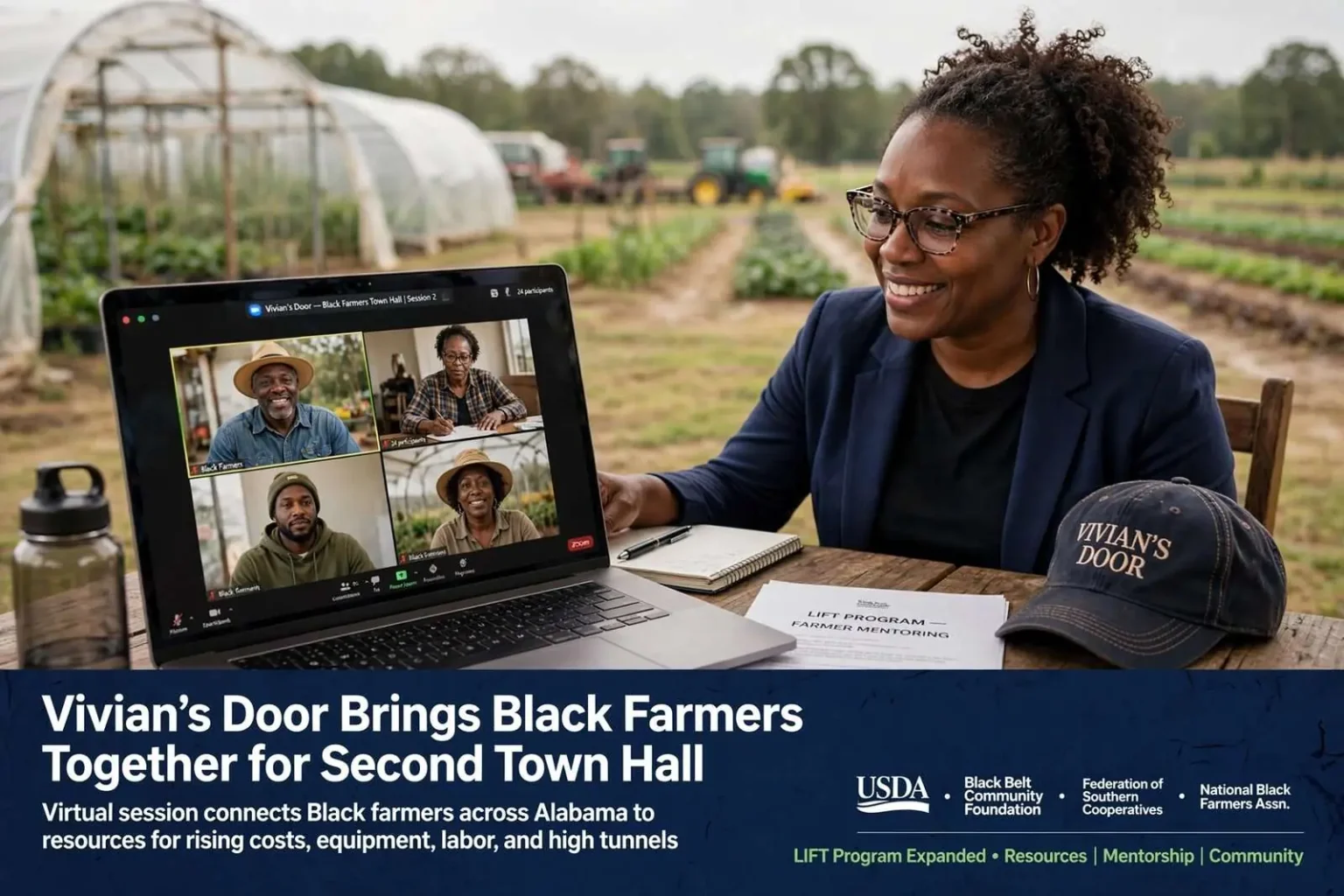
Mobile-based nonprofit Vivian’s Door hosted its second Black Farmers Town Hall, a virtual session aimed at connecting underrepresented farm owners across Alabama with the information and resources they need to grow. The online format mattered: farmers in a state where agricultural operations are spread from the Tennessee Valley to the Gulf Coast often sit hours from the nearest Extension office or lender, and a video town hall lets them hear directly from program providers without a day of driving. Attendance and questions from the first session encouraged organizers to bring the series back for a second round.
Vivian’s Door describes itself as a gateway for minority-owned businesses, helping them build corporate and community relationships, find mentors and investors, and reach higher levels of success. That mission has historically centered on urban entrepreneurs, but the organization has increasingly recognized that rural business owners face the same structural gaps — thinner access to capital, fewer networking opportunities, and less exposure to technical assistance programs — in an even more acute form. Bringing farmers into the organization’s portfolio is a natural extension of that work rather than a departure from it.
The organization recently expanded its LIFT program to include dedicated support for farmers. The addition gives agricultural producers a structured on-ramp to Vivian’s Door’s services, pairing them with mentoring and connecting them to the lenders, agencies, and cooperative networks that can help a small farm move from survival mode to growth. For many of the farmers the town hall was designed to reach, that kind of sustained, relationship-based support is harder to find than any single grant or loan program.
What the town hall covered
Executive Director Janice Malone said small businesses in minority and disadvantaged Alabama communities — especially owners of color, who were among the hardest hit by the COVID-19 pandemic — still need access to practical resources to recover and scale. Her point framed the entire session: recovery from the pandemic years is not a finished project in rural Alabama, and the farms that absorbed supply-chain shocks, labor gaps, and price spikes are still working to rebuild margins that were thin long before 2020.
The town hall focused on the rising cost of seeds, fertilizer, and fuel; labor shortages; repairing and replacing equipment; and the potential of high tunnels to extend growing seasons. Each of those topics maps onto a real and measurable squeeze on small operations. Input costs for fertilizer and fuel climbed steeply in recent years, hitting small producers hardest because they lack the volume discounts and hedging tools available to larger farms. A modest increase in the per-bag cost of feed or fertilizer can erase the profit on an entire crop for a market-scale grower.
Labor shortages compound the input-cost problem. Small farms rely heavily on family labor and seasonal crews, and when workers are scarce, growers either pay more for the help they can find or leave crops unharvested. Both outcomes push up costs and push down revenue at the same time. The town hall’s willingness to name labor as a first-order concern — alongside seed and fertilizer — reflected the realities farmers described back to organizers in the first session.
Equipment is a closely related pressure point. A used tractor or implement represents a major capital outlay for a small farm, and when a critical machine fails mid-season the choice between a costly repair and a missed harvest is not really a choice at all. Town hall discussions of repair resources, financing options, and shared-access models addressed one of the most common reasons small farms stall out: not a lack of skill or markets, but a broken piece of iron at exactly the wrong moment and no way to fund the fix.
High tunnels and longer growing seasons
The discussion of high tunnels carried some of the session’s most practical weight. A high tunnel — an unheated, plastic-covered structure over cropped ground — lets a grower plant earlier in spring, harvest later into fall, and protect high-value crops from driving rain, wind, and some pests. Along the Gulf Coast, where the climate already allows nearly year-round production, a high tunnel can be the difference between a seasonal farm stand and a consistent weekly supply for restaurants, schools, and market customers who expect continuity week after week.
Federal cost-share programs have made high tunnels one of the most accessible infrastructure investments available to small growers, and connecting farmers to those programs is precisely the kind of work a town hall like this one is built to do. For underrepresented producers, the barrier is often not eligibility but information: knowing the program exists, understanding the paperwork, and having someone to call when an application stalls. Presenting those pathways directly to farmers, in one session, shortens that distance considerably and puts a name and a phone number on the other end of it.
The session’s virtual format also lowered the barrier for participation in a state where distance is a real obstacle. Alabama’s Black Belt and other historically agricultural regions sit far from Mobile and Birmingham, and many working farmers cannot leave their operations for a half-day conference. A video session — accessible from a kitchen table or a truck cab — meets farmers where they are, which is the same principle the participating organizations apply to the programs themselves.
A coalition of partners behind the session
The event was presented in collaboration with the USDA, the Black Belt Community Foundation, the Federation of Southern Cooperatives, and the National Black Farmers Association. That lineup matters as much as the agenda. Each partner brings a different piece of the support system: the federal agencies that administer farm loans, conservation cost-share, and crop programs; a community foundation with deep roots in the Black Belt counties where much of the state’s historically Black farmland is located; a cooperative federation with decades of experience organizing farmer-owned businesses across the Southeast; and a national advocacy association that represents Black farmers on policy and program access.
Bringing those organizations to the same virtual table is a service in itself. Farmers navigating the agricultural support system often deal with each institution separately, with different offices, deadlines, and vocabularies, and it is easy for a small producer to fall between them. A town hall format that puts all of the partners in one session — and lets farmers ask questions of each — models a more coordinated approach and signals to attendees that the organizations are aware of one another and work together.
Why the work continues
Alabama has seen, over the past generation, a quiet renewal of interest in small-scale and minority-owned farming: farmers markets in Mobile and across the state, farm-to-school programs, and consumers who want to buy from growers they know. For that renewal to include farmers of color in meaningful numbers, the structural gaps the town hall addressed — capital, equipment, labor, technical knowledge, and markets — have to narrow. Organizations like Vivian’s Door and its partners are working at exactly that intersection.
The second town hall built on the first, and the ongoing LIFT program expansion gives attendees a next step after the session ends: a place to enroll, a mentor to call, a network to join. That continuity is what separates a one-time event from actual capacity building. For the farmers who logged in — whether they run a few acres of vegetables for market or a larger row-crop operation — the message of the session was that resources exist, the organizations administering them are reachable, and no Alabama farmer has to navigate the system alone.
The people behind the numbers
Behind every statistic about farm economics is a family making decisions with incomplete information. The farmers who attended the town hall represented a range of operations: long-held family land passed down through generations, newer market farms started within the past decade, and part-time operations that supplement household income with a few acres of produce. What they share is the experience of running a business where the owner is also the workforce, the bookkeeper, and the mechanic, and where a single season’s weather can decide the year.
That reality shapes what useful support looks like. A workshop on marketing is helpful; it is more helpful when it comes attached to a mentor who will answer the phone in July. A loan program matters; it matters more when someone has walked the farmer through the application line by line. The town hall model — and the LIFT program expansion behind it — is built on that understanding. Organizations that work with underserved small businesses have learned over the years that information alone does not move the needle; relationships and follow-through do.
How farmers can connect
Farmers who missed the live session still have paths to the same resources. The participating organizations maintain ongoing programs and staff who can answer questions about farm loans, conservation programs, cooperative membership, and technical assistance, and Vivian’s Door’s expanded LIFT track provides a single door — fittingly, given the organization’s name — through which a farmer can be connected to all of them. Organizers have indicated the town hall series is intended to continue, giving the statewide farming community recurring opportunities to engage.
For Alabama agriculture as a whole, the stakes are straightforward. The state’s farm sector is stronger when the people willing to work the land have a fair shot at the capital, equipment, and knowledge it takes to do so profitably. The Black Farmers Town Hall series is one modest but concrete effort to make that shot fairer — two hours on a video call, a room full of organizations that want to help, and a growing network of farmers who now know where to find each other. The rising costs will not ease on their own, but isolation, at least, is a problem the partners can solve.