
Volunteers Bring Annual MLK Day Cleanup to Eslava Creek
Mobile volunteers pressed ahead with the annual MLK Day of Service cleanup at Eslava Creek, registration at 8:30 a.m.
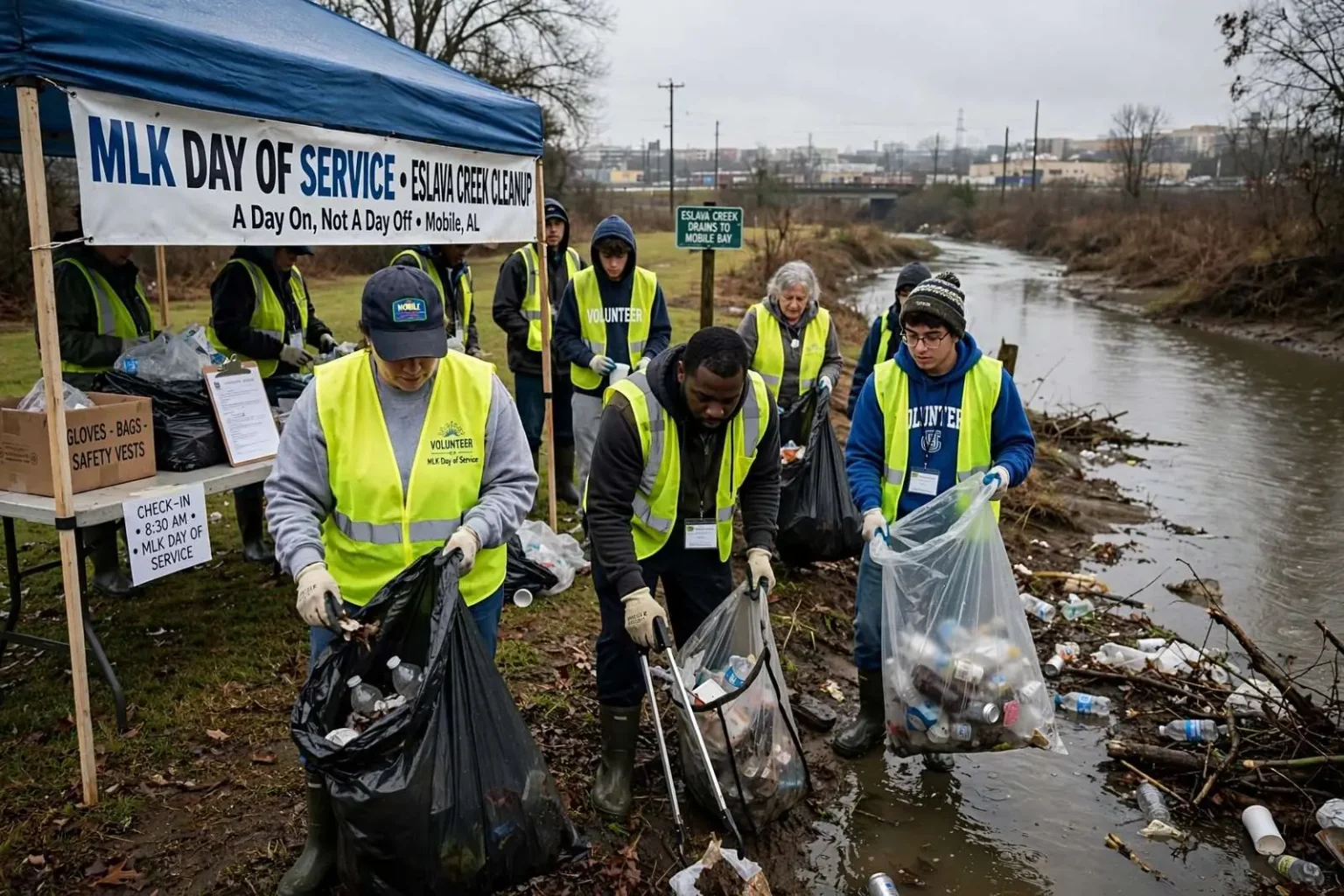
MOBILE, Ala. — Organizers of the annual Martin Luther King Jr. Day of Service cleanup at Eslava Creek planned to press ahead despite the threat of rain, with volunteers set to gather as much litter as conditions allowed along the urban waterway south of downtown. The date — a federal holiday set aside for service rather than rest — has become the creek’s standing appointment with the community that surrounds it.
The event has become a fixture of Mobile’s MLK Day observances, joining the holiday’s parades and ceremonies with the kind of hands-on work King’s legacy is often invoked to inspire. For many participants, the morning on the creek banks is the most tangible part of the day: a chance to put gloves on and change a piece of the city in a few hours’ work.
Registration opened at 8:30 a.m., with gloves, bags and safety vests distributed before volunteers fanned out along the creek banks at 9 a.m. The staging routine has been refined over the years into a smooth operation, with returning volunteers knowing to dress for mud and new arrivals paired with experienced hands who know which bends of the creek collect the worst debris.
Past turnouts have shown what the effort can accomplish. Two years earlier, on a bitterly cold morning, hundreds of volunteers trudged the creek in yellow vests and hauled away hundreds of pounds of junk and trash that had collected along the water. The memory of that cold-weather turnout has become part of the event’s lore, cited by organizers as proof that the community will show up when the cause is clear.
A creek with a history of problems
Eslava Creek drains a wide swath of west and central Mobile, and its banks have long drawn cleanup crews. The creek collects runoff from neighborhoods, commercial corridors and road miles of storm drains, carrying whatever those waters pick up — bottles, bags, tires, construction debris — toward its confluence with the waters that feed Mobile Bay.
The Mobile Area Water and Sewer System has previously pointed to debris and improper disposal around the creek as part of costly maintenance headaches. Blocked culverts and clogged channels do not merely look neglected; they reduce drainage capacity in a city where heavy rain is a routine fact of life, and clearing them costs ratepayers real money.
Groups such as Dog River Clearwater Revival have worked downstream to keep trash from reaching Mobile Bay. The volunteer organization has spent years on the waters south of the creek, pulling debris from shorelines and educating residents about how litter dropped miles inland ends up in the bay’s waters and marshes.
Organizers said every bag collected on the holiday keeps litter out of the storm drains that feed the creek — and ultimately out of the bay. That geography is the cleanup’s quiet lesson: the creek is not an isolated ditch but a working artery in Mobile’s drainage system, and its condition is felt from the neighborhoods along its banks to the bayfront.
The MLK Day of Service framework gives the cleanup its civic frame. Congress designated the holiday as a national day of service in 1994, encouraging Americans to treat the King holiday as “a day on, not a day off,” and communities across the country now mark it with food drives, school repairs, park restorations and environmental cleanups. Mobile’s creek project fits squarely in that national tradition while addressing a problem that is unmistakably local.
The choice of a waterway carries particular weight in Mobile, a city defined by its relationship with water. The bay is the city’s economic and cultural anchor, and the streams that drain into it — Eslava Creek among them — are the capillaries of that system. Cleanups like this one treat the connection as something residents are responsible for maintaining, not merely observing.
Weather on the Day of Service has rarely cooperated fully. The event has been held in cold snaps, under gray skies and, like this year, under the threat of rain. Organizers plan around the forecast rather than canceling for it, reasoning that litter does not wait for fair weather and that the creek’s condition is a year-round problem.
Rain actually sharpens the urgency. Storms flush streets and yards into the storm drain network, and every item removed from the creek banks before or between rains is one less piece of debris that a downpour can drive downstream toward the bay.
What the workday looks like
A volunteer’s morning on Eslava Creek is physical, unglamorous work. Teams spread along assigned segments with grabbers and heavy-duty bags, wading the shallows where tires settle and working the brush lines where plastic bags accumulate. Some debris — shopping carts, appliance parts, construction leftovers — requires teams and sometimes equipment to move.
The yellow vests serve double duty: they make workers visible to any traffic near the banks, and they turn the cleanup itself into a public display. Drivers passing the creek see a crowd of neighbors working the waterway, which organizers count as recruitment for future events.
Families, church groups, students collecting service hours and employees of local businesses make up the typical mix of participants. The event’s inclusive, arrive-and-work format — no special skills required, tools provided — keeps the barrier to entry low and the turnout broad.
The tally at the end of the morning is always weighed in pounds hauled out, and organizers treat the number as more than a statistic. Each year’s total is compared against the last, tracked as a measure of both the community’s commitment and the creek’s ongoing need.
By early afternoon, with the bags staged for pickup and volunteers headed home to warm up, the visible stretch of Eslava Creek looks like a different place than it did at 9 a.m. — and the neighborhood it runs through gets a cleaner creek, at least until the community comes back next year.
Urban creeks like Eslava face a year-round accumulation problem that a single annual cleanup can only dent. Between events, litter dropped in parking lots and yards travels the storm drain network with every rain, and illegal dumping — tires, mattresses, yard waste piled at the wrong spot — adds loads no rain is needed to deliver. Volunteer groups and city crews wage a continuous, uneven fight against the inflow.
That reality is why organizers frame the MLK Day event as a community statement as much as a debris removal operation. Hundreds of people spending a holiday morning on the creek banks signals to the neighborhoods along the water that the creek has advocates, and to anyone tempted to dump there that the banks are watched.
The creek’s drainage role ties the cleanup to flood concerns as well. When channels and culverts clog with debris, stormwater backs up into streets and yards during heavy rain, and Mobile’s flood-prone geography gives every blockage real consequences. Maintenance crews from the water and sewer system spend portions of their budgets clearing what litter and dumping put in the way.
Downstream, the stakes grow larger. Debris that makes it through the creek network reaches the waters that feed Mobile Bay, where litter entangles wildlife, litters shorelines and degrades the marshes and seagrass beds that make the estuary productive. Dog River Clearwater Revival’s downstream work exists precisely because upstream prevention never catches everything.
Service as a living legacy
Participants often speak of the day in terms of legacy. King’s holiday asks communities to consider what service looks like in their own circumstances, and for Mobile’s volunteers the answer has taken the form of muddy boots and full bags rather than speeches. The connection between the civil rights movement’s organizing tradition and a community mobilizing to reclaim a shared resource is one organizers draw explicitly.
The event also builds the civic relationships that sustain other projects. Volunteers meet at the creek and carry those connections into neighborhood associations, bay advocacy groups and later cleanups through the year, multiplying the day’s effect well beyond the holiday itself.
Schools and universities use the event as a service-learning anchor, sending students who study the watershed in class to see it &mdash and clean it — in person. The lesson lands differently with mud on one’s shoes, teachers say, and many of the event’s returning volunteers first arrived with a class.
Local businesses and civic organizations contribute supplies, food and hauling help, treating sponsorship as a straightforward community investment. The partnership structure keeps the event’s costs low and its scale high, which is what allows hundreds of volunteers to be equipped on a holiday morning.
As this year’s volunteers gathered under threatening skies, organizers’ expectations were set by history rather than the forecast: the community had turned out in bitter cold before, and rain was not going to keep it from the creek this time.


