WalletHub study: Alabama among states with lowest property taxes, home values
A WalletHub study ranks Alabama's real estate property tax rate second-lowest in the nation at 0.42 percent, with median home values also among the lowest.
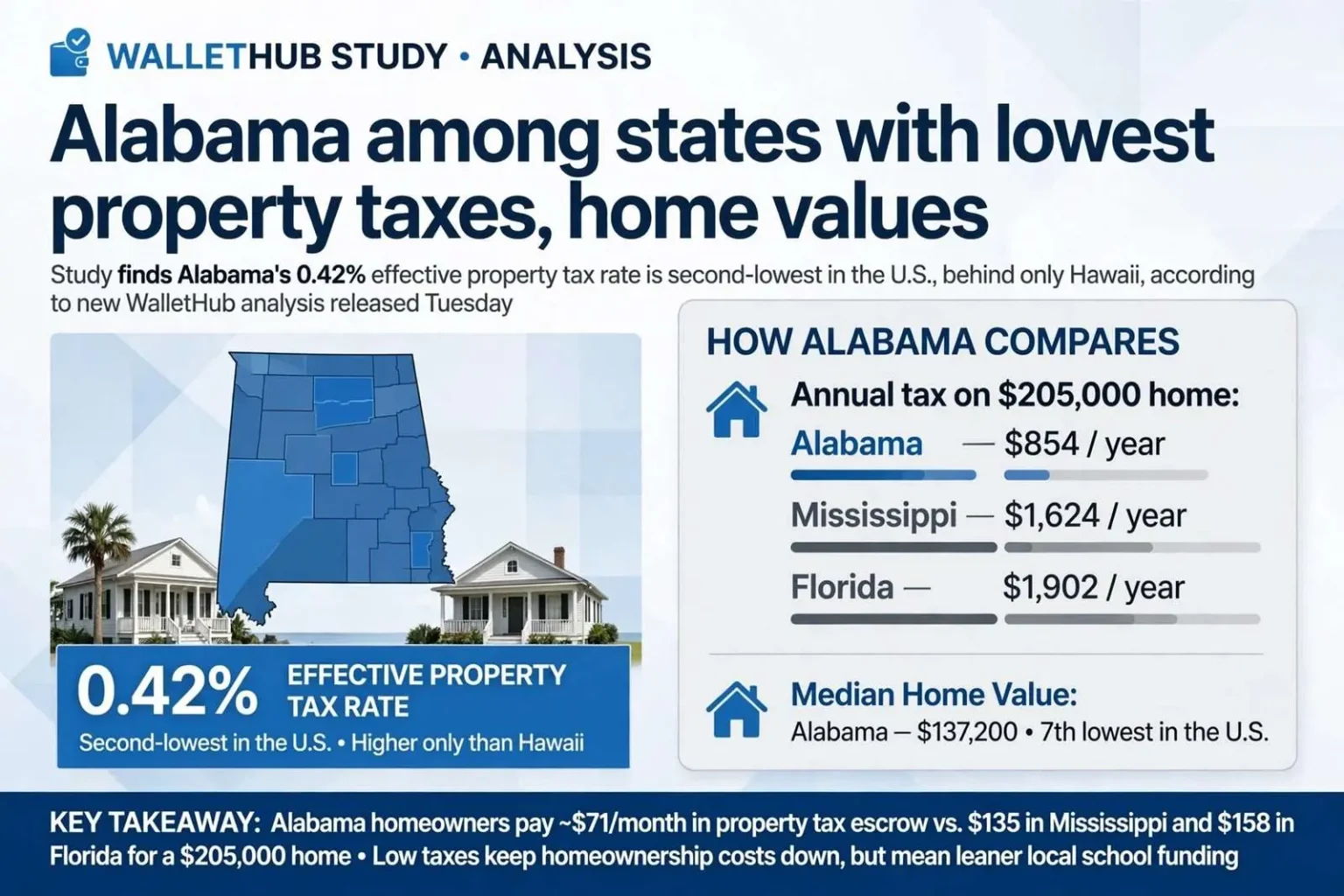
Alabama levies the second-lowest real estate property taxes in the country, according to a new analysis from the personal finance website WalletHub. The study, released Tuesday, ranked Alabama’s effective real estate tax rate at 0.42 percent — higher only than Hawaii. For homeowners along the Gulf Coast and across the state, the figures confirm what many already know: the annual cost of taxing a home in Alabama is among the lightest burdens in the United States.
On a $205,000 home, the national average value, an Alabamian pays about $854 a year in real estate taxes. By comparison, Mississippi collects $1,624 on the same home and Florida $1,902. The gap with Alabama’s immediate neighbors is striking — a homeowner in the same valued house pays roughly double in Mississippi and more than double in Florida what an Alabamian pays, a difference that shapes household budgets and, over the life of a mortgage, amounts to tens of thousands of dollars.
Home Values Near the Bottom Too
Alabama also landed near the bottom on home values. The median home in the state is worth $137,200 — the seventh-lowest in the nation — producing an annual property tax bill of about $572. That combination of low values and low rates means the typical Alabama homeowner’s annual tax bill is small enough to fit into a single monthly budget line with room to spare, compared with the several-hundred-dollar monthly escrow payments common in high-tax states.
The figures stand in stark contrast to high-tax states. In New Jersey, where the median home is valued at $327,900, a homeowner faces a property tax bill of roughly $8,104 based on that state’s 2.47 percent rate. In other words, a New Jersey homeowner with a house worth less than two and a half times a typical Alabama home pays more than fourteen times as much in annual property taxes. The gap illustrates how dramatically local tax philosophy varies across the country, from states that fund schools and services heavily through property levies to states like Alabama that rely on other revenue sources.
WalletHub’s rankings weigh a range of housing and tax factors to estimate the annual cost of owning a home in each state. The analysis uses effective tax rates — what homeowners actually pay relative to home values — rather than nominal rates, which gives a more accurate picture of real-world burdens. Effective rates smooth out differences in assessment practices, exemptions and millage decisions across thousands of local jurisdictions, producing an apples-to-apples comparison between states.
What the Rankings Mean for Alabama
Low property taxes are a longstanding feature of Alabama’s fiscal landscape, rooted in the state constitution and decades of local tax policy. The state has among the lowest property tax collections per capita in the nation, a structure that keeps homeownership costs down but has also been cited in debates over school funding, since property taxes are a primary local revenue source for education in much of the country. The WalletHub numbers put hard figures on both sides of that tradeoff: minimal tax bills for homeowners, and comparatively lean local tax bases.
For newcomers, the state’s tax profile has long been a selling point. Retirees relocating from the Midwest or Northeast often cite property tax savings as a reason for moving to Gulf Coast communities, where the cost-of-living equation improves further because of moderate housing prices. A buyer leaving a high-tax state can see annual property costs fall by thousands of dollars while purchasing a comparable or larger home, a shift that compounds over retirement years.
For current Alabama homeowners, the low rates also influence the rental market. Landlords’ carrying costs are lower than in most states, which moderates — though does not eliminate — upward pressure on rents relative to high-tax markets. Real estate agents along the Gulf Coast regularly point to the combination of low taxes, low insurance deductibles relative to hurricane-prone coastal markets elsewhere and modest home prices as the region’s core affordability pitch.
Context Behind the Numbers
The WalletHub study arrives amid a national conversation about housing affordability, with property taxes one of several recurring costs — alongside insurance, interest rates and maintenance — that determine whether ownership remains within reach. While Alabama’s 0.42 percent effective rate leads the low end of the table, states in the Midwest and Northeast dominate the high end, with rates several times higher. The spread between Hawaii and Alabama at the bottom and states above 2 percent at the top means geography alone can change a homeowner’s tax bill by a factor of five or more.
Hawaii’s position ahead of Alabama reflects a quirk of that state’s system: it caps effective rates aggressively, particularly for owner-occupied homes, even though its sale prices are among the highest in the country. Alabama’s second-place finish, by contrast, comes from genuinely low millages — the rates applied to assessed values — combined with assessment rules that shield a large share of a home’s value from taxation. Both owner-occupied and rental properties in Alabama are assessed at fractions of market value before rates apply, a structural feature that keeps bills low regardless of appreciation.
The study’s release also gives context to local government debates in Mobile and Baldwin counties, where rapid growth has raised questions about infrastructure funding. Because Alabama’s property tax base is thin, fast-growing municipalities often turn to sales taxes and other fees to pay for roads, schools and public safety. That pattern is visible across the Gulf Coast, where sales tax rates in many jurisdictions rank among the highest in the nation even as property rates stay at the bottom of national tables — a tradeoff homeowners implicitly accept every year they write smaller checks to the tax office.
The Bottom Line for Homeowners
For the typical Alabama household, the practical takeaway from the WalletHub analysis is straightforward: the state remains one of the cheapest places in America to own a home from a pure tax standpoint. A median-value home at $137,200 carries an annual tax bill of roughly $572 — about $48 a month — a figure that barely registers in most family budgets and compares with monthly tax escrows of hundreds of dollars in the highest-taxed states.
Buyers weighing a move to Alabama should nonetheless budget for the full cost of ownership, since low property taxes do not offset every expense. Homeowners insurance in coastal counties, where hurricane risk is real, can be a significant line item, and flood insurance requirements apply in many Gulf Coast zones. But on the specific question WalletHub measures — the annual property tax burden relative to home value — the data is unambiguous. Alabama’s 0.42 percent effective rate, second only to Hawaii, continues to make the state one of the most tax-friendly places in the country to hold real estate, and the new rankings confirm that the gap with neighboring Mississippi and Florida remains wide.
The rankings also matter for the appraisal and lending side of the housing market. Mortgage lenders calculate escrow requirements from projected tax bills, and Alabama’s low rates translate into smaller monthly escrow components for borrowers across the state. On a $205,000 purchase — the national average value used in the study — an Alabama buyer escrowing at the state’s typical effective rate would set aside roughly $71 a month for taxes, compared with about $135 in Mississippi and $158 in Florida for the identical house. Over a 30-year loan, the difference between the Alabama and Florida figures approaches $31,000 inescrowed dollars, before accounting for any rate changes along the way.
Local assessors’ offices in Mobile and Baldwin counties note that actual bills vary by jurisdiction, since school districts, municipalities and county commissions each levy their own millages on top of state-level amounts. A homeowner in one city limit can pay a different bill than a neighbor across the line with an identical house, and exemption programs — including homestead exemptions for owner-occupants and additional breaks for seniors and disabled veterans — can push effective bills well below the statewide averages the study cites. The WalletHub figures should therefore be read as a statewide baseline rather than a quote for any specific address.
Still, the direction of the data is consistent with every national comparison in recent memory: Alabama anchors the low end of American property taxation, and the distance to even its nearest neighbors is substantial. For Gulf Coast residents, the new study provides fresh numbers for an old argument — that the region’s cost of homeownership, taxes included, remains one of its strongest economic advantages as it competes for relocating families, retirees and the employers who follow them. Whether the comparison is with the Deep South’s own capitals or the high-tax metros of the Northeast, the math keeps pointing the same way.