Walmart plans about $69 million in Alabama store renovations, including Mobile and Bay Minette
Walmart planned about $69 million in 2019 Alabama store renovations across 14 locations, including Mobile and Bay Minette, plus expanded grocery pickup.
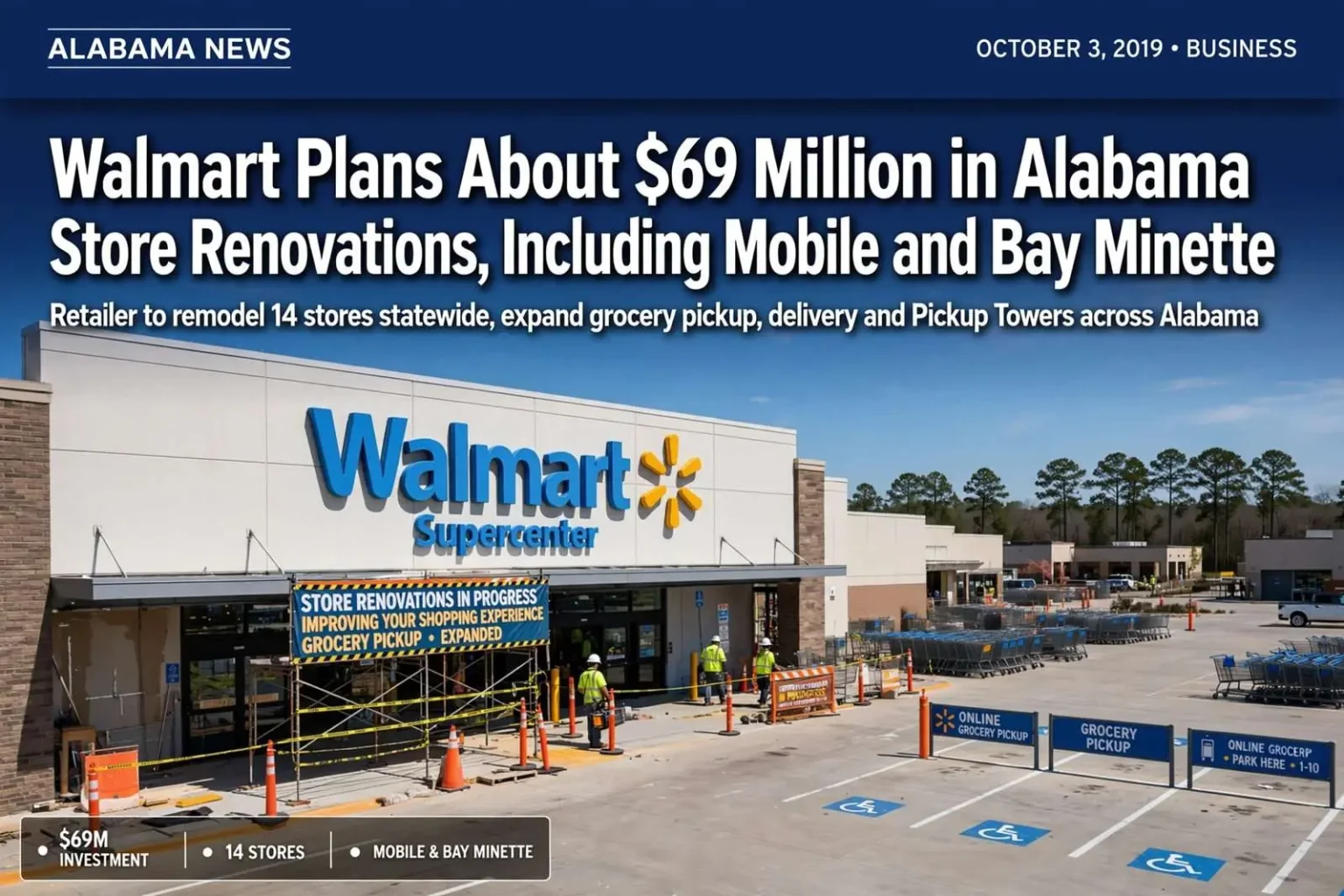
Walmart expected to spend an estimated $69 million in Alabama during 2019, remodeling 14 stores and expanding several customer-focused services across the state. The investment ranked among the larger single-year retail spending commitments announced in Alabama that year, and it touched stores from the Gulf Coast to the Tennessee line, including locations in Mobile and Bay Minette. Regional General Manager Annemarie Browning said the investment builds on the company’s effort to save shoppers time and money through innovations such as grocery pickup, grocery delivery and Pickup Towers.
Among the Alabama stores slated for renovation were locations in Bay Minette, two in Mobile, Dothan, Birmingham, Florence, Greenville, Jasper, Ozark, Madison and Talladega. The list spanned large and small markets alike, which company officials said reflected a strategy of refreshing stores wherever customers live rather than concentrating upgrades in the state’s biggest metros. For Baldwin County shoppers, the Bay Minette project meant a full remodel of a store that serves as the primary big-box retailer for the northern half of the county, drawing customers from Bay Minette, Stockton, Perdido and communities along U.S. Highway 31 and Interstate 65.
In Mobile, the two remodels covered stores that anchor retail corridors on opposite sides of the city. Mobile-area shoppers had already grown accustomed to online grocery ordering, and the renovations were designed to expand the physical space and staffing devoted to filling those orders, as well as to update aisles, signage, electronics departments and pharmacy areas. Remodels of this scale typically proceed section by section, with temporary walls and relocated displays, so stores generally remained open to customers throughout construction.
The company also planned to widen grocery pickup to more than 27 additional stores, add grocery delivery at 22 stores, install 16 Pickup Towers, expand a backroom “Fast Unloader” system to 27 stores and roll out autonomous floor scrubbers to 43 stores. Each of those programs addressed a different side of the retail operation: pickup and delivery changed how customers receive goods, Pickup Towers automated the handoff of online orders inside the store, the Fast Unloader sped the movement of merchandise from trucks to shelves, and the robotic scrubbers took over one of the store’s most repetitive maintenance tasks.
How the new services work
Grocery pickup allows customers to order items online or in the Walmart app, choose a time window, and collect their order from designated parking spaces without leaving their vehicles. Store associates shop the order, keep refrigerated and frozen items temperature-controlled, and load the groceries directly into the customer’s car. The service proved especially popular with families with small children, elderly shoppers and customers with limited mobility, and Walmart expanded it aggressively across the Southeast during the same period.
Grocery delivery took the model one step further by bringing orders to the customer’s home. At the time, Walmart offered the service with delivery fees and through a membership program, using store inventory and third-party drivers to complete the last leg of the trip. In mid-sized Alabama markets, delivery options had historically been limited, so the expansion to 22 stores gave many shoppers their first practical alternative to an in-person grocery run.
Pickup Towers, the tall kiosks installed near store entrances, hold online orders in automated lockers. A customer scans a barcode at the kiosk, and the machine retrieves the package in a matter of seconds, eliminating the wait at a service desk. The 16 Pickup Towers slated for Alabama stores were part of a nationwide rollout of the machines, which Walmart positioned as a way to make online purchases — electronics, toys, household goods and other general merchandise — available the same day without shipping costs.
Behind the scenes: the Fast Unloader and the robots
Not all of the investment was visible to shoppers. The backroom “Fast Unloader” system, extended to 27 stores in the state, automates part of the process that begins when a trailer of merchandise arrives at a store. Incoming boxes are scanned and sorted so that they move toward the sales floor in an organized flow rather than sitting in a pile on the receiving dock. Store officials said the system reduces the time between a truck’s arrival and products’ availability on shelves, which matters most for high-demand items and seasonal merchandise.
The autonomous floor scrubbers, assigned to 43 stores in Alabama, were among the most visible of the new technologies even though they work during off-hours. The battery-powered machines follow computerized routes through the sales floor, scrubbing and drying the polished concrete typical of Walmart locations while associates handle other tasks. Retailers across the country were testing similar machines during that period, and Walmart’s deployment in Alabama made the state part of one of the largest such rollouts in the industry at the time.
Company officials framed both systems as ways to redirect labor rather than eliminate it, arguing that hours freed from unloading and scrubbing could be spent helping customers and filling online orders. That argument reflected the broader tension in retail at the time, as chains invested heavily in automation while competing on the quality of personal service, and Walmart used its store-level announcements across the country to emphasize the customer-service side of the equation.
What the investment meant locally
For the communities on the renovation list, the spending carried practical significance beyond the store itself. A remodel of the Bay Minette store brought construction activity and contractor work to the northern Baldwin County economy, and the expanded pickup and delivery services reduced the number of trips residents had to make to larger towns for shopping. In markets such as Greenville, Ozark, Jasper and Talladega, the local Walmart is frequently the largest retailer in town, and its condition and services shape where residents spend their money — and whether those dollars stay in the county.
The two Mobile stores served densely populated corridors where competition from other grocers, discounters and online retailers was strongest. Mobile’s retail market includes national grocers, warehouse clubs and a growing assortment of curbside pickup offerings, so Walmart’s push to match convenience features was aimed squarely at keeping and growing its share of weekly household spending in the city. The renovation years also coincided with renewed commercial development activity along major Mobile corridors, raising the stakes for chains competing for shoppers’ attention.
Browning’s framing of the program — saving shoppers time and money — captured the twin promises retailers were making as e-commerce reshaped habits. The company had committed to expanding online grocery service nationwide, and Alabama, with its mix of rural counties and growing metros, was a proving ground for how far those services could reach beyond major cities. By the end of the 2019 program, the majority of the state’s Walmart locations were scheduled to offer at least one of the new convenience options.
A broader push to blend technology with service
The upgrades are part of a broader push by the retailer to blend technology with in-store service, giving customers more options for how and when they shop. Industry analysts described the strategy as an effort to make the physical store the backbone of online retail — a fulfillment center, a pickup point and a shopping destination all at once — rather than a competitor to it. Stores that offer pickup and delivery effectively extend their reach well beyond the customers who walk through the door each day.
Context: retail competition in 2019 Alabama
The timing of Walmart’s announcement reflected the pressures facing American retail at the end of the decade. Discount chains, dollar stores and online marketplaces were expanding across the Southeast, and grocery sales had become the battleground on which store loyalty was largely decided. Walmart’s grocery business accounted for the majority of its domestic sales, which explains why pickup and delivery — both grocery-centered services — stood at the center of the Alabama program alongside the cosmetic and structural remodels.
The state’s demographics made it a natural fit for the expansion. Alabama’s mix of a large metro core in Birmingham, mid-sized markets in Mobile, Montgomery, Huntsville and Dothan, and dozens of small-town stores meant the retailer could test nearly every service configuration it offered nationally. Madison and Florence, on the list of renovation locations, sat in the fast-growing Huntsville region, where population growth had been pulling retail investment north; Dothan and Greenville anchored markets in the Wiregrass and Black Belt regions where the local store’s role is even larger.
Baldwin County’s inclusion carried its own logic. Bay Minette sits at the crossroads of Interstate 65 and U.S. Highway 31, north of the booming coastal towns, and its store serves a wide rural radius. As Baldwin County’s population grew rapidly during that decade, investment in the northern-county store helped the chain hold customers who might otherwise drive south to Spanish Fort or Daphne for a wider selection of services.
Taken together, the 2019 program gave Alabama one of the more extensive state-level retail modernization efforts announced that year. Fourteen remodeled stores, dozens of new service offerings and a suite of backroom automation touched communities from the Tennessee Valley to the Gulf Coast, and the Mobile and Bay Minette projects ensured that the lower Alabama market — where the company’s Gulf Coast customers had long depended on its stores — shared directly in the investment. The remodels and service rollouts described in the announcement proceeded through the year, changing the look and the logistics of the state’s Walmart stores in ways shoppers encountered every week.