Washington County pastor apologizes for social media comment some called insensitive
A Washington County pastor apologized after a Facebook comment some called racially insensitive drew criticism in Millry, Alabama.
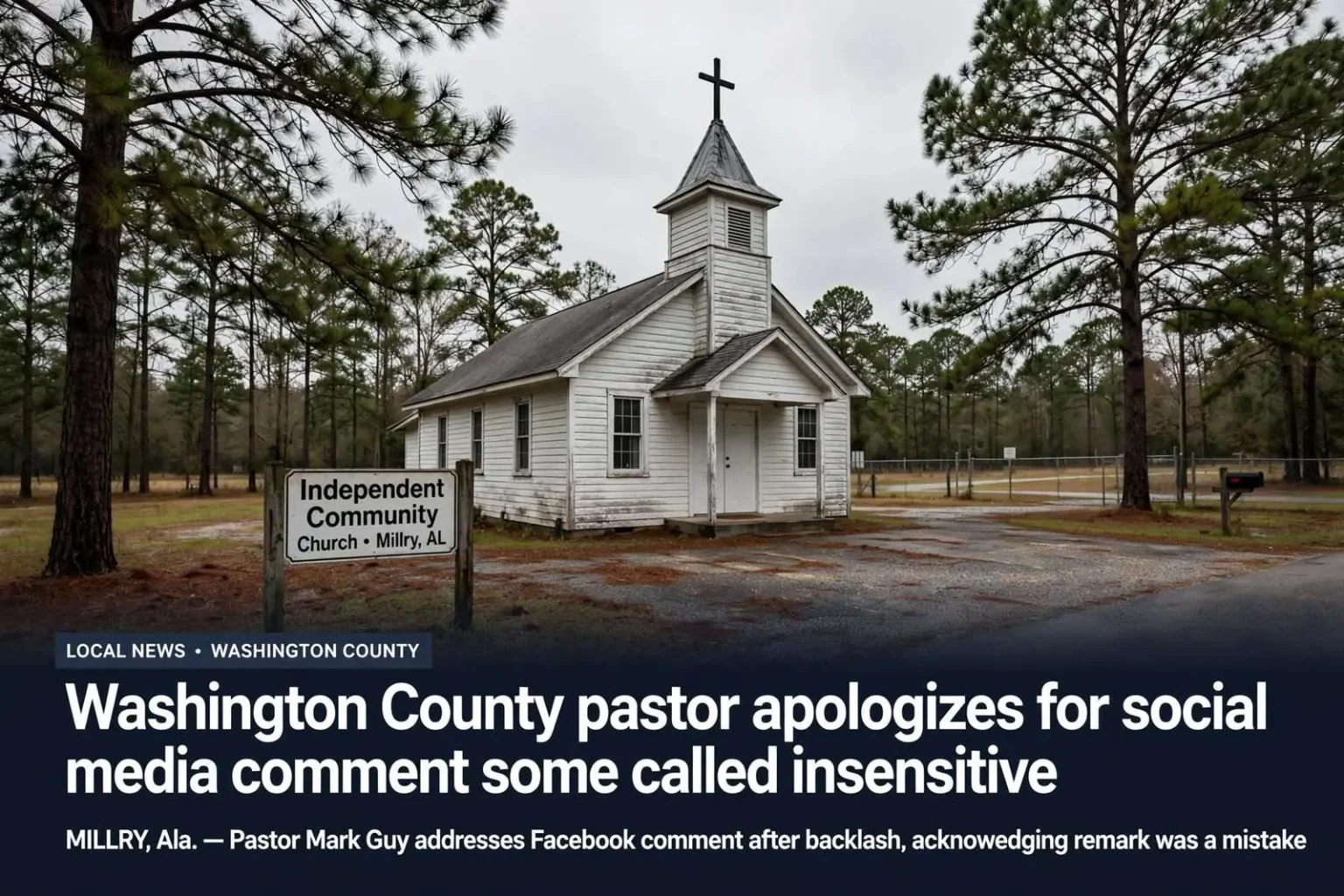
MILLRY, Ala. — A Washington County pastor is apologizing for a social media comment that some readers described as racially insensitive, after his remark on another resident’s Facebook post drew criticism across the community over the weekend. Pastor Mark Guy, who identifies himself on Facebook as the pastor at Independent Community Church in Millry, responded publicly after a comment he made on a woman’s Facebook post sparked the backlash. The episode highlights the speed with which a single social media remark — made from a personal account — can become a matter of public concern in a small Alabama town.
According to posts reviewed by the news outlet, Guy wrote, “Need to go back to the old days and start hanging again, crime will stop when they see people rot off rope in every town,” in response to the woman’s post about items being stolen from her home. The comment, written as a reaction to a report of theft, quickly drew attention from other users, and some readers called the remark insensitive — particularly its evocation of hangings, a punishment with a painful history in the American South.
The Comment and the Reaction
The exchange began as a routine feature of small-town social media: a resident reporting that belongings had been taken from her home, and neighbors responding with frustration about local crime. Guy’s reply went beyond expressions of sympathy, invoking the return of hangings as a deterrent. Readers who saw the comment raised objections over the weekend, arguing that the imagery was disturbing regardless of intent and that its historical resonance made it worse. Screenshots of the exchange circulated as more residents learned of the remark, and the criticism reached the pastor directly.
Washington County, along the Mississippi state line in southwest Alabama, is one of the state’s most rural counties, where communities like Millry are closely knit and news travels fast — both by word of mouth and through the Facebook groups that now function as town squares. In communities of that size, a pastor is among the most visible figures in public life, and comments attributed to one carry weight well beyond a personal page’s follower count.
The Pastor’s Response
The pastor addressed the reaction on his own Facebook page Sunday. “It has been blown way out of proportion. I was watching a western at the time of the post. In the old days they hung people for stealing. I read her post and made the comment, had not one thing to do with race. Might not should have but I did,” the post read in part. In the statement, Guy attributed the comment to a movie he was watching and to historical practice, denied any racial motivation, and acknowledged — in the phrase “Might not should have but I did” — that he recognized the remark had been a mistake.
The response did not end the discussion. Some who saw it accepted the explanation as an honest account of a poorly chosen remark; others argued that the explanation did not address why the imagery was harmful in the first place, or what accountability should look like for a community religious leader. The episode joined a longer-running national conversation about what public figures’ social media activity means for their standing in the communities they serve.
Social Media and Small-Town Leadership
The incident reflects a dynamic playing out in communities across Alabama and the country. Facebook groups devoted to community news, crime reports and local chatter have become primary channels of information in rural counties where traditional news outlets have thinned. Pastors, mayors, sheriffs and business owners participate in those spaces alongside their neighbors, often commenting casually and without the review that formal statements receive. The informality that makes those exchanges feel authentic also makes them risky — a remark typed in seconds can define a public figure’s reputation for far longer.
For religious leaders, the stakes are compounded by their role. A pastor speaks not only for himself but, in the eyes of many residents, for a congregation and a faith community. Comments that readers perceive as threatening or racially charged can therefore affect perceptions of an entire church, particularly in a county whose population includes families connected to its history of racial tension — history that imagery of hangings inevitably calls to mind for many Southerners.
Millry, the community at the center of the episode, is a small town in northern Washington County, a region of pine forests, family farms and churches that anchor social life. Independent and community churches like the one Guy identifies with his name are common across rural Alabama, often serving as both worship centers and gathering places for their neighborhoods. Pastors in such settings typically know most of their congregants by name, preach at funerals and weddings across the community, and function as informal civic leaders — a role that magnifies both their influence and their accountability.
Crime and Punishment in the Public Conversation
The underlying subject of the exchange — property crime in rural communities — is itself a persistent concern in southwest Alabama. Residents in small towns frequently report thefts of equipment, tools and household items on community social media pages, sometimes faster than they report them to county sheriff’s deputies whose coverage areas span hundreds of square miles. Frustration with repeat offenders and slow responses is a common theme, and calls for harsher punishment surface regularly in comment threads.
Guy’s comment drew on that frustration, invoking a historical form of punishment as a hypothetical deterrent. But the specific imagery he chose — hangings, described in graphic terms — carried associations that transformed a complaint about theft into a controversy about race and history. In the South, public hangings and extrajudicial lynching are intertwined with the region’s racial history, and readers who criticized the comment said that history made the remark indefensible regardless of the writer’s stated intent. The pastor’s acknowledgment that he “might not should have” made the comment suggested he understood, after the fact, that the phrasing itself — not merely its misreading — was the problem.
What Remains Unclear
Guy told the news outlet he had not been reached for further comment at the time the story was published, leaving several questions open. It was not immediately known whether the leadership or congregation of Independent Community Church would address the comment, whether the pastor faced any formal response from within his church or the broader community, or whether he intended any further statement. The woman whose post prompted the exchange did not appear to have responded publicly to the pastor’s comment or his apology in the posts reviewed.
The episode may also fade as quickly as it surfaced. Small-town social media controversies often burn bright for a news cycle and then subside, particularly when the person involved apologizes and no institutional action follows. But the weekend’s events in Millry illustrate how the rules of public speech have changed for everyone in the social media era, including leaders of small rural congregations: a comment intended for a neighborhood audience is now a public statement, subject to public judgment — and, when readers find it wanting, a public apology.
A Community Weighing the Words
For now, the matter rests where it began: on Facebook, in the judgment of Washington County residents. The pastor’s Sunday statement stands as his public accounting — a denial of racial intent, an explanation drawn from a movie watched, and a partial admission that the comment should not have been made. Whether the community accepts that accounting, and whether Independent Community Church addresses the matter further, will be decided in Millry itself, where the conversation over the weekend’s posts continued as the new week began. The episode serves as a reminder, in a county of small towns and close ties, that words posted in seconds can echo through a community for far longer than their author expects.
The role of Facebook in rural Alabama’s information ecosystem deserves particular attention when weighing the episode. In counties without daily newspapers, community groups on the platform have absorbed much of the function local media once performed: residents post about road closures, storm damage, lost pets, school events and — as in this case — crime. The audience is simultaneously intimate and public, composed of neighbors who know one another but also of an unseen wider readership, since any post or comment can be screenshotted and shared beyond its original circle in moments.
That structure sets the stage for the kind of controversy that unfolded in Millry. A comment written for a handful of neighbors becomes a document examined by a community; context that might have been supplied in conversation never reaches readers who encounter only the screenshot. Public figures in rural counties are still adjusting to this reality, and the past several years have produced similar episodes across the region — sheriffs, council members and pastors whose casual remarks online became the subjects of formal complaint. The lesson drawn by observers is consistent: for anyone in a public role, the neighborhood audience and the public audience are now the same audience.
Apology and Accountability in Public Life
The pastor’s Sunday statement follows a recognizable pattern of public apology: an assertion that the reaction exceeded the provocation, an explanation of circumstance, a denial of the most serious reading, and a partial concession of fault. Such statements walk a line between defense and contrition, and they rarely satisfy everyone. Supporters view them as proportionate responses to an honest mistake; critics note that the framing — “blown way out of proportion” — pushes responsibility back onto those who objected, rather than fully owning the original words.
What happens next, if anything, depends on institutions rather than the platform. Churches handle matters of their ministers’ conduct through their own structures — congregational meetings, boards of deacons or elders, or the discretion of the leadership itself. Independent churches, unaffiliated with denominational bodies, have no outside hierarchy to review a pastor’s conduct, which means accountability in such cases rests almost entirely with the local congregation. No indication had emerged by the time the story was published of any such process underway in Millry.
The Broader History Behind the Reaction
The intensity of the reaction is difficult to understand without acknowledging the history the comment invoked. Lynching and public hangings occupy a grim place in Southern and Alabama history, and for many residents — particularly Black residents of rural counties — references to returning to “the old days” of hangings carry the weight of that history directly. Readers who called the comment racially insensitive were responding not to a hypothetical about crime deterrence, they said, but to language whose historical use terrorized communities across the South. That is why the pastor’s denial that the comment “had not one thing to do with race” did not resolve the dispute: the debate concerns the effect of the words, not only the intention behind them.
Washington County’s population is small, and its communities include families of every background who have shared the same schools, churches and civic institutions for generations. Episodes like this one test the fabric of those relationships, and the outcome is usually determined not by statements on Facebook but by the day-to-day willingness of neighbors to talk. The coming weeks in Millry will show which kind of resolution this episode receives — a quiet return to normal, or a longer conversation about the words a community will and will not accept from its leaders.
The Story So Far
Recapping the sequence: a Millry woman posted about items stolen from her home; Pastor Mark Guy, identified on Facebook as pastor of Independent Community Church, replied with a comment invoking hangings as a deterrent to crime; readers objected over the weekend, with some calling the remark racially insensitive; and Guy responded Sunday on his own page, calling the reaction overblown, explaining that he had been watching a western, denying racial intent, and conceding he might not should have made the comment. He told the news outlet he had not been reached for further comment when the story was published. The episode now rests with the community it happened in — a small Washington County town deciding what to make of words its pastor says he regrets.