Weekend Detour Set for U.S. 31 in Spanish Fort as Crews Install Drainage Line
A weekend detour will close U.S. 31 in Spanish Fort near Ember Lane starting March 8 so crews can install a new drainage line as part of a $19 million highway widening project.
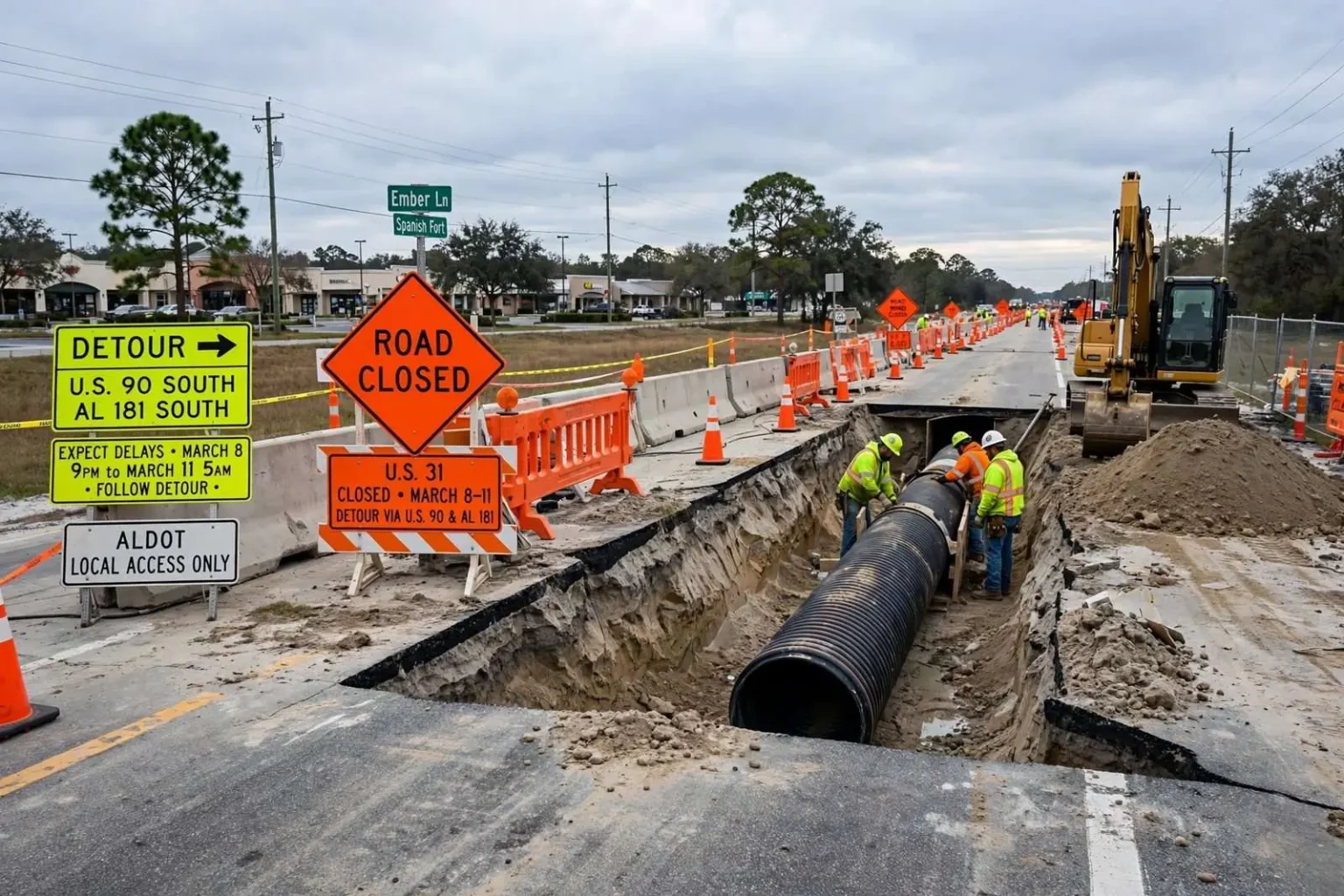
Drivers who rely on U.S. 31 through Spanish Fort should plan for a weekend detour beginning Friday, March 8, as road crews shut down both directions of the highway to install a new drainage pipe beneath the roadway near Ember Lane. The closure will cut one of Baldwin County’s principal north-south routes for an entire weekend, and commuters, shoppers and freight traffic alike will need to plan around it.
The closure is tied to the ongoing widening of U.S. 31, a project designed to add capacity to one of Baldwin County’s busiest north-south corridors as growth continues to bring more traffic to the Eastern Shore. Spanish Fort’s commercial boom — anchored by the retail districts that have risen along the highway corridor in recent years — has transformed a once-quiet stretch of two-lane road into a daily parade of commuters, shoppers and delivery trucks.
Before crews can widen the highway, they must first relocate and upgrade the drainage infrastructure that runs underneath it, which requires temporarily cutting into both the northbound and southbound lanes. It is unglamorous work, but it is the foundation of every successful road-widening project: a wider road that sheds water improperly is a wider road that floods, and Baldwin County’s sandy lowlands make drainage design a central concern.
The Alabama Department of Transportation says the work crew will open-cut the roadway to lay the new drainage crossing, a process that cannot safely be done while traffic continues to flow through the work zone. Unlike trenchless methods that bore beneath an active road, an open cut requires excavating the full depth of the pavement, laying the pipe, and rebuilding the roadway from the bottom up — a sequence measured in days, not hours.
As a result, U.S. 31 will be closed to through traffic at the project site starting at 9 p.m. on Friday, March 8. The late-evening start allows Friday commute and shopping traffic to clear before barriers go up, and gives crews a full weekend of uninterrupted work time.
Weekend highway closures are never convenient, but March is a strategic month for them in Baldwin County. The peak summer beach season, which multiplies traffic on every route between Interstate 10 and the coast, has not yet begun, spring break travel is still weeks away in most school calendars, and the region’s event calendar is lighter than it will be from April onward. Scheduling disruptive work in this window costs the traveling public far less than it would in July.
How traffic will get around
Local residents who live along the affected stretch will still be able to reach their homes, but all other through traffic will be routed around the closure. Access management of that kind is standard on ALDOT projects — the goal is to keep every address reachable while making the work zone itself a construction site rather than a highway.
ALDOT is directing motorists heading through the area to detour via U.S. 90 south or Alabama 181 south. From either route, drivers can reconnect with Interstate 10 at Exits 35 or 38 to continue their trip on U.S. 31 beyond the work zone. The two alternatives bracket the closure neatly: U.S. 90 serves traffic coming from the east side of the corridor, while Alabama 181 handles the west, and both offer straightforward connections back to the interstate system.
Drivers weighing their weekend plans should build the detour into their math. A trip that normally runs straight down U.S. 31 will add several miles and a pair of interstate ramps, and the alternate routes will absorb every through vehicle the closure displaces. Friday night and Saturday midday — peak shopping hours for the Eastern Shore’s retail corridor — are the likeliest windows for congestion on the detour routes.
The geography of the detour deserves a closer look for drivers unfamiliar with the area. U.S. 90, the old pre-interstate highway, parallels U.S. 31 and Interstate 10 along the Eastern Shore before running through the heart of Daphne and onward toward the beaches, making it a natural alternative for local trips. Alabama 181, by contrast, is the newer north-south artery running from Interstate 10 up through the western side of Baldwin County toward Fairhope and points north, and it carries much of the growth traffic that the U.S. 31 widening is meant to relieve. Between them, the two routes give every origin and destination in the area a workable path around the closure.
Crews expect the detour to remain in place through the weekend, with U.S. 31 scheduled to reopen to normal traffic by 5 a.m. Monday, March 11, assuming favorable weather. The Monday-morning reopening target matters enormously to commuters: Spanish Fort feeds one of the busiest morning flows in Baldwin County, with residents heading toward Mobile across the bay and local traffic converging on the city’s schools and commercial centers.
Weather is the wild card in any open-cut schedule. A Gulf Coast rain event over the weekend would complicate both the excavation and the reconstruction of the roadway, and ALDOT’s officials built the “weather permitting” qualification into the timeline accordingly. Drivers planning Monday commutes should check for updates before assuming the highway will be open.
Why the work matters
ALDOT frequently schedules this kind of underground utility and drainage work overnight and over weekends specifically to reduce the impact on the daily commute, though drivers passing through Spanish Fort late Friday and over the weekend should still budget extra travel time or consider the alternate routes in advance. The weekend-closure model trades one difficult 56-hour window for weeks of slower, single-lane traffic — a calculation that usually favors everyone.
The drainage work is one piece of a larger, multi-million-dollar effort to widen U.S. 31 through the Spanish Fort area, a corridor that has outgrown the roadway it was built on. The project reflects a straightforward arithmetic problem: the Eastern Shore’s population and commercial base have grown faster than the highway network serving them, and the roads that carried a smaller Baldwin County comfortably now carry one that keeps expanding.
U.S. 31 through Spanish Fort serves several roles at once. It is the main street of the city’s retail economy, a commuter artery connecting Spanish Fort and points north to Interstate 10 and the Bayway, and a freight route that links inland Baldwin County to the port and industrial facilities around Mobile. Projects that widen the corridor have to serve all three constituencies, which is why the work has come in stages and why drainage, turn lanes and signal work are woven through the schedule.
The Eastern Shore’s growth is the backdrop for all of it. Spanish Fort and neighboring Daphne have been among the fastest-growing communities in the Mobile metropolitan area, drawing families with schools, retail access and a commute to Mobile’s job centers. Every new subdivision and shopping center along the corridor adds vehicles to a road whose original design never anticipated them.
For local businesses along the highway, weekend closures are a mixed experience. The barrier itself cuts off drive-by traffic for two days, but the improved road at the end of the project promises better access, better drainage and the capacity to handle the traffic that keeps the corridor commercially viable. Merchants typically work with ALDOT on signage directing detour and local traffic to open businesses during construction windows.
Advice for the weekend
The practical advice for drivers is simple. If your trip can avoid U.S. 31 near Ember Lane between Friday at 9 p.m. and Monday at 5 a.m., plan it that way. If it cannot, build in extra time, expect heavier traffic on U.S. 90 and Alabama 181, and remember that Interstate 10 at Exits 35 and 38 is the connection point back to your route.
Local traffic inside the closure area should carry proof of address or be prepared to explain their destination to crews managing access points, and residents should expect construction equipment, open trenches and uneven pavement near the work zone throughout the weekend.
Emergency services have also planned around the closure. Fire, police and ambulance coverage in Spanish Fort depends on knowing which routes are passable at all hours, and a full closure of U.S. 31 requires shifting response patterns for the weekend — one more reason ALDOT coordinates such closures with local public safety agencies well in advance rather than springing them on short notice.
Weekend closures like this one will become a familiar feature of Baldwin County life as the U.S. 31 widening and similar corridor projects advance. The inconvenience is temporary; the infrastructure underneath it — bigger pipes, wider lanes, better drainage — is the part drivers will never see but will rely on every time a Gulf Coast storm rolls through.