Teens Injured in 2007 West Mobile County Crash
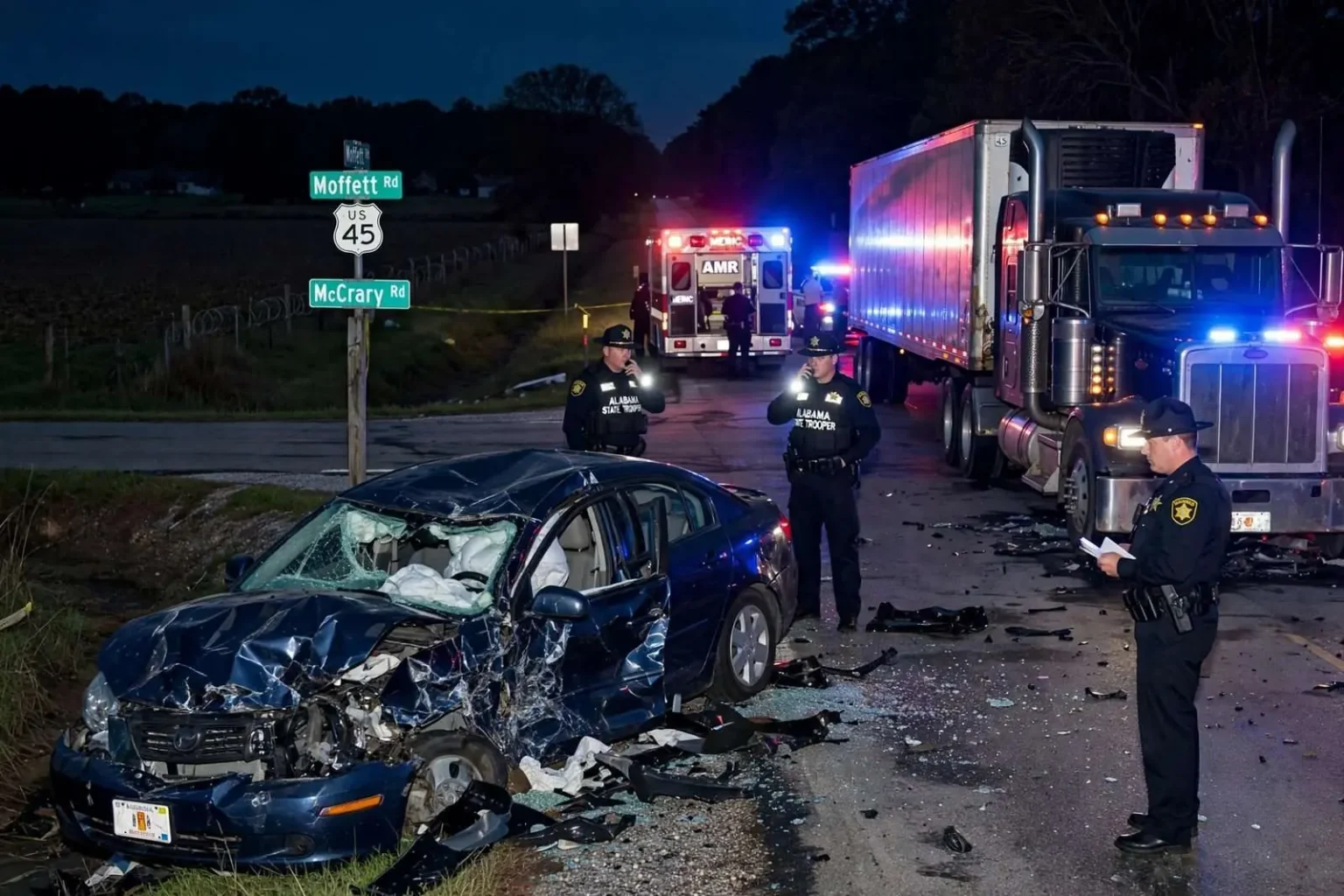
At least two teens were injured after a vehicle carrying five teens collided with an 18-wheeler near Moffett and McCrary roads in 2007.
Teens Injured in 2007 West Mobile County Crash Involving 18-Wheeler
Originally reported October 8, 2007. At least two teens were injured in a late-night crash in West Mobile County in October 2007, according to an archived local news report. The collision, which involved a car carrying five teenagers and a commercial truck, occurred in a rural corner of the county where farm roads meet commuter routes.
Mobile County deputies said five teens were in a vehicle traveling at a high rate of speed when it collided with an 18-wheeler near Moffett and McCrary roads shortly before midnight. The intersection area sits along the Moffett Road corridor, a major artery running northwest out of Mobile, where the grid of suburban streets gives way to the rural landscape approaching the Mississippi line.
Two teens were taken to a hospital for treatment. Alabama State Troopers handled the investigation, which is standard for crashes involving serious injuries on county roads, and no additional information had been released in the report. The archived account does not include the names of those involved, the extent of the injuries, or the final findings of the investigation.
The Scene Along the Moffett Road Corridor
The junction of Moffett and McCrary roads lies in West Mobile County, an area that in 2007 was one of the fastest-growing edges of the Mobile metropolitan area. Moffett Road, carried on the U.S. 45 alignment, functions as the main link between west Mobile’s neighborhoods and the small communities to the northwest, and it carries a mix of local traffic, commuters and commercial vehicles at all hours.
McCrary Road intersects that corridor amid a landscape of subdivisions, churches and remaining farmland. Intersections along the corridor had long been flagged by residents as trouble spots — high approach speeds, limited sight lines at side roads, and heavy truck traffic generated by the logging, construction and shipping industries that move goods through the region after dark.
An 18-wheeler on a rural county road brings physics that passenger vehicles cannot overcome. A fully loaded tractor-trailer can weigh twenty times what a car weighs, needs far more distance to stop, and in a nighttime collision the driver of the smaller vehicle has little protection. Crashes between cars and commercial trucks account for a disproportionate share of fatalities on roads of this kind, which is why they trigger state-level investigation rather than a routine county response.
Why State Troopers Take These Cases
Alabama State Troopers handle crash investigations across unincorporated areas and on many state and federal routes, and serious-injury collisions typically receive the full treatment: reconstruction specialists who measure skid marks and vehicle damage, interviews with everyone involved, and a report that can determine fault for insurance and legal purposes. In 2007, troopers from the Mobile post covered a wide territory that included the county’s fast-growing western edge.
Speed was the factor deputies cited in this crash — five teens in a vehicle traveling at a high rate of speed shortly before midnight. Nighttime speed-related crashes were a persistent problem on the corridor, where long straight stretches invite speeding and where traffic is light enough that drivers underestimate the risks.
Five teenagers in one car also raised the graduated-licensing questions that Alabama’s laws were designed to address. The state’s rules at the time restricted the number of passengers a young driver could carry and imposed night driving limits for newly licensed teens, precisely because crash statistics showed that teenage drivers with teenage passengers face dramatically elevated risk. Late-night hours multiply the danger, combining inexperience with darkness, fatigue and fewer adults on the road.
Teen Driving Risk in Context
The circumstances described in the archived report fit a pattern that highway safety researchers had documented for decades. Nationally, motor vehicle crashes were the leading cause of death for American teenagers in 2007, and the riskiest conditions were exactly the ones present here: night driving, multiple teen occupants, high speed and rural roads. Each factor is independently dangerous; together they compound.
Passenger presence changes teen driving behavior measurably. Studies of crash data show that the presence of other teenagers in the car increases the likelihood of speeding, aggressive maneuvers and distraction, an effect that grows with each additional passenger. Safety campaigns of the era urged parents to set their own passenger and curfew rules, and Alabama’s graduated driver license law — adopted a few years later, strengthening the restrictions on young drivers — drew directly on that body of evidence.
Rural roads carry their own dangers even for careful drivers. West Mobile County’s network of two-lane roads sees speeds that outpace their design, and when a car leaves its lane or approaches an intersection too fast at midnight, the chances of a serious collision rise sharply. The addition of a commercial truck at the same spot, as in this case, leaves almost no margin for error.
Commercial Trucks on County Roads
The 18-wheeler in this crash was operating in an environment that trucking companies and regulators had long identified as hazardous. County roads that connect freight corridors to industrial sites, timber operations and construction zones were never built to interstate standards, and the trucks that use them — like the passenger cars around them — must share narrow lanes and older intersections with school buses, farm equipment and local traffic.
Federal hours-of-service rules, licensing requirements and equipment inspections governed the trucking industry then as now, and investigators in a truck-involved crash typically examine the driver’s logs, the vehicle’s maintenance history and any mechanical factors alongside the conduct of the car’s driver. The archived report does not indicate what investigators found regarding the truck or its driver, and no findings were released in the original account.
What the report did establish was the human toll: five teenagers involved, two of them taken to a hospital. For the families gathered at hospital emergency rooms in the early hours of that October morning, and for the school communities the five teens belonged to, the crash was a stark local reminder of the statistics that safety officials repeat every year.
The Night’s Timeline
The crash occurred shortly before midnight, according to the report — a window when deputies knew the corridor’s traffic would be thin but its speeds at their highest. Emergency crews arriving on the scene found a passenger car and an 18-wheeler in collision near the intersection, with five teenagers in the smaller vehicle. Two needed hospital treatment and were transported; the report did not say how the others fared or whether anyone in the truck was hurt. Deputies secured the scene while word reached the troopers who would handle the investigation, and the roadway stayed closed long enough for the wreckage to be cleared and the evidence documented.
What Happened After the Report
The archived account ends where the original reporting ended, with two teens hospitalized, troopers investigating, and no further information released. That is typical of crash coverage from the era: initial reports established the facts emergency responders could confirm on scene, and follow-up details — names, charges if any, and the troopers’ final reconstruction — appeared only when investigators completed their work, if the newspaper followed up at all.
For readers encountering the story years later, the value of the archive is in the confirmed basics: the date, the location near Moffett and McCrary roads, the number of people involved, the vehicle at high speed, the 18-wheeler, and the agency that took the case. Everything beyond those facts remains outside the historical record as preserved.
Changes to the Corridor Since 2007
The Moffett Road corridor continued to grow in the years after this crash, with new subdivisions and commercial development pushing further out from Mobile. Growth brought road projects, signal upgrades and continued attention to the intersections that residents had long flagged, even as increased traffic brought its own pressures.
Teen driving safety also evolved. Alabama’s graduated driver license law now imposes clearer restrictions on night driving and passengers for young drivers, seatbelt enforcement has intensified, and smartphone-era distracted driving has become the newest front in the campaign that crashes like this one helped illustrate. The core message has not changed since 2007: speed, darkness and inexperience remain the most dangerous combination on the road.
A Note on This Historical Update
This article preserves a report originally published October 8, 2007, describing a crash that occurred shortly before midnight near Moffett and McCrary roads in West Mobile County. It does not include information released after the original report, and no names, charges or findings have been added. Readers seeking official records of the crash would need to consult Alabama State Trooper archives or other primary sources from that time.
What the record preserves is a snapshot of a single night on a West Mobile County roadway — five teenagers in a car moving too fast, a commercial truck in their path, and two of them on the way to a hospital as state troopers began the work of determining what happened.