Schillinger Road Business District Annexed Into Mobile in 2007
A 2007 special election brought a West Mobile business district along Schillinger Road into Mobile's city limits.
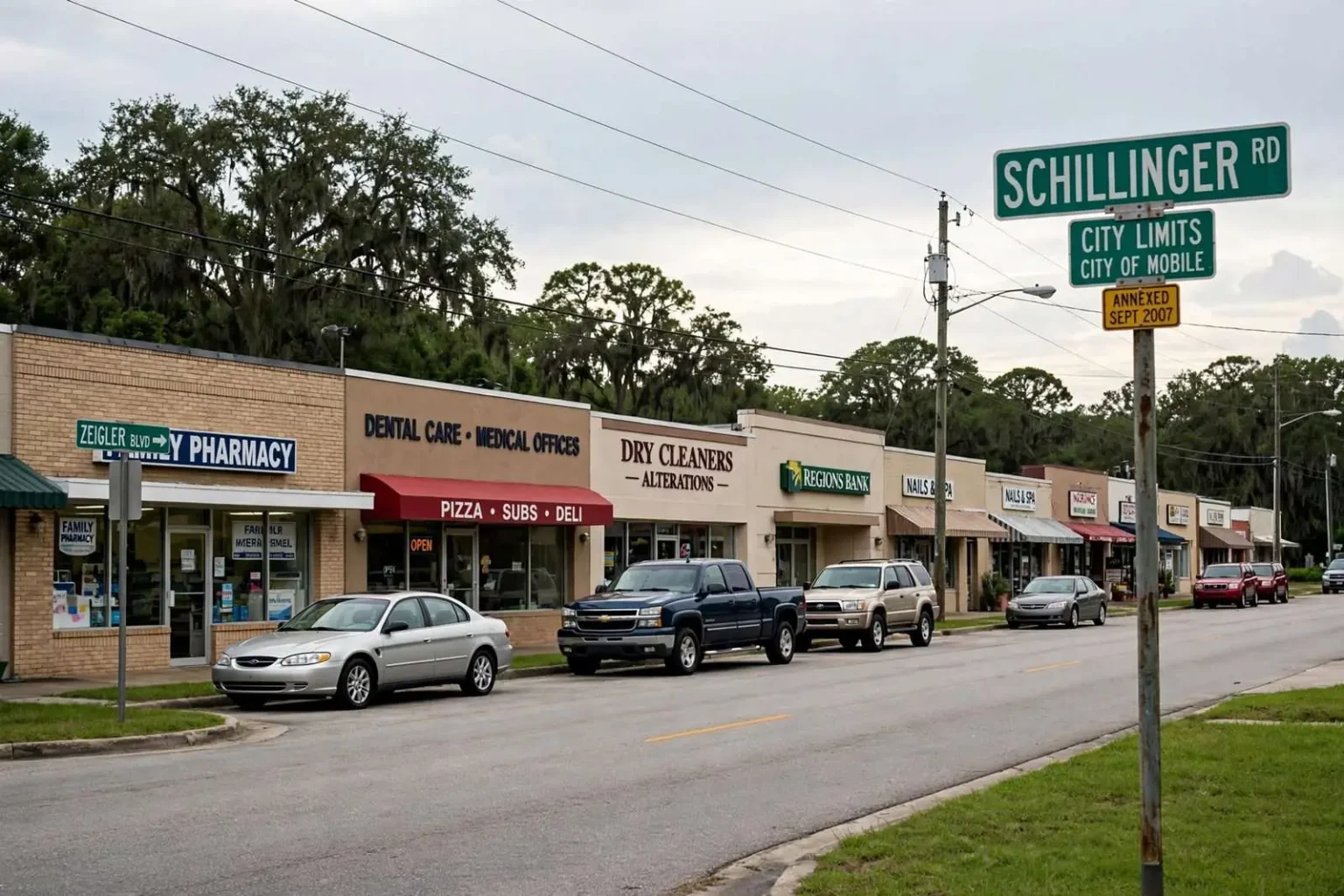
MOBILE, Ala. — A special election in September 2007 brought a business district along Schillinger Road in West Mobile into the City of Mobile, according to a local station, extending the city’s limits along one of the fast-growing corridors of its western flank. Voters considered four annexation areas in the election, but only one succeeded: the district stretching from Zeigler Boulevard to Hitt Road passed, with 153 votes for and 126 against, while the other three areas were rejected by voters.
The result drew the familiar, sometimes bewildering map that annexation leaves behind. The Schillinger Road business district — a stretch of retail and commercial property in the heart of West Mobile’s growth corridor — became part of the city, while neighboring residential areas that voted in the same election chose to remain outside the limits. That patchwork outcome is a hallmark of annexation in Alabama, where state law lets residents of each affected territory decide separately whether to join a neighboring city, producing boundaries that follow election results rather than tidy lines.
Annexation votes of this kind carry real consequences for both sides. For the property owners brought into Mobile, city limits meant city services — police patrols from the Mobile Police Department, city fire protection, street maintenance, and municipal planning and zoning — along with city taxes. For the City of Mobile, each annexation brought new commercial tax base and the authority to shape development along a corridor that was filling in with new businesses as West Mobile’s population pushed westward toward the county line.
Why the Schillinger corridor mattered
Schillinger Road runs north-south through West Mobile, threading through a part of the county that grew rapidly in the 1990s and 2000s as subdivisions, schools, and shopping followed residential demand outward from the city core. The stretch between Zeigler Boulevard and Hitt Road sits amid that growth, where commercial development clustered to serve the surrounding neighborhoods. Bringing that district into the city gave Mobile a foothold along the corridor and a say in how it developed.
Zeigler Boulevard and Hitt Road themselves have grown into significant crossroads of West Mobile commerce, and the Schillinger corridor between them has long been lined with the retail, dining, medical offices, and service businesses that follow rooftops. The 2007 election captured a moment in that evolution — the city reaching to keep pace with growth that was already reshaping the map, and residents weighing what city status would mean for their daily lives and their tax bills.
The votes against annexation in the other three areas told the other half of the story. Many residents of unincorporated Mobile County prize their distance from municipal government — no city property taxes, no city zoning, and a relationship with the county that many rural and suburban voters prefer. annexation supporters typically pitch services and the influence of being part of the state’s third-largest city; opponents push back on taxes and on extending city boundaries into unincorporated territory. In September 2007, voters in three of the four areas decided the pitch was not for them.
How annexation works in Alabama
Annexation in Alabama follows paths laid out in state law, most commonly through a vote of the residents of the territory proposed for annexation, or through petition in some circumstances. A city declares its interest, the affected territory is defined, and the residents vote — often in special elections held separately from the general calendar. Only the people who live in the proposed territory decide its fate, which is why cities sometimes succeed in one district and fail in the adjacent one on the same day, as happened in the September 2007 election.
For cities, the calculus is fiscal as much as philosophical. Commercial annexations are prized because sales taxes generated by businesses flow to the city, while the cost of serving a commercial strip — police response, road maintenance, planning oversight — is generally modest relative to the revenue. Residential annexations, by contrast, bring households whose children attend schools and whose demands for services can exceed the taxes they pay. That arithmetic explains why cities along the Gulf Coast have historically chased retail corridors and why residential areas often resist being folded in.
The Schillinger Road annexation fit the commercial pattern. The district from Zeigler to Hitt was approved by a margin of 27 votes — 153 to 126 — a narrow result that reflected how closely divided residents and property owners were on the question. The tally also underscored the hyperlocal nature of the decision: a few dozen voters determined the municipal fate of an entire commercial corridor.
This account is a historical summary of a 2007 special-election result. Municipal boundaries and conditions may have changed in the years since, as Mobile has continued to grow and as subsequent annexations and developments have further altered the map of West Mobile. But the September 2007 election remains a marker in the story of how the city came to its present shape — one corridor, one vote, and one business district at a time.
The growth story of West Mobile puts the 2007 election in context. Through the final decades of the twentieth century, Mobile’s population shifted steadily westward and outward, following the pattern of American Sun Belt cities: new subdivisions on the outskirts, older neighborhoods aging closer to downtown, and retail development chasing the newest rooftops. Corridors like Airport Boulevard, Government Boulevard, and Schillinger Road became the commercial spine of that growth, and by the mid-2000s the city’s limits sat well inside the true extent of the urbanized area. Annexation was the tool available to bring the map back into line with reality.
Business owners in the affected district had their own reasons to weigh the question carefully. City annexation brought Mobile’s municipal sales tax structure to the businesses along the corridor, but it also brought the city’s services — and, supporters argued, the benefit of belonging to a municipality with the resources to police, plan, and promote the area. Retail centers often favor annexation for the improvements in infrastructure and code enforcement that come with it, while others fear the tax changes. The 153-126 result suggests the business district itself was closely divided on where its interests lay.
The politics of the boundary line
Annexation battles in Mobile County have a long history, and they are rarely just about services and taxes. They are about identity — whether a community sees itself as part of Mobile or as its own place in the county — and about control, since municipal zoning rules that follow annexation can restrict what property owners may do with their land. Special elections give each territory its own voice, and the results often turn on turnout: a handful of energized voters on either side can settle the question for everyone in the district.
The September 2007 election’s mixed outcome was neither unusual nor surprising to observers of Mobile’s annexation history. Over the years, the city has seen annexation votes succeed in commercial districts and fail in residential ones, succeed along corridors where owners saw benefit and fail in neighborhoods where the status quo felt comfortable. Each successful annexation has extended the city’s reach by a little, producing the irregular boundary lines that map readers notice where Mobile’s edges meet the unincorporated county.
The city’s planners and budget writers track those additions closely. Sales tax revenue from commercial corridors underpins the municipal budget, funding police, fire, parks, and streets across the whole city, and each commercial annexation strengthens that base. At the same time, the city inherits obligations: the corridors it annexes must be patrolled, their roads maintained, and their development reviewed. The 2007 addition to West Mobile was weighed against exactly that ledger.
What annexation meant for residents nearby
For the neighborhoods around the newly annexed district, life continued under Mobile County’s jurisdiction — county sheriff’s deputies rather than city police, county services rather than city ones, and the county’s planning framework rather than city zoning. Some of those residents had voted in the same September election and chosen to stay out; others lived in territories where no vote was on their ballot. The contrast between the annexed commercial strip and the unincorporated land around it became part of the local landscape, visible in everything from streetlight maintenance to which agency responded to a 911 call.
Over time, the effects of such annexations tend to blend into the everyday. Businesses along the corridor renewed licenses with the city, police beats were redrawn, and signs of municipal identity — city crews, city permits, city code enforcement — appeared along Schillinger Road. Residents driving through the district passed, often unknowingly, from county into city and back again, the boundaries invisible at the roadside but consequential at the tax office and the ballot box.
The September 2007 vote also reflected the competitive landscape of south Alabama municipal growth. Cities across the region — Mobile, Prichard, Saraland, Daphne, Fairhope, Foley and others — have all used annexation over the decades to capture growth corridors and protect their tax bases, and unincorporated communities have watched those ambitions with varying degrees of enthusiasm. Every special election is a negotiation between a city’s vision of its future and a community’s sense of itself.
In the end, the 2007 Schillinger Road annexation stands as a case study in how Alabama cities grow: not by fiat, but by the accumulated decisions of small groups of voters, district by district, each deciding whether the line on the map should move to include them. The 153 votes in favor moved the line across a West Mobile business corridor; the 126 against marked the resistance; and the three rejected areas showed that on that September day, most of the territory Mobile hoped to gain chose to remain outside the city limits — a reminder that in annexation, as in so much of local government, the voters get the final word.