Will Kimbrough Makes His BayFest Debut at the 2011 Festival
Mobile's own Will Kimbrough and his band made their first BayFest appearance at the 2011 edition of downtown Mobile's annual music festival.
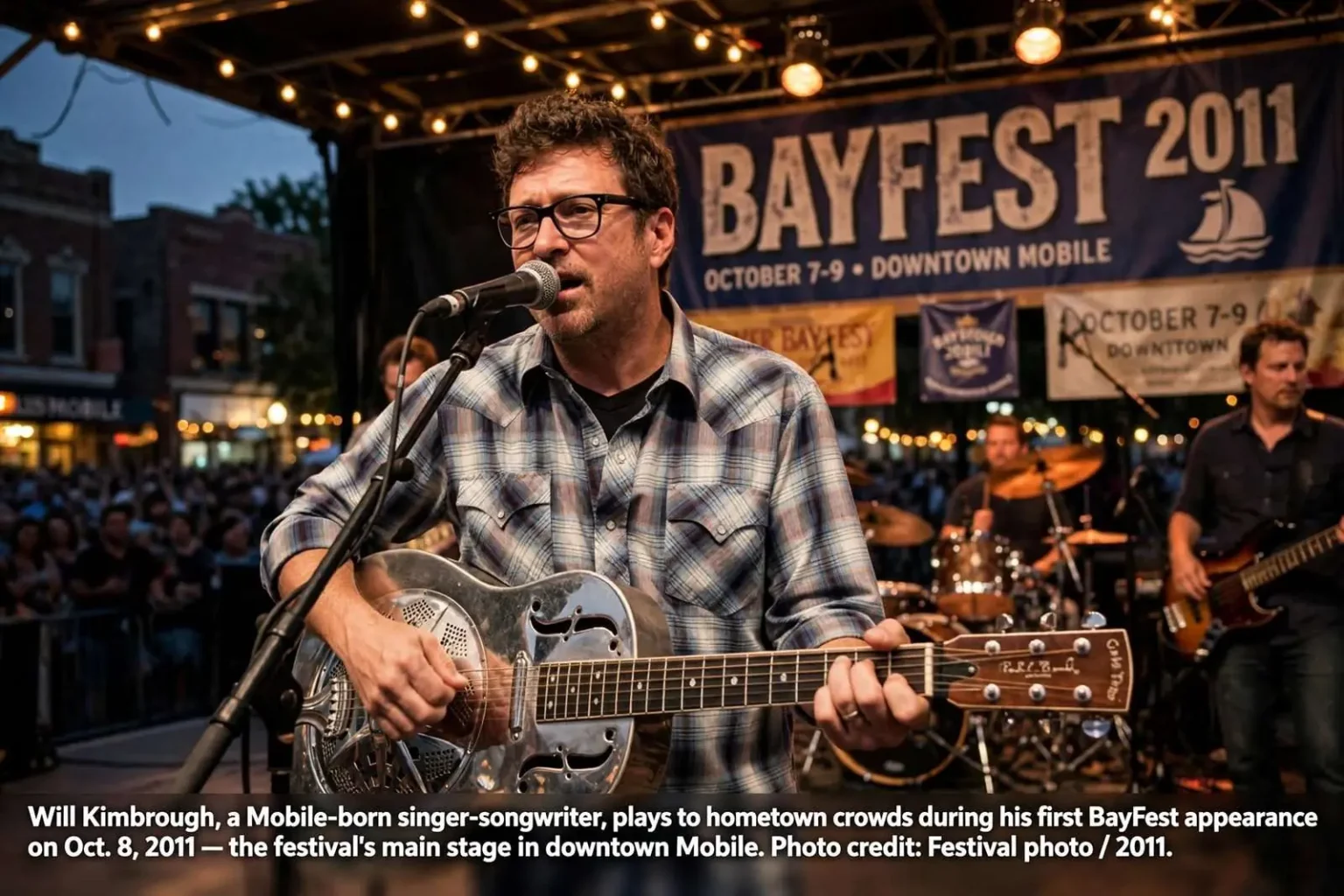
Will Kimbrough, a Mobile-born singer-songwriter and guitarist with a worldwide following, made his first BayFest appearance in 2011, leading his band before hometown crowds at the city’s annual downtown music festival. For Kimbrough, the set marked a homecoming of sorts, a chance to play one of the Gulf Coast’s biggest stages in the city where his musical life began, surrounded by the family, friends and longtime listeners who had followed his career from its earliest days.
Raised in Mobile, Kimbrough built a career that has carried him from local clubs to stages across the country, earning acclaim as both a solo artist and a sought-after guitarist, songwriter and producer whose credits span folk, Americana, country and rock. His reputation among musicians has always rivaled his reputation with audiences; artists across genres have recorded his songs and hired him for tours and sessions, making him one of the most quietly influential exports of the Mobile music scene.
BayFest, staged each October in the streets of downtown Mobile, has for years served as a showcase for national touring acts and regional favorites alike, drawing large crowds of music fans to the city’s core. The festival’s multi-stage format transformed blocks of downtown into a walkable maze of sound, with genres separated across stages and fans moving between them through an October weekend that became one of Mobile’s signature events each fall.
Kimbrough’s hour in its spotlight gave longtime local listeners a chance to see one of their own on one of the region’s biggest stages. For performers with national careers, hometown festival sets carry a different weight than club dates: the audience includes people who remember the artist before the career, alongside festivalgoers discovering the music for the first time, and the performer plays to both at once.
A Career Built Across Genres
His set was noted by festival-goers as a standout of the weekend, a performance that brought his roots-inflected songwriting and seasoned band to one of the festival’s main stages. The blend of craft and ease that defines Kimbrough’s live work, tight playing, warm between-song banter and songs that move between folk storytelling and rock energy, translated naturally to a festival audience that spanned ages and musical tastes.
Kimbrough’s path from Mobile to a worldwide following began in the clubs and listening rooms of the Gulf Coast, where he developed the guitar style and songwriting voice that would carry him forward. Musicians who come up through regional scenes often describe those early rooms as their apprenticeship, the places where a performer learns to hold an audience’s attention with nothing but songs and stage presence. Kimbrough’s later success as a sideman and producer traces back to that foundation, the versatility of a player who absorbed the folk, country, blues and rock traditions that circulated through Gulf Coast music.
As a songwriter, his catalog has been recorded by artists across the country and Americana worlds, with his compositions prized for the same qualities that mark his own recordings: vivid character sketches, empathy for working people and choruses that feel lived-in rather than manufactured. As a guitarist and bandleader he has toured with some of the biggest names in Americana and roots rock, building the professional relationships that eventually made him a producer whose judgment other artists trust with their own records.
That dual identity, solo artist and hired gun, is a demanding balancing act, and Kimbrough’s 2011 BayFest set arrived at a point when audiences nationally had grown more familiar with his name in both roles. Festival bookings like BayFest serve an important function for artists of that profile, putting them in front of casual listeners who may know a song or two but have never seen the full performance, while rewarding the dedicated fans who travel with an artist’s career for decades.
BayFest’s Role in the Mobile Music Economy
For Mobile itself, BayFest occupied a distinctive place in the city’s cultural calendar. The festival drew hundreds of thousands of attendees over its run, filled downtown hotels and restaurants on an October weekend, and gave regional bands a shot at opening slots alongside national headliners. Local musicians often described playing BayFest as both a professional milestone and a family occasion, since the festival’s crowds were filled with hometown listeners who rarely had the chance to see regional favorites on main stages.
The festival’s economic footprint on downtown Mobile was substantial, with stages set up on streets and lots across the core of the city and attendance flowing into bars and restaurants after the official stages closed each night. That pattern, festival crowds spilling into venues, is precisely how cities like Mobile measured the event’s value beyond ticket sales, as an annual demonstration that downtown could absorb and energize a massive crowd.
Kimbrough’s homecoming set fit that story neatly. A Mobile-born artist returning to lead his band on a hometown main stage embodied the pipeline the festival celebrated: young players from Gulf Coast clubs going on to national careers, then coming back to show the next generation what the route looks like. For younger musicians in the 2011 crowd, seeing a Mobile native commanding a BayFest stage offered a concrete example of a career built from the same starting point they occupied.
The 2011 edition of the festival arrived during a period of continuity for BayFest, which had grown into one of the Southeast’s larger music festivals through steady annual staging in downtown Mobile. October in Mobile brings the first breaks of fall heat, and festival weekends historically took advantage of the weather with long afternoon-to-midnight schedules across multiple stages. Attendees in 2011 moved between national acts and regional bands in the same evening, the mix that defined the festival’s identity.
For Kimbrough, performing before a hometown crowd meant playing for an audience with a long memory. Listeners who had followed him from his earliest Mobile days heard a setlist that reflected a career’s arc, early songs alongside newer material, delivered with the seasoned band that backed him on the road. Festival-goers who ranked his set among the weekend’s standouts responded to that combination: a nationally seasoned act playing with the extra intensity a homecoming brings.
The homecoming also underscored the reach of the Gulf Coast music community. Artists like Kimbrough, who leave for Nashville, tours and studios but keep their Gulf Coast roots close, form a network that feeds back into the region through return performances, collaborations and word-of-mouth in the industry. Each hometown appearance strengthens that loop, reminding booking agents and festival organizers that the region produces and supports world-class talent. His 2011 BayFest debut was one of those full-circle moments, a Mobile artist leading his band on a Mobile stage, closing the distance between the local clubs where he started and the main stages where his career had taken him.
Songwriters who succeed at Kimbrough’s level tend to describe the craft as a discipline of observation, and his body of work reflects that habit of watching people closely and writing down what they say. His songs are populated by strivers, drifters, lovers and survivors, characters drawn with enough specificity that listeners from Mobile to Europe hear their own towns in them. That universality, rooted in particular places, is a hallmark of the Americana tradition he works within, and it explains how a Mobile-born writer built an audience that circles the globe.
The producing side of his career adds another dimension. In the studio, a producer with Kimbrough’s playing background can shape arrangements from the inside out, hearing the guitar part, the groove and the song’s structure as a single problem. Artists who hire him for production are buying that integrated judgment, and his credits across folk, country and rock demonstrate a range that few producers maintain. The same versatility makes him a formidable festival performer, able to shift registers mid-set from acoustic intimacy to full-band rock without losing the audience.
Guitar players around the Gulf Coast have long traded stories about his playing, the economy and taste of it as much as the facility. In an era when technical flash is everywhere, Kimbrough’s reputation rests on serving the song, a philosophy he absorbed in the regional scenes that shaped him. Young players who watched his 2011 BayFest set saw that principle in action: every solo placed, every rhythm figure locking with the band, nothing extraneous.
His BayFest debut also connected to the broader story of Mobile’s musical exports, artists who carried the city’s sound outward and kept it recognizable on the way. The city’s contribution to American music runs deep, and each generation of Mobile-born players adds to it. When one of them returns to play the hometown festival, the occasion registers with listeners as more than a booking; it reads as the city hearing its own musical lineage played back at full volume on the streets where it began.