Firefighters Help Fuel William Carroll’s Bid to Unseat Sullivan
A $5,000 gift from the Mobile Fire Fighters Association helped power challenger William Carroll's campaign against longtime District 2 Councilman Thomas Sullivan, whose seat dates to 1989.
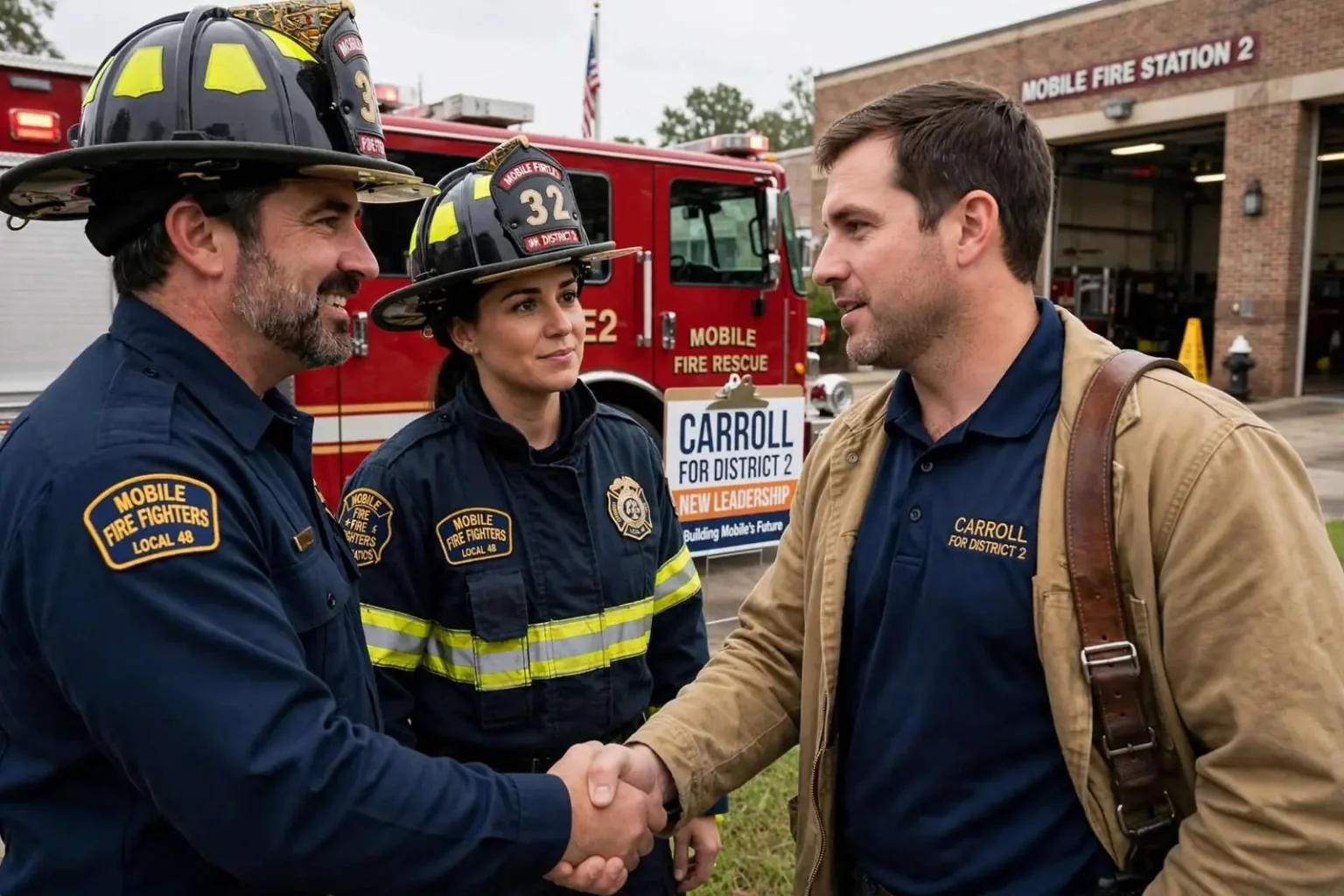
A $5,000 contribution from the Mobile Fire Fighters Association helped fuel William C. Carroll’s effort to unseat incumbent District 2 City Councilman Thomas Sullivan in Tuesday’s city elections, according to the challenger’s final pre-election financial report. The firefighters’ check was the single most visible sign of organized labor’s interest in a race that pitted a 35-year-old general contractor against one of the council’s longest-serving members.
Carroll opened the reporting period with a balance of $367.97, raised $15,640 in cash contributions and spent $6,694.05, entering the race’s final days with $10,253.92 on hand. His fundraising roughly matched that of the incumbent, signaling a genuinely competitive contest in one of the city’s most closely watched council districts.
For a challenger, matching an incumbent’s money is itself an achievement. Sullivan began the race with two decades of name recognition, a network of supporters built over six terms and the natural fundraising advantage of holding office. Carroll’s report shows a campaign that assembled its financial base in a single reporting cycle, drawing on unions, businesses and individual donors rather than a long-accumulated war chest.
A veteran incumbent, a crowded field
Sullivan had occupied the District 2 seat since 1989, and Carroll was not his only challenger; Johnny Burroughs and Jeffery Jones were also contending for the seat. Should no candidate win a majority on Tuesday, a runoff election would follow on September 13, potentially stretching the campaign into the fall.
Mobile’s council districts each elect a single member to the seven-member body, and incumbents historically enjoy substantial advantages in low-turnout municipal elections. A field of three challengers, however, can split the anti-incumbent vote — or, in a district where dissatisfaction runs deep, combine to deny the incumbent the majority he needs to avoid a runoff. The September 13 date loomed over the race’s final days as both a threat to the incumbent and a lifeline for challengers who survive to a second round with money still in the bank.
Carroll’s $10,253.92 cash position at the close of the reporting period gave him exactly that option: enough for a final advertising push before Tuesday and, if the race extended, a reserve for a runoff campaign. Sullivan, whose own reports showed comparable fundraising, faced the same arithmetic with the added burden of defending a 24-year record.
Carroll’s donors
Beyond the firefighters’ association, Carroll’s largest single contribution was $3,500 from the Republican Senate Victory PAC. Other notable donors included Kappa Alpha Psi Fraternity, Wanda Parrish, Matt Metcalfe, Airland Corporation and Gary Cooper, each at $500.
A cluster of $250 gifts came from Leroy Benton III, Merritt Oil Company, Gulf City Body & Trailer Works, Dixie Leasing and Ronald Snider, among others. Smaller contributions in the $100 to $200 range arrived from a broad mix of individuals and businesses, including Milton Isom, Matthew McDonald, Mary Taylor, Fred Gray, Claude Powe Jr., Thomas Woodford, Gary Cooper and the organization South Alabamians for Good Government. The spread suggested Carroll had assembled support from labor, business and civic quarters alike.
The donor list reads like a cross-section of the district itself. The firefighters’ association represents the city’s professional firefighters, whose union backing typically brings both money and — more valuable in municipal races — shoe leather: members who walk precincts, wave signs and turn out their neighbors. The Republican Senate Victory PAC’s contribution tied the race to state-level Republican politics, a notable investment in a formally nonpartisan city contest. Meanwhile, the presence of Kappa Alpha Psi, one of the nation’s historically Black fraternities with an active Mobile alumni chapter, alongside small businesses such as an oil company, a trailer works and a leasing firm, mapped the district’s civic and commercial networks.
Contributions at the $100-to-$250 level rarely fund television, but they are the backbone of municipal campaigns — paying for yard signs, mail pieces, printing and the incidental costs that accumulate weekly. Dozens of donors at that level also signal an argument beyond money: a challenger with broad, small-dollar support can claim a groundswell that a single large check cannot.
Where the money went
Carroll’s reported expenditures included $2,520 to Cumulus Broadcasting, $500 to the Eichold Company and $100 to Harry Austin, with radio advertising accounting for the largest share of his spending in the period.
Radio remains a mainstay of Mobile campaigns, particularly in districts where voters spend commutes in traffic along the same corridors the campaign is trying to reach. The Cumulus buy placed Carroll’s message on the market’s major stations in the race’s final stretch, when undecided voters are actually paying attention. The $500 payment to the Eichold Company, a long-established local firm, and the $100 itemized to a individual rounded out a spending report that, at $6,694.05, left more than half of the campaign’s cash unspent heading into the election’s final days.
What the numbers say about the race
Financial reports are the most objective evidence available about a municipal race’s intensity, and these numbers tell a consistent story. An incumbent since 1989 being matched nearly dollar for dollar by a challenger — with two other candidates also in the field — is the signature of a district where voters are genuinely reconsidering. Campaign finance in council races also tends to reveal the local power map: which unions are engaged, which businesses are hedging, which civic organizations see a seat as worth investing in.
The firefighters’ $5,000 contribution stands out for more than its size. Public safety unions endorse selectively, and their money usually follows a calculation that a challenger will be more responsive than the incumbent on staffing, pay and the working conditions that shape fire protection in the district. For voters, the endorsement is information: the people who run into burning buildings concluded that the District 2 seat needed a new occupant.
Carroll’s own profile reinforced his pitch. At 35, a general contractor by trade, he offered the campaign argument of a working professional who builds things for a living and wants to bring the same approach to city government — budgets, streets, drainage and development, the bread-and-butter concerns of a council district. Against a 24-year incumbent, youth and occupation function as an implicit contrast without requiring the challenger to attack the man himself.
The runoff math
Every element of the financial report pointed toward the possibility of September 13. A challenger who is outspent hopes for name recognition to carry him; a challenger who is even in money can compete on message all the way through. Should Tuesday produce no majority, the runoff would reset the race — two candidates, eight weeks and whatever remains of the campaign treasuries. Carroll’s $10,253.92 cushion was assembled for exactly that scenario.
For District 2 voters, the final pre-election reports offered the clearest picture yet of the choice before them: a veteran incumbent whose longevity is itself the issue, and a challenger whose fundraising — from firefighters, from a state Republican PAC, from fraternity brothers, from Main Street businesses and from dozens of small donors — suggested that plenty of the district agreed change deserved a chance. The money, as always in politics, was a means rather than an answer; the answer would come Tuesday, and possibly again on September 13.
Municipal races in Mobile are decided in August precisely because city elections are deliberately separated from state and federal cycles, a structure meant to keep council seats focused on local concerns. The trade-off is turnout that can dip into the single digits of registered voters, which magnifies the value of the organized support the financial reports capture. A firefighters’ local can deliver its members to the polls; a fraternity chapter can mobilize an alumni network; a PAC can fund mail. In an election decided by a few thousand voters or fewer, those structures matter more than any broadcast buy.
The reporting period itself is worth reading carefully. Opening with $367.97 and closing with $10,253.92 while spending $6,694.05 means Carroll’s campaign effectively built itself from nothing inside one cycle — raising $15,640 in cash contributions and still banking the majority of it. Incumbents usually show the opposite pattern: a standing balance accumulated over years and modest recent intake, since loyal donors give early and challengers’ giving accelerates late. The shape of these reports therefore captures a race with real movement, in a district whose voters were being asked whether tenure itself had become the issue.
However Tuesday’s vote fell, the pre-election finance reports will remain the record of who believed this seat was winnable — and who was willing to pay for the chance to prove it. The full ledger, from the $5,000 of the firefighters to the $100 of an individual donor, is the measurable footprint of a challenge to one of the longest tenures on the Mobile City Council.