Willie Sugarcapps: Five South Alabama Musicians Unite for Spontaneous Folk Magic
Five Gulf Coast musicians form Willie Sugarcapps, a folk and Americana supergroup blending guitars, banjos and four-part harmony.
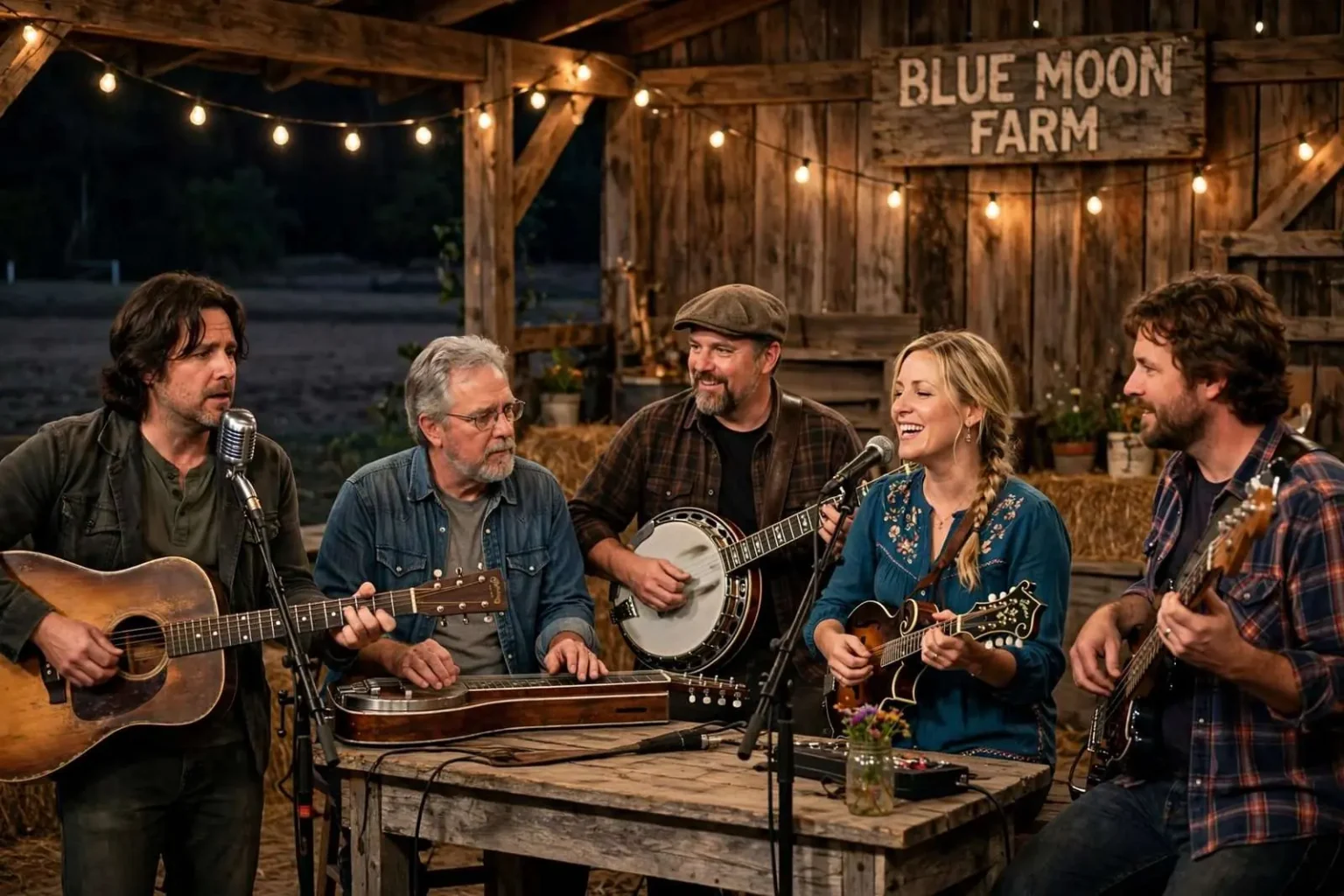
When five accomplished musicians from South Alabama’s Gulf Coast stepped onto the stage at Blue Moon Farm on February 4, 2012, none of them knew they were forming a band. There was no rehearsal, no warm-up, and no set list. What emerged instead was Willie Sugarcapps, a folk and Americana supergroup whose spontaneous chemistry would quickly capture audiences across the region.
Blue Moon Farm, the rustic venue on the outskirts of Fairhope that has long hosted songwriter rounds and acoustic gatherings, provided the unlikely birthplace. Its stage has a tradition of letting musicians who happen to be in town sit in with one another, and on that February night the impromptu combination turned out to be more than a one-off jam — it was the first performance of a group that would spend the next two years building a following across the Gulf Coast and beyond.
A band born on stage
Willie Sugarcapps brings together Grayson Capps, Corky Hughes, Will Kimbrough, and the husband-and-wife duo of Savana and Anthony Crawford, who also perform as Sugarcane Jane. Each name carries its own weight in Gulf Coast music circles. Capps, a singer-songwriter raised between the coast and New Orleans, has built a career on gritty, literary Southern songwriting. Hughes is one of the region’s most respected guitarists. Kimbrough, a Nashville-based veteran, has spent decades as a sideman, producer, and solo artist. And the Crawfords — she from Fairhope, he a seasoned session player and songwriter — had already established Sugarcane Jane as a Gulf Coast staple.
That first evening at Blue Moon Farm, the five musicians improvised their way through songs as fingers flew across guitars, banjos, and mandolins while their voices locked into haunting four-part harmony. No one had planned the blend; it simply happened, the product of five musicians whose instincts had been sharpened by thousands of nights on stage. “We didn’t know we were forming a band,” Grayson Capps recalled. “Playing together was just fun.”
The group’s name came from Johnny Fisher, a former general manager at LuLu’s in Gulf Shores and the House of Blues in New Orleans, who now owns Fisher’s in Orange Beach. Fisher coined the name after watching the ensemble perform at Blue Moon Farm — a fitting authorship, given his career spent at the intersection of the Gulf Coast’s restaurant, music, and nightlife scenes. “Willie Sugarcapps” captured the band’s loose, fanciful spirit well enough that it stuck.
What could have remained a single magical evening instead became a habit. The chemistry that surfaced at Blue Moon Farm proved repeatable — audiences responded immediately, the musicians found the collaboration creatively energizing, and the informal gatherings at the farm grew into a project all five wanted to pursue together.
From Blue Moon Farm to a debut album
After their informal beginnings, Willie Sugarcapps made their official debut at the 30A Songwriters Festival in Santa Rosa, Florida, in January 2013. The festival, held each January along the Scenic 30A corridor of the Florida Panhandle, draws songwriters and Americana acts from across the country, and it gave the band a professional stage on which to present itself — nearly a year to the month after the first accidental performance at the farm.
Bookings accelerated from there, and the band recorded their self-titled debut album on May 6, 2013, with a release date set for August 20, 2013. The quick turnaround — a debut album cut and released within the band’s first eighteen months — reflected both the momentum of its growing schedule and the fully formed quality of the material the members brought with them from their individual careers.
Each member brings a distinct musical identity to the project. Anthony Crawford described the experience of playing with his bandmates as being “at a track meet with people who can anticipate the gun and take off.” The group’s rhythmic intuition allows them to follow each other seamlessly, no matter where a song leads. That anticipation — the ability to hear where a solo, a stop, or a key change is going before it arrives — is the currency of great ensembles, and it was apparent from the band’s first unplayed note together.
A blend of styles rooted in tradition
The instrumentation tells its own story about the band’s range. Between them, the five members cover acoustic and electric guitars, banjo, mandolin, ukulele, lap steel, and bass, with harmonies layered over the top. Arrangements shift from song to song — a Capps tune built on his resonant guitar work can feature Kimbrough’s banjo and the Crawfords’ harmonies, while a Sugarcane Jane favorite gains lap steel and a second lead voice. No instrument or role is fixed, which keeps the band’s sets as fluid as its formation was.
Anthony Crawford’s pedigree as a multi-instrumentalist and producer informs much of the band’s musical map-reading. A veteran of sessions and tours well beyond the Gulf Coast, he joined Savana in Sugarcane Jane as the duo’s anchor, and in Willie Sugarcapps he takes the complementary role — holding the foundation so the others can stretch. Savana’s vocal agility, meanwhile, gives the group the upper register that few baritone-led Americana bands can reach without a dedicated harmony singer.
The musicians all share deep roots in blues, country, and rock and roll, but each contributes something unique. Kimbrough adds banjo, mandolin, and ukulele textures he does not typically feature in his solo work. Hughes layers in lap steel and electric guitar. Crawford anchors songs on bass while Savana Crawford’s vocals reach into Appalachian heights that complement Capps’s deep, New Orleans-inflected baritone. The combination gives the band a wider instrumental and vocal palette than any of its members deploy alone.
“Our music is timeless and universal,” Kimbrough said. “Our styles are different but complementary because they come from the same place. There is chemistry and humanity in the blend of our voices.” His framing gets at the paradox that defines the group: five distinct solo and band careers, five distinct styles, converging into a sound that sounds less like a collaboration and more like a single voice.
For Capps, the four-part harmony opened new creative territory. “I have never had that in my music, but I can now add call and response to my songwriting,” he said. “It is an incredible energy when the voices lock together to make a chord.” Call and response — the call-and-answer pattern rooted in gospel and the blues — gave Capps a way to structure songs around the interplay of voices rather than the voice alone, a tool unavailable to him as a solo performer.
Savana Crawford’s high harmonies against Capps’s baritone became one of the band’s signature sounds, an old-time pairing — the low male lead and the soaring female harmony — executed by musicians whose day jobs in singer-songwriter and roots music rarely call for it. Anthony Crawford’s bass work held the collective’s bottom end, freeing the guitarists to trade leads and textures across the songs’ arrangements.
The band’s commitment to spontaneity remains central to their identity. Rather than polishing arrangements in rehearsal, Willie Sugarcapps thrives on staying fresh and in the moment, channeling decades of individual musical experience into something collectively new each time they take the stage. For a group whose members all maintain separate careers, the refusal to rehearse is partly practical and partly philosophical — the belief that the band’s value lies in what happens when five seasoned players react to each other in real time, unfiltered by arrangement decisions made in advance.
That philosophy mirrors the band’s origin. Willie Sugarcapps exists because a February night at Blue Moon Farm rewarded five musicians for trusting their instincts without a plan, and every show since has been an attempt to recreate the conditions of that first performance: no net, no script, and the accumulated craft of five careers held in reserve for the moment a song needs them.
The Gulf Coast music community, which has produced nationally known songwriters and bands for decades, recognized the significance quickly. Venues from Fairhope to Orange Beach to the 30A corridor booked the supergroup on the strength of what audiences were reporting back — that a band formed by accident had become one of the region’s most compelling live acts. The self-titled debut album, recorded in a single day in May 2013 and released that August, preserved on record what the crowds had been hearing in person.
In an era when bands are assembled by managers and refined by consultants, Willie Sugarcapps remains the rare ensemble whose formation story is genuinely accidental — five friends, one stage, no set list, and a sound that convinced all of them to keep showing up. The music they make together draws on blues, country, and rock and roll traditions that run deep along the Gulf Coast, delivered with the spontaneity that started it all on a February night in 2012.