
Woman Charged in Jason Coulthart’s Death Makes First Court Appearance After 45 Days on the Run
Isabelle Johnson, charged with first-degree murder in Jason Coulthart's death, made her first court appearance after evading arrest for 45 days.
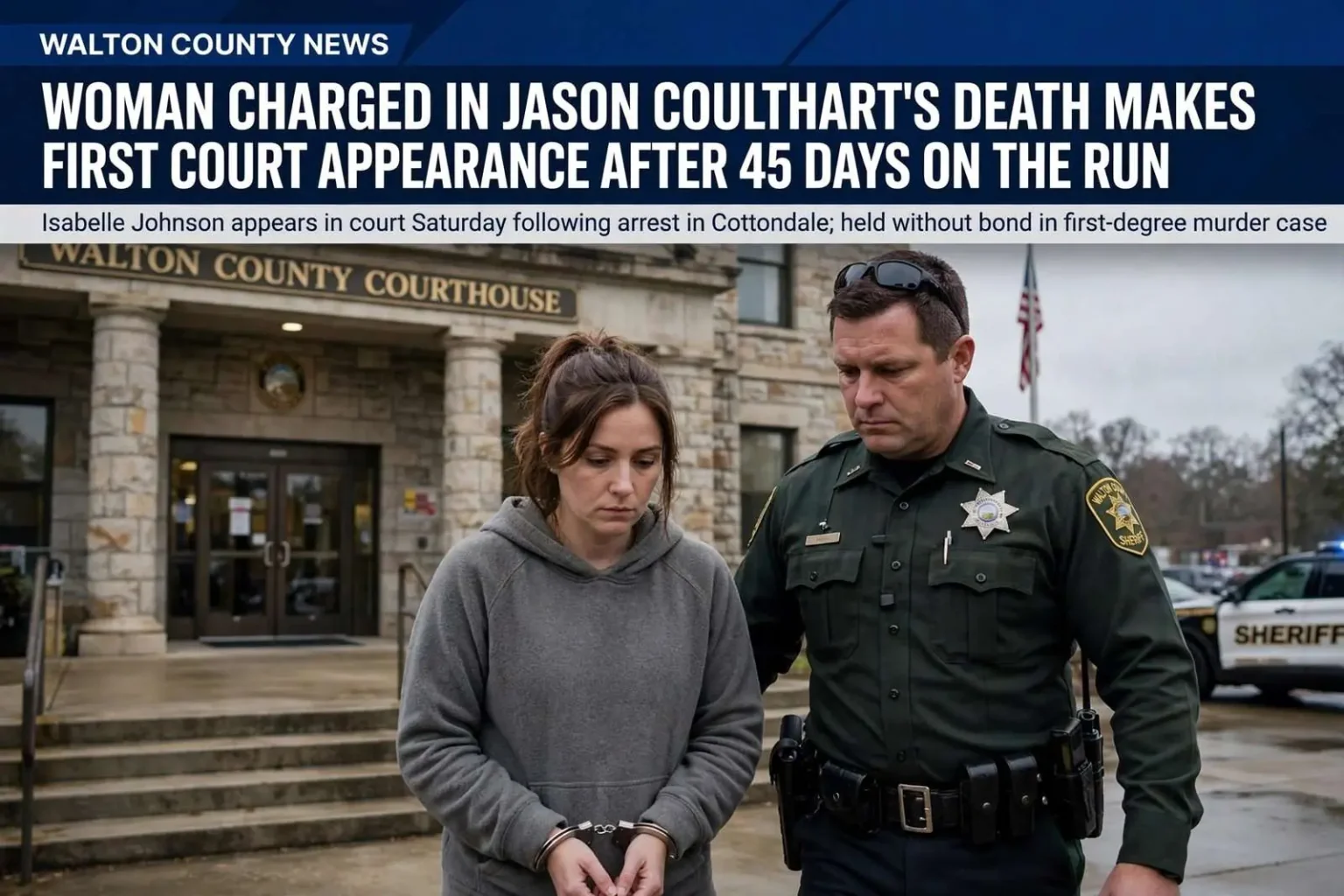
Isabelle Johnson made her first court appearance over the weekend after being arrested in connection with the death of Jason Coulthart, according to authorities. The appearance came after a 45-day manhunt that ended with her capture at a North Florida home, and it opened the next phase of a case that has already drawn charges against six people and, investigators say, may yet draw more.
From the run to the courtroom
Johnson is charged with first-degree premeditated murder and is being held without bond in the Walton County Jail. The charge is the most serious in Florida’s penal code, and a hold without bond is standard in first-degree murder cases, where the decision about pretrial release rests with a court and the presumption runs heavily against it. Her first appearance, held days after her arrest, formally presented the charge and the conditions of her detention as the case moves toward the trial process.
Johnson was extradited from Jackson County on Saturday after spending 45 days evading law enforcement, according to investigators. The extradition moved her from the custody of authorities in Jackson County — where she had been held after her capture — into Walton County, where the charge against her is pending. Forty-five days on the run is a substantial period in a murder case, and the effort that went into locating her reflected the stakes: a first-degree premeditated murder charge leaves no room for investigators to let a fugitive fade into the landscape.
U.S. Marshals Task Force agents arrested her Thursday at her home in Cottondale. The arrest location — her own residence — underscored a truth familiar to fugitive investigators: staying close to home and to familiar networks is among the most common survival strategies for people evading capture, and it is often what ultimately undoes them. The U.S. Marshals Service and its regional task forces specialize in exactly this work, combining federal fugitive authority with local knowledge to track people who have gone underground.
How investigators found her
The Walton County Sheriff’s Office said its Cyber Crimes Unit tracked her down by monitoring her online communications. The unit’s role in the case illustrates how modern manhunts are worked: fugitives communicate — with family, friends and associates — and those communications leave digital traces that trained investigators can follow. The Cyber Crimes Unit, a specialized element within the sheriff’s office, focuses on those traces, and its work in this case proved decisive in locating a woman who had successfully avoided capture for more than six weeks.
“Everybody logs online somewhere so their focus and ability to get that information and really be the resident experts on that really pays off, especially when we have to use every means necessary to capture the bad guy — find the person that we’re looking for,” said Deputy Chief Dustin Cosson of the Walton County Sheriff’s Office. Cosson’s description captured the unit’s premise: in an era when nearly everyone remains digitally reachable, expertise in online investigation has become one of law enforcement’s most reliable tools for finding people who do not want to be found.
The 45-day search also demonstrated the coordination required among multiple agencies. Local investigators in Walton County, the U.S. Marshals Task Force that made the arrest in Cottondale, and the Jackson County authorities who held Johnson after the capture each played a role in moving her from fugitive to defendant — a chain that ended Saturday with her extradition and, over the weekend, her first appearance before a judge.
Five others already charged
Investigators said they are still working to determine who else may have helped Johnson evade capture. The question of assistance is central to the case: a 45-day flight rarely succeeds without help — someone providing money, transportation, a place to stay or information about the movement of law enforcement. Each of those forms of aid carries its own legal exposure, and investigators reviewing the timeline of the manhunt will be examining who had contact with Johnson and what they provided.
Five other people are already facing accessory-after-the-fact-to-capital-murder charges in connection with the case: Martin and Sandra Leaverton, Bobbie Wagstaff, Kathleen Morris and Michael White. The accessory-after-the-fact charge applies to people whom authorities accuse of helping after a crime has been committed — shielding a suspect from arrest, warning them of police activity or assisting their flight — rather than participating in the underlying act itself. Under Florida law, accessory-after-the-fact to a capital felony is a serious felony in its own right, reflecting the state’s position that helping a murder suspect escape justice is not a lesser act of loyalty but a crime that prolongs the harm.
All five were scheduled to appear in court this week. The cluster of court dates — the alleged principal’s first appearance over the weekend and the five accessory defendants’ appearances in the days following — marked the transition of the case from investigation to prosecution, with a prosecutor now responsible for assembling what each defendant did, and when, into a coherent account for a jury.
What may come next
Investigators said they believe additional charges are possible as the case continues. That warning, standard in complex multi-defendant prosecutions, carries particular weight here given the open question of who assisted the 45-day evasion. If the Cyber Crimes Unit’s digital evidence and the marshals’ investigation identify others who sheltered or supported Johnson during the run, those individuals could join the six already charged. Conversely, charges against those already in custody could be amended or expanded as the picture of the case sharpens.
The case’s arc to this point has showcased the layered machinery of a modern murder prosecution: the original investigation into Coulthart’s death, the identification of Johnson as a suspect, the formal charge of first-degree premeditated murder, the multi-agency manhunt that spanned county lines and 45 days, the cyber investigation that located her, and the marshals’ arrest that brought her into custody. Each stage involved different units and different agencies, coordinated toward the single outcome that a weekend court appearance now represents.
For the Walton County Sheriff’s Office, the arrest closed one chapter and opened another. The Cyber Crimes Unit’s role — highlighted by the deputy chief as the difference between a fugitive found and a fugitive lost — has become a template the office and agencies like it cite when explaining why digital investigation capability belongs in departments of every size: in a world where everyone leaves online traces, the people who know how to read those traces hold the advantage in almost every manhunt, and the 45 days Johnson spent running ultimately ended not on a highway or at a border, but at home, with the evidence of her own connections leading authorities to her door.
As the defendants move through the court system, investigators continue their work on the questions that remain — who else may have helped, and whether the full architecture of the flight, once mapped, will bring further names into the case. Additional court proceedings are expected in the coming weeks as each of the six charged answers the accusations before a judge.
The manhunt in context
Fugitive investigations of this length test every resource a sheriff’s office can bring to bear. During a 45-day run, investigators must maintain the case even as leads age: re-interviewing associates, monitoring known locations, coordinating with other departments when the fugitive is believed to have moved, and keeping the public engaged through requests for tips. The physical search and the digital search run in parallel, and in this case the digital effort — the Cyber Crimes Unit’s monitoring of Johnson’s online communications — produced the break that the street-level search had not.
The involvement of the U.S. Marshals Task Force is likewise standard in serious felony manhunts. The marshals’ fugitive teams bring nationwide reach, database access and dedicated personnel to cases where a local agency’s resources would be stretched thin, and their joint operations with county offices routinely end with arrests in the kind of quiet residential settings — like the Cottondale home where Johnson was taken — where fugitives believe themselves safest.
First-degree premeditated murder, the charge Johnson now faces, requires the state to prove a killing that was willful, deliberate and premeditated. It is the grade of homicide for which Florida law provides the harshest penalties, and cases at this level move through the system with a thoroughness that reflects those stakes — from the first appearance and bond determination through discovery, pretrial motions and, eventually, trial. Held without bond in the Walton County Jail, Johnson will await those proceedings in custody, as defendants charged with capital-grade offenses ordinarily do.
The road ahead for the case
The weekend’s court appearance and the week’s docket of accessory defendants mark the start of a long process rather than the end of one. Multi-defendant felony cases generate years of activity — separate attorneys, separate trial strategies, plea negotiations and scheduling conflicts — and the possibility of additional charges that investigators have flagged could enlarge the cast further. For the family and community of Jason Coulthart, the progression of six defendants from wanted or uncharged to formally accused represents the justice system’s first concrete movement in a case that began with his death.
What investigators emphasized in the aftermath of the arrest was continuity: the same Cyber Crimes Unit monitoring that found Johnson continues to review evidence, the same question of who helped her evade capture for 45 days remains under active investigation, and the same prosecutors who will handle the accessory cases are assembling the murder case that stands at the center of them all. The manhunt is over; the accounting has begun.


