Woman dies in three-vehicle crash on Destin bridge
A woman died in a three-vehicle crash on the Destin Marler Bridge after a GMC failed to slow and struck a Toyota, troopers said.
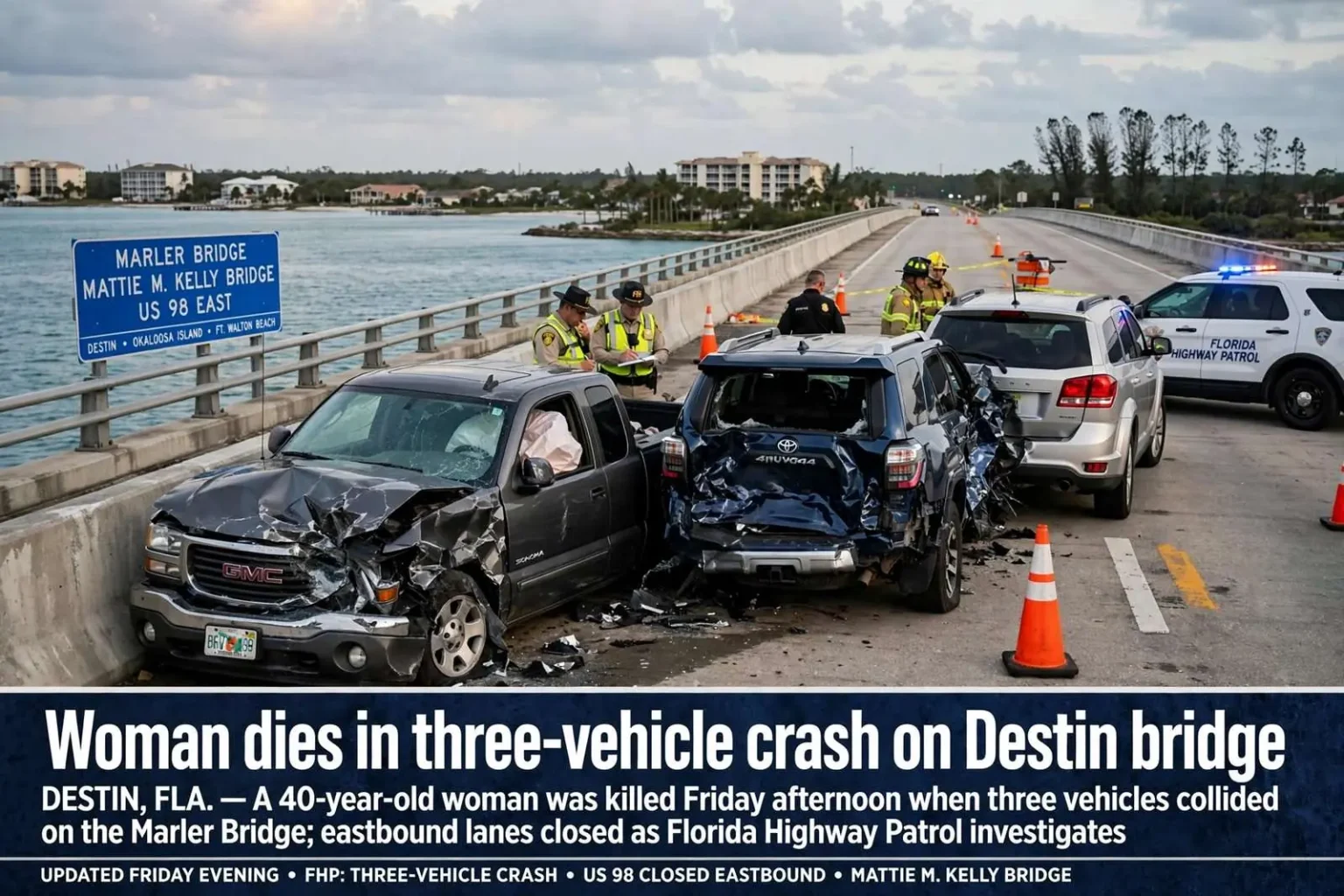
DESTIN, Fla. — A woman has died in a three-vehicle crash on the Destin bridge, the Florida Highway Patrol said. The crash happened in an eastbound lane of the Marler Bridge, the span that carries U.S. 98 over Choctawhatchee Bay and connects Destin to Okaloosa Island and Fort Walton Beach. Troopers said a GMC Sonoma, a Toyota 4Runner and a Dodge Journey collided Friday afternoon in a chain-reaction sequence that closed eastbound traffic at one of the region’s busiest crossings at the height of the travel day.
According to the Florida Highway Patrol’s preliminary account, the drivers of the Toyota and the Dodge had slowed for traffic ahead on the bridge. The driver of the GMC, identified as Larry Hopson, failed to slow in time and slammed into the back of the Toyota, which was then pushed forward into the Dodge. The force of the initial impact proved catastrophic for the front passenger in the GMC: Hopson’s 40-year-old passenger died in the crash. Her name will be released after next of kin are notified, which is standard practice for the patrol in fatal crashes.
Bridge crashes present challenges that set them apart from wrecks on ordinary roads. The Marler Bridge offers narrow shoulders, limited escape routes and no room for drivers to maneuver around a stopped or slowing line of traffic, so any sudden slowdown compresses the traffic flow into a chain of vehicles with little margin for error. Once a crash occurs, the bridge has few ways on or off, meaning emergency crews must work in close quarters while traffic backs up in both directions until the roadway can be cleared.
Troopers investigating a fatal three-vehicle collision will reconstruct the sequence with exacting care, documenting each vehicle’s final position, the point of impact and the damage transfer between vehicles to establish who struck what, and in what order. Speed, following distance and any sign of impairment or distraction all become questions to answer. In rear-end chains like this one, the lead vehicles’ drivers are typically viewed as having little opportunity to avoid the crash, while the driver of the striking vehicle faces the central questions about why he did not slow in time.
The death marks another hard afternoon on a crossing that tens of thousands of drivers use every day, particularly during tourist season when bridge traffic swells with visitors moving between the beaches of Destin and the communities to the west. For the family of the woman who died, the notification process that follows such a crash is the first step in a long road; for the drivers and passengers in the other two vehicles, the physical and emotional aftermath of a bridge collision often lingers well after the roadway reopens.
The Marler Bridge and its traffic burden
The Marler Bridge — formally the Mattie M. Kelly Bridge — opened in the mid-1990s as the eastern of two crossings over Choctawhatchee Bay on U.S. 98, the coastal highway that ties together the beach communities of Okaloosa County. Together with the Brooks Bridge to its west, it funnels the daily flow of commuters, beachgoers and freight between Destin’s resort corridor and Fort Walton Beach and Okaloosa Island. In summer, when the panhandle’s population swells with visitors, the bridge routinely carries traffic volumes far beyond what the road network was designed for, and afternoon slowdowns on the span are a familiar experience for anyone who has visited the Emerald Coast.
That congestion is more than an inconvenience — it is the backdrop against which rear-end crashes happen. Stopping and starting traffic on a high bridge, with sight lines limited by the crest of the span and drivers distracted by the water and the beaches on either side, creates exactly the conditions where a moment of inattention produces a collision. Traffic safety engineers have long noted that speed differential, not speed alone, is what makes rear-end crashes dangerous, and a bridge where some vehicles are slowing while others are still at highway speed is a textbook setting for it.
What happens after a fatal crash
In the hours after a fatal collision, the Florida Highway Patrol’s work follows a well-established path. The roadway must be investigated and cleared before traffic can resume, and on a bridge crossing that means significant delays in both directions. Investigators photograph and measure the scene, examine each vehicle, and interview drivers and witnesses while their memories are fresh. Any charges, if warranted, typically come after the investigation is complete rather than at the scene, and the patrol’s final report becomes the public record of what happened.
The identification process for the victim follows its own protocol. Authorities withhold the name of a deceased person until family members have been notified, both out of respect for the family and to ensure that next of kin learn of the loss from officials rather than from news reports. Once the notification is complete, the name is released with the patrol’s final details of the crash.
Rear-end crashes and passenger risk
The front passenger seat in a vehicle struck from behind at speed is among the most dangerous places to be in a highway collision, a reality this crash illustrates in the hardest way. Modern vehicles are engineered with crumple zones and restraint systems that absorb and distribute the forces of a crash, but the physics of a high-speed rear impact — particularly when the struck vehicle is then driven forward into a third — expose occupants to multiple impacts in a fraction of a second. Investigators will examine restraint use as part of their work, though the patrol’s initial statement did not address it.
Three-vehicle crashes also complicate the aftermath for everyone involved. Drivers and passengers in the middle and trailing vehicles often sustain injuries that are not immediately apparent, and emergency crews routinely transport multiple patients from chain-reaction collisions to be evaluated. The vehicles themselves are typically towed from the scene, adding insurance claims and repair timelines to the immediate medical and legal questions that follow.
Troopers urge drivers crossing high-traffic bridges to maintain generous following distances, put phones away, and prepare for sudden slowdowns — the three habits that most directly reduce rear-end crashes. On a span like the Marler, where a fender-bender can close the only practical route for miles, those habits protect not just the vehicles involved but the thousands of drivers stacked up behind them.
A community reminded
For Destin and the surrounding beach communities, a fatal crash on the bridge is a sobering interruption of the routine that carries residents and visitors back and forth every day. Locals know the span’s slowdowns and its crest, and visitors learn them quickly during tourist season. The death of a 40-year-old woman in an afternoon collision — in traffic, on a bridge crossed by thousands daily — underscores how ordinary the setting was and how suddenly it turned deadly.
The Florida Highway Patrol has not released the victim’s name, pending notification of her next of kin, and has not announced any charges. The investigation remains active, and additional details — including the conditions of the other drivers and any findings about speed or distraction — will come in the patrol’s final report. Until then, the eastbound lane where three vehicles collided on Friday afternoon has returned to the everyday flow of bridge traffic, carrying with it the memory of how quickly that flow can go wrong.
Emergency response on a bottleneck crossing
When a serious crash happens on the Marler Bridge, the response is shaped by geography as much as by medicine. Fire and rescue units must reach the scene from one end or the other, and with the bridge blocked, ambulance crews face the same standstill as everyone else. Wreckers capable of clearing multiple damaged vehicles have to be dispatched through backed-up traffic, and investigators cannot release the scene until their documentation is complete — a sequence that routinely turns a single afternoon crash into hours of closure on a crossing with no detour short of the island routes to the east.
Local agencies have refined their playbook over years of bridge incidents. Variable message signs and alerts warn approaching drivers to seek alternate routes, law enforcement directs traffic at the bridge approaches, and tow operators prioritize clearing travel lanes once the injured are cared for. The coordination works, but it depends on drivers heeding the warnings to stay away, and every bridge closure tests the region’s limited alternatives across the bay.
For the families of those involved, the hours after a crash like Friday’s move slowly — waiting at the scene, then at hospitals, for word of loved ones and for the official account of what happened. The patrol’s procedure ensures that the details are established carefully, but careful work takes time, and a community that watched the bridge close for the afternoon was left with little information beyond the essentials: three vehicles, one fatality, and a driver who, troopers say, did not slow in time.