Work Begins on Bay Minette Mega-Site Enhancements
Heavy machinery has begun moving earth at Baldwin County's 3,000-acre mega-site near Bay Minette as work starts on nearly $7 million in rail and site.
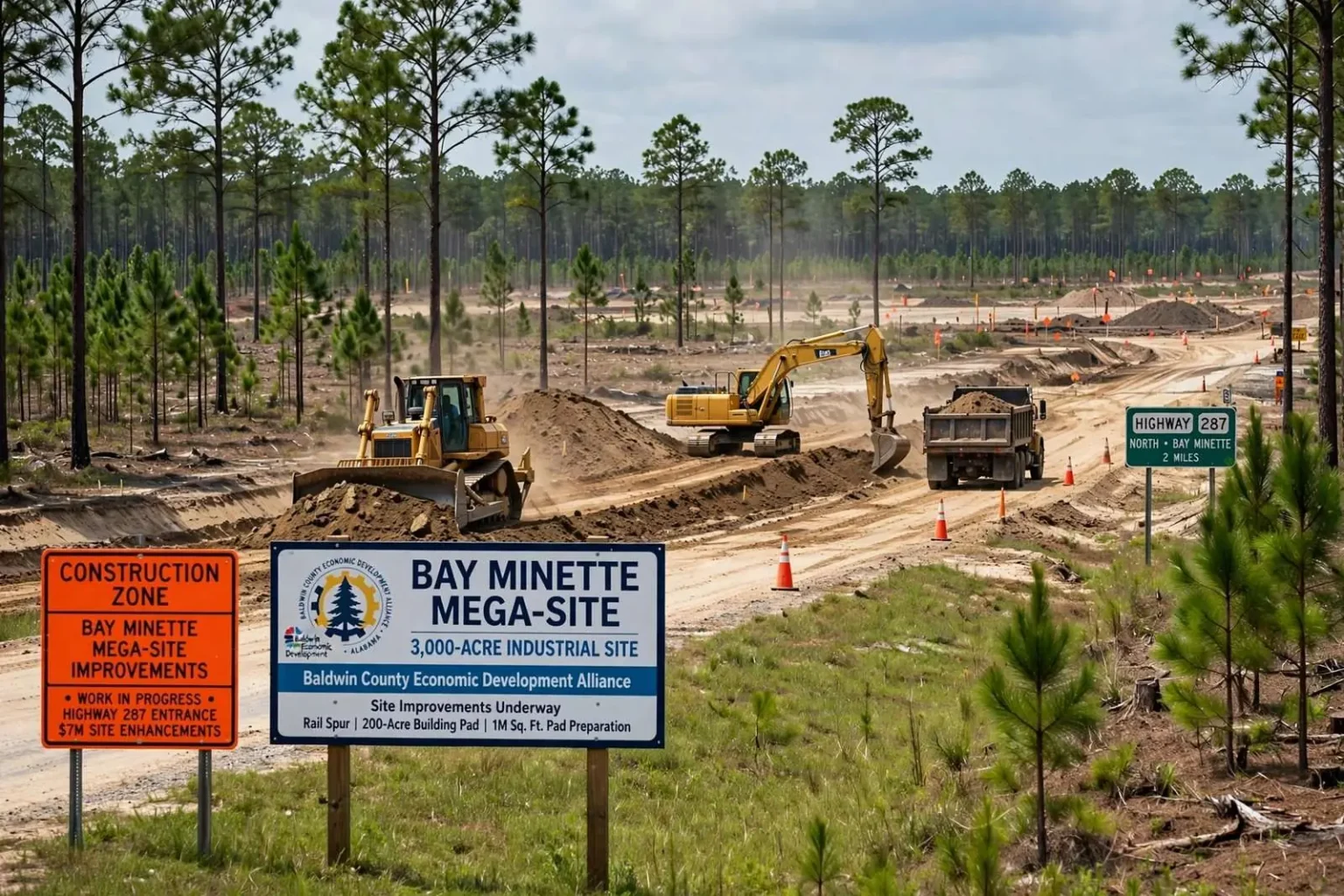
BAY MINETTE, Ala. — Heavy machinery is already moving earth at the entrance to Baldwin County’s 3,000-acre mega-site, as work begins on millions of dollars in improvements aimed at making the property more attractive to major industry. Crews have started grading near the entrance on Highway 287, just north of Bay Minette — the first visible sign of a construction program designed to transform a vast tract of raw land into something manufacturers and distribution companies can act on.
The work now underway covers a defined sequence. Over the next month, work is scheduled to begin on extending a rail spur into the property, grading a 200-acre building pad, and preparing a roughly 1 million-square-foot building pad on the site. Each element targets a specific obstacle between a prospect and a deal. The rail spur connects the site to the freight network that heavy industry depends on for raw materials and finished goods. The 200-acre pad gives a large manufacturer the flat, prepared ground a major plant requires, ready rather than raw. The million-square-foot pad anticipates the warehouse and distribution buildings that have become the largest single category of industrial demand across the Gulf Coast — structures big enough that most sites cannot accommodate them without exactly this kind of advance preparation.
From County Hands to the Alliance
The construction push became possible because of an administrative move made earlier this summer: the property was transferred from the county to the Baldwin County Economic Development Alliance, the public-private organization that leads industrial recruitment for the county. The transfer was made so the alliance could pursue grant funding for the enhancements — a distinction that matters in the competition for state and federal money, where economic development organizations are often better positioned than county commissions to apply for, receive and administer infrastructure grants. With the site under the alliance’s control, the funding applications and the construction program could move together.
The scale of the investment is significant for a single site: over the next two years, close to $7 million is expected to be invested to improve access to both interstate and rail service. That figure covers the improvements that make a distant tract of land reachable in every sense — road access adequate for heavy trucks and construction traffic, rail service extending to the pads where plants would stand, and the site work that lets a prospect visualize, on a visit, exactly where its building would go.
Why a Mega-Site, and Why Here
The mega-site has long been viewed as a key tool for recruiting large manufacturers and distribution operations to Baldwin County, offering the kind of shovel-ready, rail-served acreage that major employers often require. The logic is rooted in how industrial location decisions actually work. Large manufacturers — an automotive supplier, a food processor, a building-products plant — typically need hundreds of acres, rail access, interstate proximity and utilities, and they need them quickly: a company that picks a site wants to break ground within months, not years. Communities that wait until a prospect appears to begin assembling those ingredients lose to communities that prepared in advance.
Baldwin County’s geography gives the site its strategic value. The county sits between Mobile’s port and industrial corridor and the Florida Panhandle’s markets, with Interstate 10 running east-west through the county and Interstate 65 running north from the coast. Rail lines cross the county, connecting it to the national freight network. Bay Minette, the county seat, sits near the northern edge of the population centers, where land is available in the quantities a mega-site requires and highway access is straightforward. A 3,000-acre tract in that location — one of the largest industrial sites in south Alabama — is the kind of property that appears on site-selection consultants’ lists long before a single pad is graded.
The economic stakes for Baldwin County are considerable. The county has grown into one of Alabama’s economic powerhouses on the strength of tourism, construction and residential growth, but its leaders have long sought a deeper industrial base — employers that bring manufacturing wages, diverse employment and a cushion against the swings that tourism-dependent economies experience. A single large plant on the mega-site would ripple through the county’s economy in wages, supplier contracts and the service businesses that follow industrial payrolls. Distribution operations, while employing fewer people per square foot than manufacturing, bring steady logistics employment and reinforce the county’s position along the freight corridors connecting the Port of Mobile to the Southeast.
The mega-site concept has spread across Alabama precisely because of results elsewhere in the state. The state’s experience with prepared megasites — most famously in regions that landed automotive and aerospace plants — taught economic developers that the difference between winning and losing a project often comes down to whether a suitable site was ready when the search began. Alabama’s certification programs and grant streams now support counties in exactly the work Baldwin County has begun: buying, assembling and preparing large tracts so that the state can compete for projects that would otherwise pass it by.
What the Construction Sequence Buys
Each element of the current work answers a question a prospect asks. Can rail reach my building? The spur extension answers yes. Can I put a large plant on flat, prepared ground without spending a year moving dirt? The 200-acre pad answers yes. Can a million-square-foot distribution building actually be sited here, with truck access and clearances to match? The large pad under preparation answers yes. Site selectors rate properties on these criteria with checklists, and a site that answers them in advance moves to the top of the list; a site that answers them with promises does not.
The two-year, roughly $7 million program also signals commitment to the property’s neighbors and to the county’s residents. Industrial sites can sit for years as paperwork, and communities’ belief in them fades. Visible progress — grading equipment at the Highway 287 entrance, a spur taking shape, pads emerging from the pine flatwoods — demonstrates that the county’s recruitment effort is real and ongoing. Bay Minette residents, who have watched the mega-site concept develop over years, will see the work itself as the report on how it is going.
The Road Ahead
The next milestones are the ones the schedule has already set: rail spur extension beginning within the month, the pads taking shape over the seasons that follow, and the access improvements accumulating toward the two-year mark. The property, now under the Baldwin County Economic Development Alliance, will continue to be marketed while it is improved — the two activities reinforce each other, because a site under active construction is a site a prospect can believe in. Whether the mega-site’s first major employer signs during the improvement program or after it, the work underway north of Bay Minette is what turns 3,000 acres of possibility into a place where a company can actually build.
The grant strategy behind the county-to-alliance transfer reflects the current funding landscape for industrial site development. Federal infrastructure programs, state site-preparation grants and utility partnerships have become the principal sources of money for the kind of advance work the mega-site needs, and those programs generally require an eligible applicant with a direct stake in the property. Baldwin County’s arrangement places the alliance in that role, aligning the site’s ownership with the organization whose mission is filling it. Close to $7 million over two years, assembled from grants and partner contributions, is the practical product of that alignment.
The improvements themselves also build on the region’s freight identity. Mobile’s port has expanded into one of the fastest-growing deepwater ports in the United States, drawing warehouses and distribution centers along the corridors that connect it to inland markets — and Baldwin County sits directly in that path. Interstate 10 through the county carries freight from the port toward Pensacola, Tallahassee and the wider Southeast, while Interstate 65 links the region north toward Montgomery and the Midwest. Rail lines through the county connect to the Class I networks that move the nation’s bulk freight. A rail-served, interstate-adjacent mega-site in that geography is positioned to catch manufacturers and distributors that want Gulf Coast access without Gulf Coast port pricing.
A Long Game Reaching a New Stage
Mega-site development rewards patience, and Baldwin County’s project illustrates the timeline such efforts require. Years pass between the assembly of a large tract and the arrival of its first employer — years of title work, environmental review, planning approvals, utility negotiation and site preparation, all conducted before a single hiring notice exists. Communities that sustain the effort do so because they understand the arithmetic: the land is not getting cheaper, the growth is not slowing down, and the projects that would transform the county’s economy go to whichever community is ready.
The work visible now at the Highway 287 entrance — the grading crews, the pads, the rail spur to come — marks the transition from that long preparation to a demonstrably active project. Over the next month, the spur extension and pad grading begin; over the next two years, the roughly $7 million in access improvements accumulate. The Baldwin County Economic Development Alliance continues to market the site while the work proceeds, and the county watches its 3,000-acre bet on industrial recruitment move, at last, from concept to construction.