
Wynton Marsalis and the Jazz at Lincoln Center Orchestra Play the Saenger Monday
Wynton Marsalis and the Jazz at Lincoln Center Orchestra brought a rare big-band night to Mobile's Saenger Theatre, with deep student discounts.
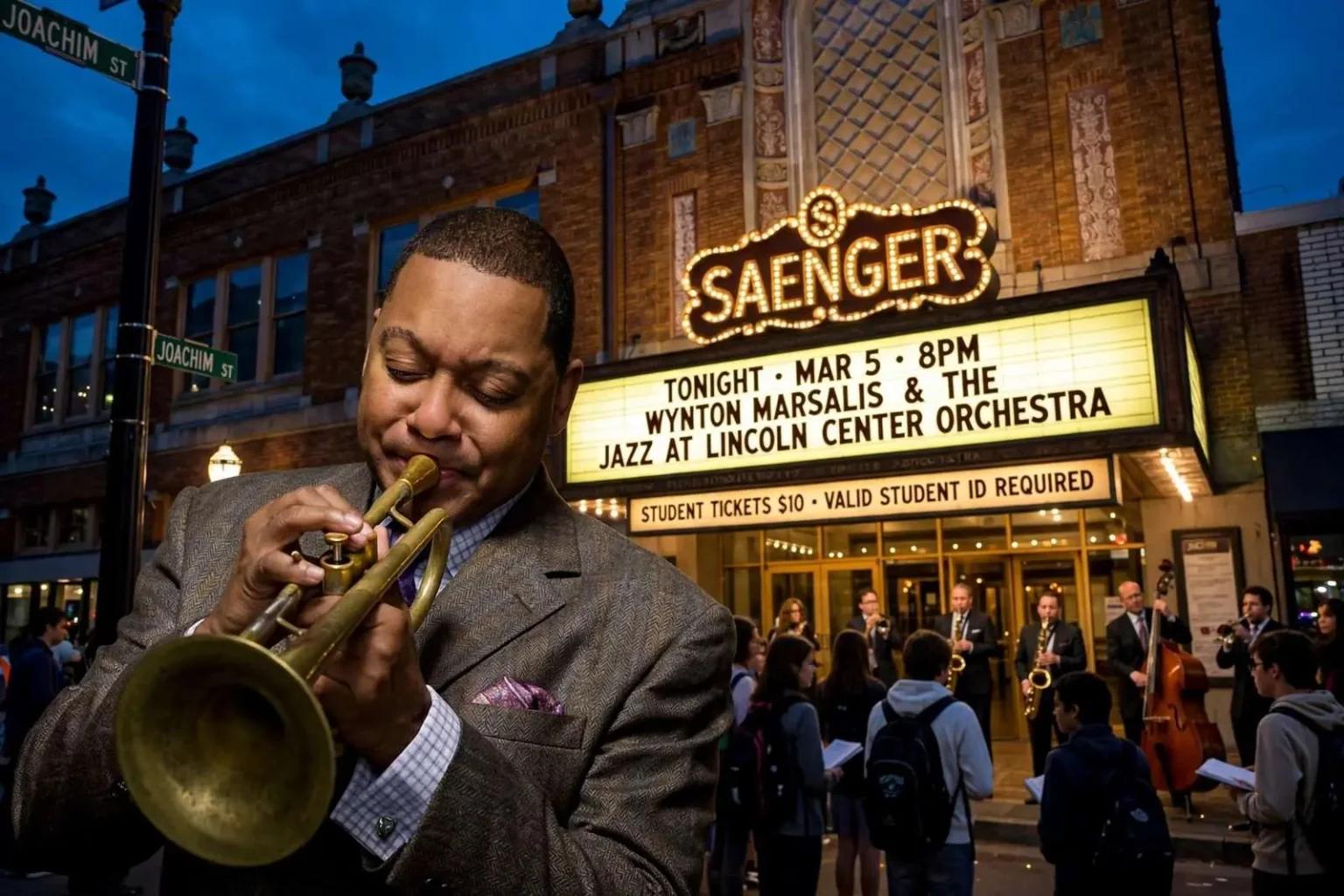
Wynton Marsalis and the Jazz at Lincoln Center Orchestra made a rare Mobile appearance at the Saenger Theatre on Monday, March 5, 2012 — a stop local jazz fans were urged not to miss. For one night, downtown Mobile hosted one of the masters of modern jazz leading the most celebrated big band in American music.
The visit came with a steep student discount designed to fill seats with young players. Tickets were priced at $10 for high school students and $25 for college students, service fees applied, with a valid student ID required at the box office at the time of purchase. Regular tickets were available through Ticketmaster, giving the region’s general audiences the usual online and phone routes to the box seats.
The pricing structure told the story of the visit’s ambition: this was not merely a concert for the established fans of big band music, but a deliberate effort to put Mobile’s young musicians — the trumpet players, saxophonists and drummers filling band rooms across the Gulf Coast — into the same hall as the band that defines the form.
The man leading the band
Wynton Marsalis stands nearly alone in American music. A trumpeter from New Orleans, the birthplace of jazz, he rose to prominence in the early 1980s and went on to collect Grammy Awards in both jazz and classical categories in the same year — a feat no other artist has matched. In 1997 he became the first jazz musician to win the Pulitzer Prize for Music, honored for his epic oratorio “Blood on the Fields.”
As artistic director of Jazz at Lincoln Center, the organization he helped shape in New York, Marsalis has built the most visible platform jazz has had in generations. The orchestra he leads is a repertory big band in the truest sense: fifteen of the finest improvisers and section players in the world, carrying the arrangements of Duke Ellington, Count Basie, Thelonious Monk and the other architects of the music, alongside new works written for the ensemble.
The orchestra tours internationally and stages concerts year-round at its home in Manhattan’s Columbus Circle, but appearances on the Gulf Coast are rare. That scarcity was part of the urgency local fans felt about the March 5 date — an evening with Marsalis and the orchestra was not something the Mobile calendar offered often, and might not offer again for years.
The Saenger, Mobile’s grand old hall
The Saenger Theatre has been downtown Mobile’s showplace since 1927, a movie palace built in the grand style with ornate detailing and the atmospheric touches that defined the great American theater houses of the era. Restored and maintained across its long life, the Joachim Street landmark hosts touring Broadway productions, concerts and comedy bookings, and remains one of the city’s most treasured cultural venues.
The room suits a big band well. Its acoustics were designed in an age when orchestras and stage shows filled theaters without amplification, and the hall’s warm, live sound gives brass and saxophone sections a resonance that modern clubs and arenas cannot replicate. For a repertory orchestra playing the classic big band book, the Saenger is precisely the kind of hall the music was written for.
The theater sits in the heart of downtown’s entertainment district, within walking distance of the restaurants and bars of Dauphin Street, and a Monday night concert there brought crowds to a part of the city that has seen its fortunes rise with downtown’s renewal. Concert nights on Joachim Street have long been part of the rhythm of cultural life in Mobile.
A city with jazz in its ear
Mobile’s connection to jazz runs deeper than one touring date. The city sits at the western edge of the Gulf Coast corridor that runs to New Orleans, and the musical currents that flowed out of the Crescent City in the early twentieth century moved through Mobile’s vaudeville houses, dance halls and neighborhood clubs on their way around the world. Generations of Mobile musicians grew up with the brass band tradition, the blues and the big band repertoire within earshot.
By the time Marsalis and the orchestra took the Saenger stage, the city’s younger players had their own places to learn the music — school jazz bands, community ensembles and the clubs that host working musicians along Dauphin Street. The $10 ticket price for high school students was aimed squarely at that population: the teenagers who would understand, watching the band from a few rows back, what it takes to play at that level.
Music educators across the region understood the opportunity. Students who sit in band rooms working through scales and swing charts rarely see the music’s highest expression performed live, and a full performance by the leading big band in the world — in their own city, for the price of a movie ticket — was a master class disguised as a concert.
What the audience heard
The Jazz at Lincoln Center Orchestra’s repertoire draws on the whole sweep of the music: Ellington masterpieces, Basie swing, bebop standards, New Orleans roots and contemporary commissions. Marsalis, a composer and historian as much as a performer, often narrates the program from the stage, tracing the lineage of each piece and introducing the soloists whose improvisations carry each arrangement.
Big band performance is a team sport played at the highest individual level. The orchestra’s sections — trumpets, trombones, saxophones and a powerhouse rhythm section — trade ensemble precision for extended solos from one show to the next, and no two performances of the same program are alike. That balance of structure and freedom is the heart of jazz, and it is what distinguishes the orchestra from any other touring ensemble of its kind.
For Mobile audiences, the Monday night date offered something else as well: the chance to hear the music played at the tempo and volume it was meant for, in a hall built for exactly that sound. Audiences at Saenger shows often remark on the intimacy of the room, and a fifteen-piece orchestra at full swing fills it to the brim.
The box office details that shaped the night
The student pricing carried conditions worth noting for anyone planning a trip to the box office: a valid student ID was required at the time of purchase, and service fees applied on top of the advertised $10 and $25 prices. Even with the fees, the discount represented a fraction of the cost of an orchestra seat in larger markets, where touring jazz programs often price well beyond student budgets.
Regular tickets moved through Ticketmaster, the national ticketing service, as well as through the theater’s own outlets. The arrangement was standard for Saenger touring shows, letting buyers choose between online convenience and the box office window — with the student discount available only in person, at the window, with ID in hand.
The discount’s design said something about the promoter’s intent. By requiring the ID at purchase and limiting the offer to the box office, the pricing scheme targeted students specifically rather than the general public, ensuring the young-musician seats the offer was meant to fill actually got filled.
A rare stop on a national circuit
The Jazz at Lincoln Center Orchestra’s touring calendar is dense and international, taking the band to major concert halls across Europe, Asia and the Americas each season. Smaller Gulf Coast markets rarely appear on that itinerary, which is what made the Mobile date unusual — and what made the local push to fill the hall feel like a limited opportunity rather than the first of many.
Touring stops of this kind depend on presenters willing to book a fifteen-piece orchestra into a regional theater, a booking that carries real logistics: travel and lodging for the band, the theater’s technical riders and a marketing budget aimed at an audience that may see the orchestra once in a decade. The Saenger’s booking on March 5, 2012 placed Mobile on the same map as the orchestra’s much larger markets for at least one night.
For local promoters and the theater’s staff, the student pricing served a practical purpose too. A Monday date in early March is not the easiest sell on a theater calendar, and filling the house with young players and their families builds the kind of full-room energy that touring artists remember and that presenters hope will justify a return visit.
The education argument for jazz
Marsalis has spent decades making the case that jazz is essential education — that learning to play the music teaches discipline, listening, cooperation and the history of the country that created it. His organization’s education programs reach thousands of students each year, and the discounted seats offered in Mobile were an extension of that philosophy: get the young players into the hall, and let the band do the teaching.
The argument has local resonance. School music programs across south Alabama have long relied on community support to fund instruments, travel and instruction, and exposure to world-class performance is the rarest and most motivating form of that support. A teenager watching the orchestra’s horn sections lock into an Ellington passage hears, in a single moment, what years of practice are aiming at.
The students in the hall that Monday saw working musicians at the peak of the profession. They saw how a bandleader communicates without stopping the music, how soloists listen to each other before they play, and how a section rehearsed to precision still leaves room for invention. Those are lessons no classroom can fully deliver.
One night in downtown Mobile
When the lights came down at the Saenger that Monday evening, downtown Mobile held the same kind of crowd that Manhattan’s halls hold for the orchestra’s home performances — an audience spanning devoted jazz fans, curious first-timers and the students whose $10 tickets the pricing scheme had been built for.
The visit joined a line of significant cultural bookings that have marked the Saenger’s modern era, and it remains a touchstone for the Gulf Coast jazz community: the night the most celebrated big band in American music came to town, and the city’s young players were given every reason to be in the room.
For one night, the masters of the music played Mobile’s grandest hall, the student seats were full, and the connection between the city’s musical past and the living tradition of jazz was heard in every chart the orchestra performed.


