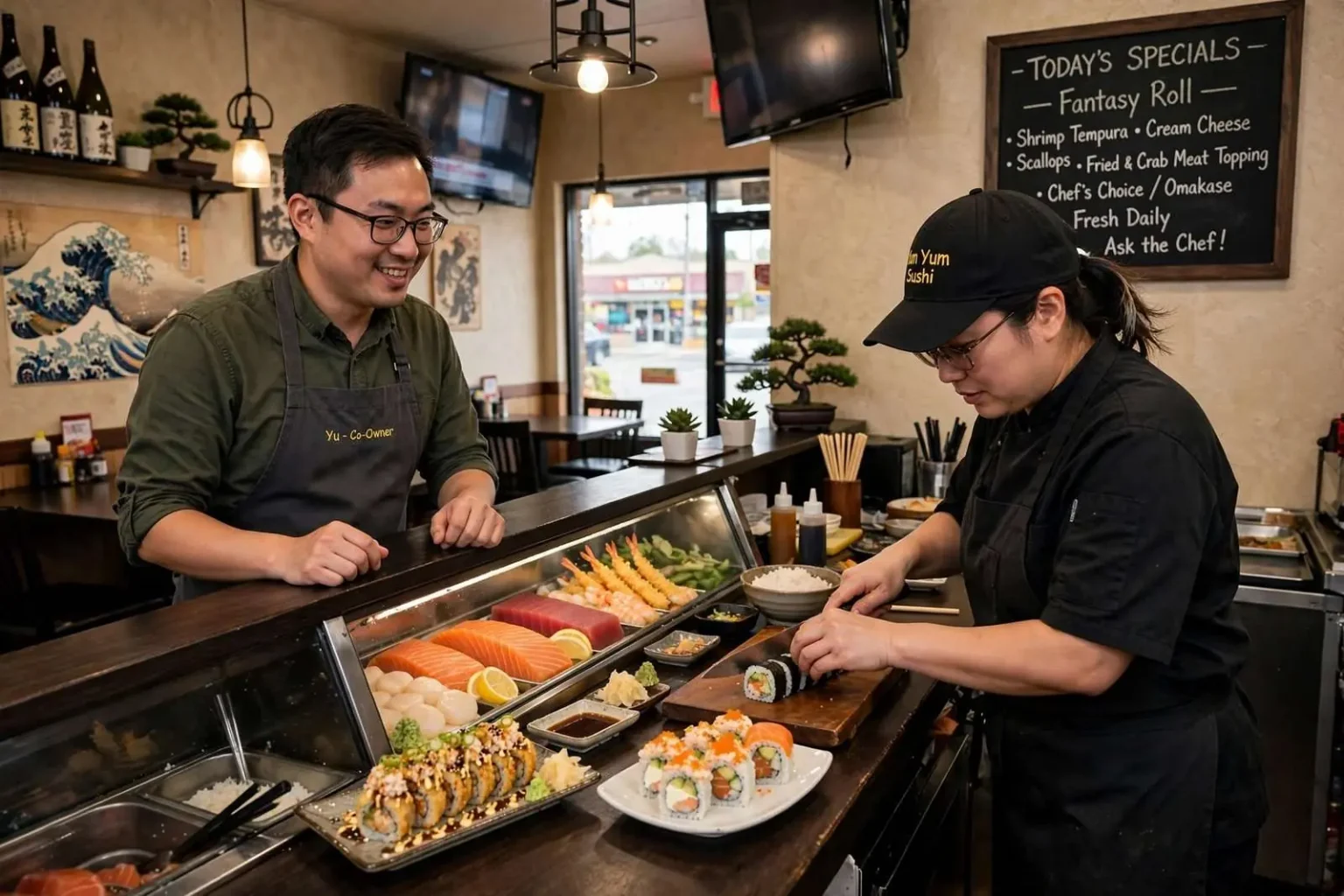
West Mobile’s Yum Yum Sushi, open at 8155 Cottage Hill Road since September 2011, has built its reputation around sushi prepared at a bar that sits front and center in the dining room. The restaurant arrived in a corridor better known for fast food and strip-center takeout, and it has quietly carved out a following among Mobile diners willing to seek out scratch-made sushi in a part of town where it remains a rarity. Cottage Hill Road west of Airport Boulevard has grown into one of the city’s busiest commercial arteries, lined with shopping centers and restaurants serving the dense residential neighborhoods that stretch toward the Mobile County line.
Co-owner Yu Zhu, a chemical engineering major at the University of South Alabama before opening the restaurant, put considerable work into updating the location with a sushi bar, decorations, air conditioning and flat-screen televisions. Zhu’s path from science student to restaurateur reflects the entrepreneurial streak of Mobile’s international food scene, where family-run kitchens have long anchored the city’s Vietnamese, Korean and Chinese dining options. The renovation turned what had been a generic storefront into a compact dining room organized around the sushi counter, where the restaurant’s craft is on display for every table.
Though the restaurant sits near a gas station, the small dining area is inviting for dine-in customers. The strip-center setting is easy to drive past, which is precisely why regulars describe Yum Yum Sushi as a find — a place that rewards customers who know to look for it. Inside, the room is modest but comfortable, sized for a neighborhood restaurant rather than a destination chain, with the sushi bar positioned so that the interaction between chef and customer becomes part of the meal itself.
A Chef With Japanese Training
Head sushi chef Chi Chi Soun, a longtime friend of Zhu, trained under a second-generation Japanese sushi chef and has worked under two Japanese sushi masters. That lineage matters in sushi, where rice seasoning, knife work and fish handling are learned through years of apprenticeship rather than short courses. Soun’s training shows in the fundamentals — properly seasoned and cooled rice, fish cut to order, and the discipline of a menu built around what is fresh that day rather than what can be frozen and thawed.
Guests at the counter can watch their food prepared, and adventurous diners can let the chef choose the dish — potentially a specialty roll that is not even on the menu. The omakase-style arrangement, in which the customer puts the meal in the chef’s hands, remains unusual in Mobile but has become the way sushi enthusiasts measure a kitchen’s confidence. At Yum Yum Sushi, the chef’s-choice option turns the daily specials into a running conversation between Soun and the customers seated at the bar.
One example is the popular “fantasy roll,” combining shrimp tempura, cream cheese and scallops, fried and topped with crab meat. The roll captures the style that has made the restaurant popular along the Gulf Coast, where cooked and fried rolls dominate orders and cream cheese appears in combinations that would surprise diners in Tokyo. Soun creates new specialty rolls every day, writing them up on the board rather than waiting to rotate the printed menu, which gives regulars a reason to check in frequently.
Fresh Fish and a Focused Menu
Unlike many area restaurants that also serve Chinese or hibachi dishes, Yum Yum Sushi focuses on sushi as a main course, though a fried menu offers catfish and shrimp for diners who prefer cooked food. The single-cuisine focus is a deliberate choice in a market where many Asian restaurants hedge with broad menus spanning hibachi grills, noodle dishes and fried rice. By keeping the kitchen’s attention on raw fish and rice, the restaurant concentrates its refrigeration, sourcing and skill on the one thing it wants to be known for.
Zhu said fish is shipped in fresh regularly, because fresh product is very important for raw preparations. Sourcing is the unforgiving variable in the sushi business: fish that arrives a day late or has been frozen and thawed carelessly shows up immediately in texture and flavor. Gulf Coast diners bring high standards for seafood, shaped by the region’s own fishing culture, and a sushi restaurant that cuts corners does not survive long in a market where word of mouth travels quickly among regulars.
“All of our product is high quality. We don’t use any low quality fish. Higher quality fish tastes better, and I would rather the customer have something that tastes good,” Zhu said. The philosophy places the restaurant in line with the small-operator tradition of Mobile’s independent dining scene, where owners who work their own counters compete on quality rather than volume. It also shapes the restaurant’s pricing and pace — the dining room is small, the food is made to order, and the turnover comes from loyal repeat customers rather than a high-volume formula.
The fried menu gives the kitchen a bridge to customers who do not eat raw fish, an important consideration in a family-oriented city like Mobile. Catfish and shrimp are Gulf Coast staples, and frying them in a kitchen that also handles sushi requires care to keep flavors and odors where they belong. Diners who come with mixed groups — part of the family adventurous, part not — can order from both sides of the menu without compromise.
Expansion Plans and a Growing Following
Zhu planned to add a liquor license in August 2012, allowing the restaurant to offer sake and other alcoholic beverages, and considered an outdoor patio that could feature live music. A beer and sake list would complete the sushi house experience and give the small dining room a second revenue stream, while a patio would add seats without expanding the building. Live music on a patio would also make the restaurant part of Mobile’s small but active scene of neighborhood venues, where local musicians play for tip jars on weekend evenings.
The restaurant’s own plans were to be detailed on a website then under construction. Its Facebook page had more than 400 likes by mid-2012 — a modest number by later standards but a meaningful one for a neighborhood restaurant in its first year, built almost entirely by Mobile customers posting rolls and recommending the place to friends. Social media did much of Yum Yum Sushi’s marketing in its early days, as it did for many of the independent restaurants that opened in Mobile around the same time.
“We want to build a place that is unique and different, not the same thing you can get anywhere else,” Zhu said. That ambition sets the restaurant against the national chains and franchise rollouts that dominate West Mobile’s commercial corridors, and it explains the loyal customer base the business has cultivated from its location on Cottage Hill Road.
Yum Yum Sushi is at 8155 Cottage Hill Road in Mobile, Alabama. Hours were Monday through Thursday 11 a.m. to 10 p.m. and Friday and Saturday 11 a.m. to 11 p.m. The restaurant is closed Sundays, giving the kitchen a weekly reset for the fish deliveries that anchor its menu.
The restaurant’s setting along Cottage Hill Road places it in the middle of one of West Mobile’s most heavily traveled dining corridors. The stretch between Airport Boulevard and the Crosby Road area carries steady traffic from the surrounding subdivisions, schools and churches, and its mix of national chains and family-owned kitchens has long made it a first stop for Mobile diners deciding where to eat. In that environment, a restaurant like Yum Yum Sushi depends on the customers who discover it once and return weekly — the regulars who sit at the sushi bar, order the fantasy roll and bring friends the next time.
Zhu’s background in chemical engineering shows up in the way the business is run, from the temperature discipline required for raw fish storage to the systems that keep a small kitchen turning out made-to-order rolls on a tight schedule. The training is not decorative: a sushi operation lives or dies on cold-chain management, portion control and consistency, all disciplines that translate directly from laboratory habits. Restaurateurs in Mobile’s international community have long combined day jobs and family kitchens before opening full-time, and Zhu’s move from coursework at South Alabama to a sushi counter of his own follows that well-worn local path.
For diners in West Mobile, the restaurant’s arrival added something the corridor lacked: a place where raw fish is treated as a craft rather than a side option. The combination of a trained chef, daily specials and a chef’s-choice option gave southwest Mobile a genuine sushi bar within a few minutes’ drive, without a trip across town to Midtown or downtown. Whether the patio, the liquor license and the website plans came to pass as Zhu hoped, the foundation he described — quality fish, a trained hand at the counter and a room built around both — remained the restaurant’s core promise to the customers who found it on Cottage Hill Road.