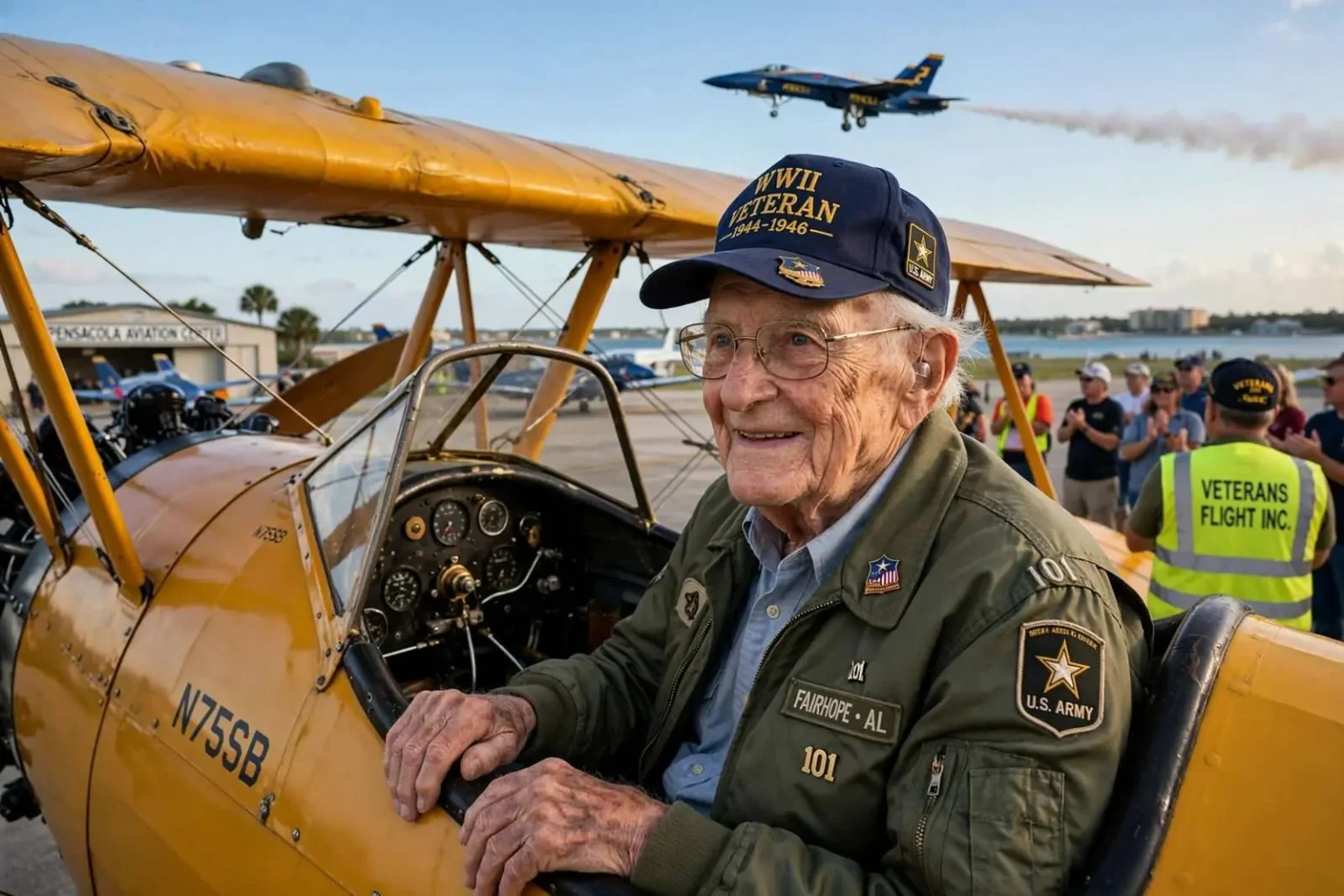
Bob Hasewinkle, a 101-year-old World War II veteran from Fairhope, took to the skies Saturday as part of the annual veterans flight held during the Pensacola Blue Angels air show. Born and raised in Indianapolis, Indiana, Hasewinkle served in the U.S. Army from 1944 to 1946 and fought on the front lines during the Battle of Okinawa, one of the bloodiest campaigns of the Pacific war.
He was injured by mortar shrapnel during the battle before being rescued and sent into surgery. Hasewinkle said he believes there is a 99.9% chance the medic who rescued him was Desmond Doss, the celebrated combat medic who refused to carry a weapon because of his personal beliefs and later received the Medal of Honor for his heroism under fire.
The claim is less improbable than it sounds. Doss’s actions at Okinawa — where he scaled the Maeda Escarpment again and again to lower wounded men down its face under enemy fire — became legend within the Army units he served, and the men he saved spent decades afterward trying to confirm which rescues were his. Hasewinkle, like many veterans of the battle, has carried that question — and that gratitude — for most of a century.
Back in the Air After 60 Years
Hasewinkle, who lives in Fairhope with his wife, Jeanne, holds a private pilot’s license but said he hadn’t flown in a plane like Saturday’s in more than 60 years. He called the experience a lot of fun.
“I wasn’t afraid or anything,” Hasewinkle said after his flight. “I used to watch all the gauges. Well, I watched all the gauges, made sure everything was operating right, and the view was spectacular of course. All over the Pensacola area plus the beach. It was just a fun thing.”
The habit of a trained pilot ran through every word — checking instruments, verifying the aircraft, reading the landscape below. Hasewinkle flew in a Stearman Model 75, also known as a Boeing Stearman, a biplane produced during the 1930s and 1940s that saw widespread use throughout World War II as the primary trainer in which a generation of American pilots learned to fly.
The particular aircraft he flew in worked as a crop duster in California for about 25 years after the war before joining the Pensacola Air Show — a second career that is itself part of the Stearman story, since the thousands of surplus trainers sold after 1945 became crop dusters, racers and barnstormers across the country.
The Veterans Flight Mission
The Pensacola Veterans Flight takes place during the Blue Angels’ air show to give veterans a chance to fly again in a historic aircraft, with each plane lifting off from the Pensacola Aviation Center and flying to Pensacola Beach before returning. The route traces the shoreline where the Navy’s flight demonstration squadron performs, and the veterans ride in open-cockpit visibility over the water they once shipped out across.
Roy Kinsey, founder and president of Veterans Flight Inc., the nonprofit that runs the event, said the organization has now helped 14 veterans aged 100 or older take flight. The milestone reflects both the group’s persistence and the narrowing window it flies against: the youngest Americans who served in World War II are now in their late 90s, and each flight season begins with a race against time.
Among them was Royce Williams, a retired U.S. Navy aviator whose heroism during the Korean War was recognized with the nation’s highest honors for aerial combat. The roster of centenarian flyers has become a roll call of living history — men and women whose flights draw crowds of families and active-duty personnel who line the ramp to watch each takeoff and greet each landing.
Why the Stearman Matters
For veterans of a certain generation, the Stearman is not an antique — it is the first airplane they ever flew. Nearly every American military pilot of the World War II era learned the fundamentals in its open cockpit before moving on to more advanced trainers and, eventually, combat aircraft. The airplane’s forgiving manners on the ground and demanding handshake in the air made it the classroom for the largest air force the world had ever assembled.
That history is why Veterans Flight uses the type. A veteran climbing into a Stearman today is climbing back into the earliest chapter of his own service — the smells of fabric, dope and exhaust, the wind in the wires, the gauges set in a row exactly as Hasewinkle remembered checking them. No museum display reproduces that; only flight does.
The aircraft that carried Hasewinkle has lived three lives: military trainer, quarter-century crop duster in California and now air show veteran — a biography that mirrors the airplanes and the men it carries, both long past their original missions and still going up on Saturdays.
Okinawa and the Medic Who Would Not Carry a Gun
The battle Hasewinkle survived remains one of the costliest of the Pacific war. Fought from April through June 1945 on the island south of mainland Japan, Okinawa cost tens of thousands of American casualties and introduced U.S. forces to the kamikaze threat at scale. Front-line riflemen and their attached medics endured weeks of shelling, rain and close combat in the island’s fortified ridgelines and tombs.
Desmond Doss’s service there — rendered without a weapon, as a Seventh-day Adventist conscientious objector — earned him the Medal of Honor, presented by President Harry Truman, and made him the subject of books and, decades later, a major film. For the men he pulled from the line, the memory was personal rather than cinematic, and Hasewinkle’s certainty about his own rescue belongs to that living archive.
Veterans who reached their hundredth year have become, in the past decade, the final generation able to tell those stories firsthand. Events like the Pensacola flight exist precisely to gather the telling while it is still possible — the flights themselves recorded, photographed and shared so the accounts outlast the men.
A Fairhope Pilot’s Second Century
Hasewinkle’s day ended the way the flights always do: back at the Pensacola Aviation Center ramp, wheels stopped, crew steadying the biplane as the pilot climbs down to a line of applause. He had watched every gauge, admired the view from Pensacola Beach to the bay, and pronounced the whole thing fun — the understatement of a man who once took shrapnel on a Pacific island and called surviving that the greater accomplishment.
He returns home to Fairhope — across Mobile Bay from Pensacola’s airfield, a drive the Eastern Shore’s veterans make each year for the event — as the 14th centenarian the nonprofit has flown, a private pilot who waited six decades for a flight worth the wait.
For the families and volunteers who make the Veterans Flight happen, each flight is equal parts reunion and remembrance: a historic airplane, a veteran above the water he crossed to war, and a shoreline full of people who came to watch — and to say thank you while they still can.
The Blue Angels Backdrop
The veterans fly during the Blue Angels’ air show weekend for good reason. Pensacola is the squadron’s home, and the show draws hundreds of thousands of spectators to the Gulf Coast each season — an audience that naturally includes the crowds watching the older, slower biplanes depart the Aviation Center between the jets’ rehearsals. The contrast is part of the point: the Navy’s newest fighter pilots in F/A-18s above, and the WWII generation in a 1940s trainer below, sharing the same sky over the same beach.
Pensacola’s connection to naval aviation runs deeper than the show. The area’s air station has trained Navy and Marine Corps pilots for more than a century, which makes the region a fitting stage for veterans’ flights and one of the reasons the nonprofit’s aircraft and volunteers are based there. When a Stearman lifts off toward Pensacola Beach, it flies over a coastline that has watched military aviation grow up.
The flights are typically brief — out over the water, along the shore, back to the field — but they are long enough for the view Hasewinkle described: the emerald water, the sugar-sand beach, the whole Pensacola area laid out for a passenger who has earned the perspective.
Honoring the Last of the WWII Generation
The math of the WWII generation explains the urgency behind the program. American forces in the war numbered more than 16 million; today, the survivors are counted in the tens of thousands and dwindle each year, with the Department of Veterans Affairs projecting the near-total passing of that generation within the decade. Centenarian veterans — the 14 Hasewinkle joined — represent the oldest and rarest of the group.
Programs like Veterans Flight therefore serve a purpose beyond the individual ride. Each flight is an event a family remembers, a story recorded on video by children and grandchildren, and a public moment in which a community visibly honors service that is otherwise becoming history. The nonprofit’s count of centenarian flyers is, in its way, a ledger of living memory.
For Baldwin County, Hasewinkle’s participation adds a local chapter. Fairhope’s veterans community — like those in Daphne, Spanish Fort and across the Eastern Shore — has supported the Pensacola events for years, and the drive across Perdido Bay to the Aviation Center is a familiar pilgrimage for families marking anniversaries, birthdays and, more and more, these milestone flights.
The flight itself lasted, as they do, only minutes. The memories, by every account from the men who take them, last considerably longer — a final turn over the beach in the airplane of their youth, gauges checked, everything operating right.