2010 Was the Year Mobile’s Film Scramble Scene Took Off
Mobile's 48-hour Film Scramble competitions flourished in 2010, crowning winners from Bryant High School to the Giallo Scramble.
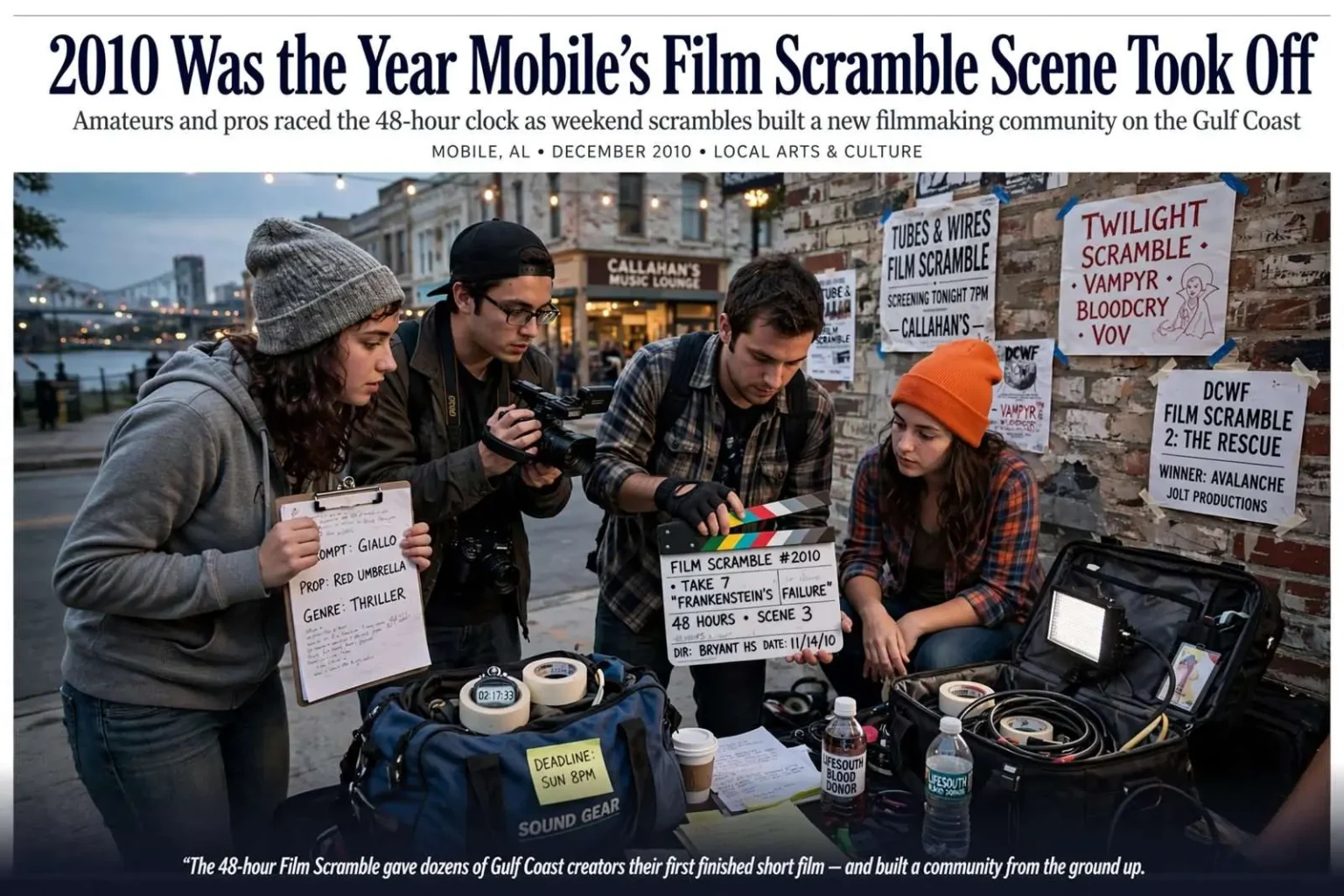
Mobile filmmakers — amateurs and professionals alike — produced a bumper crop of short films in 2010, and much of the credit goes to a fast-growing local format: the Film Scramble. Teams get as little as 48 hours to write, shoot and finish a short film, often to specific criteria, and 2010 delivered scramble after scramble across the city. What had begun as an occasional experiment quickly became a fixture of the local arts calendar, drawing students, hobbyists and working professionals onto the same playing field.
The format’s appeal is easy to understand. Traditional filmmaking rewards patience, planning and money, and those three things are in short supply for most people who want to make movies. A scramble strips the process down to its essentials: a prompt, a deadline, whatever equipment a team can gather, and a finished short at the end. Nobody needs a studio backlot or a Hollywood budget. The result is a scene that grows from the bottom up, one weekend at a time.
For a port city with a long cultural history — Mobile’s theatrical and music traditions stretch back well over a century — the scramble boom added a new strand. The city had long produced writers, musicians and performers, but a dedicated pipeline for short filmmaking had been thin. The scrambles of 2010 changed that, and the names attached to the year’s entries now read like a roster of the Gulf Coast’s emerging film community.
How the scramble format works
The rules of a film scramble are simple by design. Teams are given a window — as little as 48 hours — in which to write, shoot and edit a complete short film. Often they must satisfy specific criteria: a genre drawn at random, a required prop, a theme, or a title. The constraints are the point. They force quick decisions, discourage overthinking, and push filmmakers to solve problems with the resources in front of them rather than the ones they wish they had.
That pressure produces a distinctive kind of work. Because every team is working against the same clock, the finished films tend to be raw, inventive and varied in tone, even when they answer the same prompt. Screenings become communal events, with audiences reacting to how differently each crew interpreted the same assignment. For beginners, the format offers a low-risk way to earn a first credit. For experienced filmmakers, it is a test of craft under constraint.
The model also builds crews. A scramble weekend creates working relationships — directors meeting camera operators, writers finding actors, editors pairing with producers — that often outlast the event itself. By the end of a single year of scrambles, a city’s film community can develop the informal network that formal film offices spend years trying to cultivate.
The headline winners
The year’s most prominent prize went to a team from Bryant High School, whose entry Frankenstein’s Failure took the 2010 SoAl Film Scramble. That a high school team claimed the top spot was one of the year’s signature stories, and it underscored how the scramble format rewards energy and ideas as much as technical polish. Arel Watson’s The Masochist finished runner-up, giving the year’s flagship event a competitive finish that stretched across age groups and experience levels.
The first DCWF Film Scramble honored one of Mobile’s own music legends, guitarist Johnny Jenkins. Teams drew a random film genre on the spot and produced a trailer that had to reference the fictional character Johnny Jenkins, blending local tribute with improv sensibilities. Jolt Productions’ Collision Course emerged a clear crowd favorite, and Garred Brannon’s Marionette also drew strong response. The most cautious strategy of the night belonged to “SuperTeam,” which hedged its bets by cutting two trailers for the same film in different genres — a move that showed how seriously some teams took the genre-draw format, and how much of a scramble’s appeal lies in watching crews navigate its constraints.
Tying a new filmmaking competition to a name Mobile already knew gave the first DCWF scramble an audience beyond the participating crews, and it set a template for later scrambles that attached themselves to local institutions and causes. In a city where music history runs deep, honoring a guitar legend through the newest corner of its creative economy made for a fitting crossover.
New organizations, new formats
Two groups launched in 2010 left their mark on the scene. The Student and Filmmaker Alliance debuted with the Tubes & Wires Film Scramble, an experiment that reached well beyond the usual filmmaking crowd: short fiction written by middle school students was turned into short films by Mobile filmmakers. Sarah Lawrence’s winning story, The Mysterious Object, was realized on screen by Timothy Dixon and Trey Lane. The event created exactly the kind of pipeline the alliance’s name promised, connecting classroom writing assignments to working production crews.
The alliance later partnered with LifeSouth, the community blood bank, on the Twilight Film Scramble, which required films built around a LifeSouth prop and a vampire or werewolf. The prompt produced a memorable slate of entries: Artie McGowan’s Vampyr, Colin Dacy’s VOV: Victims of Vampires, BRTL Films’ BloodCry, and Bad Friday from Trey Lane and Doc Valso. Partnering with a health organization showed the scrambles could serve public purposes as well as artistic ones, giving a community institution a fresh way to reach young audiences.
DCWF kept the pace with Film Scramble 2: The Rescue, which challenged teams to make a rescue-themed short. Jolt Productions returned with Avalanche, Melon Helmet Productions offered Expiration Gone Bad, Timothy Dixon submitted F. Scott Fitzgerald, and the Lane/Valso pairing added Bad Friday to the slate. The quick turnaround between events — a rescue-themed prompt arriving on the heels of the vampire entries — gave the year a drumbeat rhythm that kept crews in nearly constant production.
Freestyle and genre experiments
The DCWF Freestyle Scramble flipped the usual structure: teams could do anything they liked so long as they beat the deadline. Renae Brewer adapted Ray Bradbury’s There Will Come Soft Rains, Colin Dacy turned in Quit Fire, and Trey Lane made Graphic User Interface. A satellite team of Auburn-affiliated filmmakers, Jonny Moze and Rivers Langley, contributed the comedy of errors Almost Exactly Like Bonobos. The freestyle edition showed what the scene’s crews could do without a prompt — and, tellingly, the results were as varied as the teams themselves.
Genre exercises pushed further afield. The SoftCore Scramble produced Timothy Dixon’s Esrever, Jolt Productions’ Dixar’s Sex Toy Story, and Colin Dacy’s crowd favorite Dirty Shirt, along with McKinney Lillian and Trey Lane’s STARCH. The Giallo Scramble challenged teams to work in the style of 1970s Italian thrillers, a demanding assignment that drew Amalie and Jake Stroud’s Son Cœur Était un Tombeau Vide and Jason Lewis’s A Glint in the Dark. Asking regional crews to imitate a foreign genre tradition was a bet on the scene’s ambition, and the entries that came back suggested the bet paid off.
Across formats, the same names kept appearing — Dixon, Dacy, Lane, Valso, Jolt Productions — a sign that the scrambles had built not just one-off events but a recurring community of creators who moved between prompts and teams as the year went on. Repetition of that kind is usually what separates a sustainable film scene from a flash of activity that fades after its first novelty.
What the scrambles gave Mobile
Taken together, 2010’s scrambles gave dozens of Gulf Coast filmmakers their first finished credits — and gave Mobile a working pipeline from classroom writing assignments to festival-ready shorts. A middle school student’s story could become a film; a high school team could beat the whole city; a first-time crew could pick up a camera on Friday and screen a finished work on Sunday. The format collapsed the distance between wanting to make a film and actually having made one.
The year also demonstrated how local organizations could plug into the scene. Schools, blood banks and tribute events all found room in the scramble calendar, and each partnership broadened the audience. That civic layer matters: a film scene sustained only by filmmakers tends to stay small, while one that gives community groups a reason to show up grows year over year.
For residents of Mobile and the surrounding Gulf Coast, the practical takeaway is simple. The scrambles that filled 2010 were open to newcomers by design, and the crews that dominated them had mostly earned their first credits in exactly the same way — by showing up, drawing a prompt and finishing on deadline. Anyone with an idea, a camera and a free weekend had a place in the field, and the bumper crop of 2010 is what happened when enough of them did.