2012 South Alabama Film Festival Unveils Full Schedule and Feature Lineup
The South Alabama Film Festival returned to downtown Mobile in November 2012 with a three-day celebration of independent and Southern cinema, spreading scr.
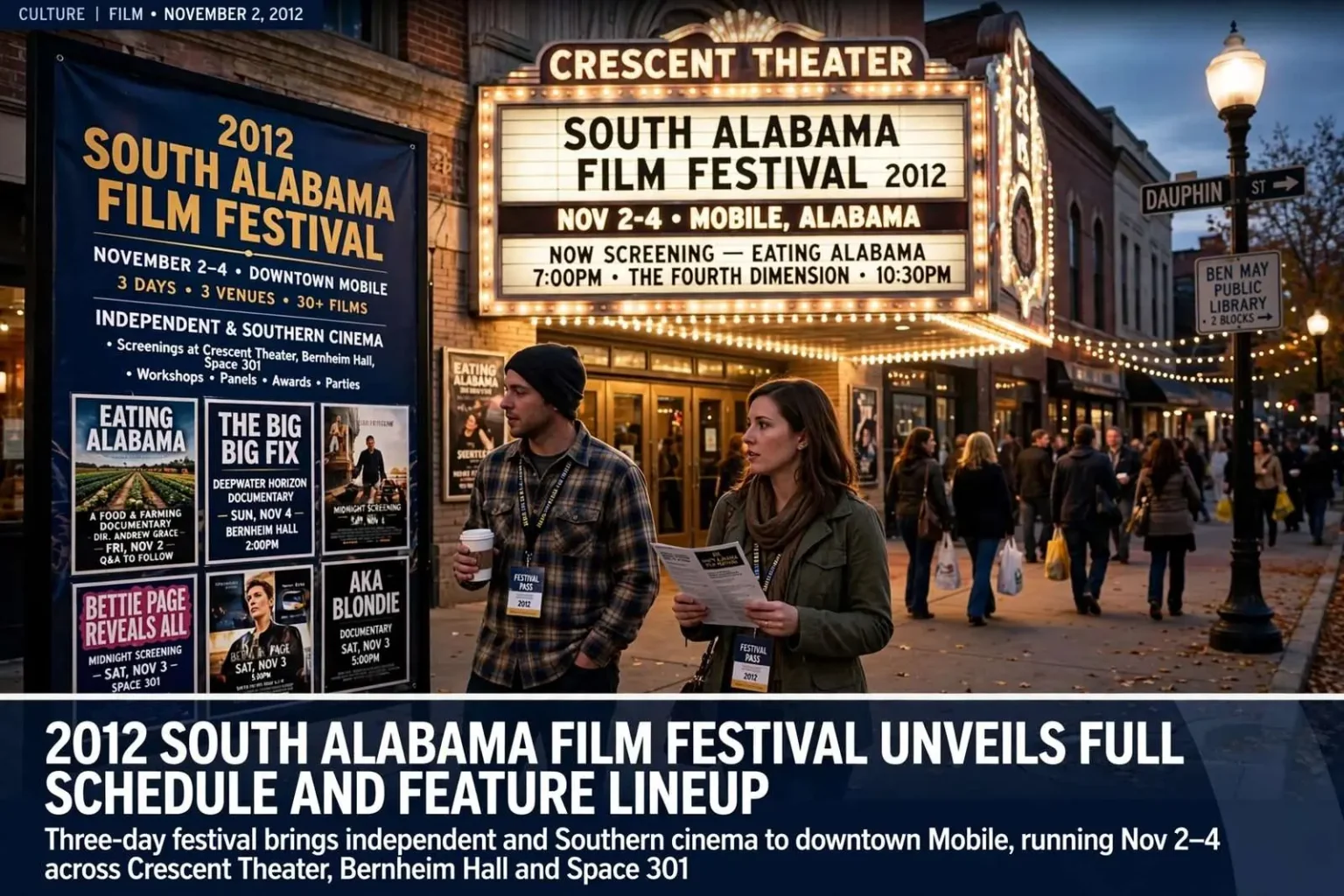
The South Alabama Film Festival returned to downtown Mobile in November 2012 with a three-day celebration of independent and Southern cinema, spreading screenings, workshops and parties across several of the city’s cultural venues. From Friday evening through Sunday afternoon, festivalgoers moved between the Crescent Theater, Bernheim Hall at the Ben May Public Library and Space 301, sampling a lineup that stretched from food-and-farming documentaries to a midnight portrait of Bettie Page. The schedule confirmed what organizers had been building toward for years: a festival designed to make downtown Mobile a weekend-long home for filmmakers and audiences from across the Gulf Coast.
A Weekend of Screenings Across the City
The festival opened Friday, November 2, with a pass-holder party at the Fort Conde Inn, sponsored by Wintzell’s Oyster House and Cathead Vodka. From there the crowd moved into the Crescent Theater for opening-night presentations of Eating Alabama with filmmaker Andrew Grace, followed by The Fourth Dimension at 10:30 p.m. The double bill set the tone for the weekend — one film a personal essay about food, community and the South, the other an experimental anthology project — and gave opening night the feel of a genuine event rather than a simple first screening.
Saturday’s program, November 3, was the marathon: twelve hours of programming that ran from noon to midnight. Local and regional shorts screened at Bernheim Hall in the Ben May Public Library, while the Crescent Theater and Space 301 hosted narrative, documentary and animated programs. Highlights included AKA Blondie, American Man, Duke & The King, Tchoupitoulas, Pilgrim Song, Big Easy Express and a midnight showing of Bettie Page Reveals All. The spread of venues meant audiences could build their own festival experience, hopping from a documentary on the library’s stage to a narrative feature downtown without ever leaving a few blocks of the city center.
Sunday, November 4, closed the festival with The Big Fix at Bernheim Hall and an awards and encore screening at Space 301. Closing a festival with a documentary about the Deepwater Horizon disaster — and following it with a celebration of the weekend’s award winners — sent the crowd home with a reminder of how much material the Gulf Coast itself supplies to independent filmmakers. The awards presentation, backed by encore screenings of the weekend’s honored work, gave the festival a traditional send-off after three days of unconventional scheduling.
The Feature Films
The full slate of features covered an unusually wide stretch of territory, in subject and in geography. It ranged from Harmony Korine’s anthology entry in The Fourth Dimension to Andrew Beck Grace’s farming-and-food essay Eating Alabama, the Atlanta exotic-dancer portrait AKA Blondie, the football-and-ALS story American Man, and the Deepwater Horizon documentary The Big Fix, Josh and Rebecca Tickell’s examination of the spill’s aftermath. Together the films mapped the concerns of contemporary Southern filmmaking: land, faith, labor, sports, and the environmental and economic shocks that Gulf Coast communities have absorbed in recent years.
Weekend passes covering all films, workshops, parties and special events were priced at $35, with individual tickets at $7. The pricing kept the festival within reach of students and families while rewarding pass-holders with the full social calendar, including the Friday opening party. For a festival of this scope — three venues, three days, dozens of titles — the cost of admission was a deliberate statement about who the event was for: the whole city, not just the film-community faithful.
Directors on Hand and a Courtroom Documentary
Several filmmakers attended the weekend in person, including Andrew Beck Grace of Tuscaloosa with his food-and-farming documentary Eating Alabama. The film follows Grace and his wife as they attempt to eat locally in Alabama, and its festival screening doubled as a conversation starter about the state’s food systems — exactly the kind of post-screening discussion the festival’s workshops and Q&A slots were built to host. Grace’s presence gave audiences a direct line to the questions the film raises about farming, community and what it means to eat deliberately in the Deep South.
The local connection deepened with Duke & The King, from Theodore native Wayne Franklin and co-director Kris E. Wheeler. The documentary is the portrait of Alabama-born musician Duke Bardwell and his years playing in Elvis Presley’s band, a story that runs from the Gulf Coast through the upper reaches of American popular music. Having a hometown filmmaker on stage to introduce it gave the Saturday program one of its signature moments, and the film itself — part music history, part Alabama biography — fit the festival’s Southern-centered identity squarely.
Jon Watts’ AKA Blondie, Mark Mori’s Bettie Page Reveals All, Emmett Malloy’s Big Easy Express and Martha Stephens’ narrative feature Pilgrim Song rounded out the slate of Southern-linked features. The range was striking: a portrait of an Atlanta exotic dancer from the director who would go on to major studio work, a documentary retrospective of the iconic 1950s pin-up model, a music documentary following a train-bound caravan of indie rock bands toward New Orleans, and a character-driven road narrative. Each carried a Southern thread, and each demonstrated the breadth the festival’s programmers were willing to defend.
Unfit: Ward Vs Ward
The program also included Unfit: Ward Vs Ward, Katie Carmichael, Edwin Scharlau and Penny Edmiston’s documentary revisiting the mid-1990s Pensacola custody case in which a Florida judge weighed a mother’s sexuality against her ex-husband’s murder conviction — a ruling that ignited national controversy and became a touchstone in LGBT parenting debates. For Mobile audiences, the film carried uncomfortable regional resonance: the case unfolded just across the state line, and its questions about courts, family and civil rights were debated in living rooms and courtrooms throughout the Gulf Coast at the time.
Programming a documentary like Unfit alongside music films and food essays was a statement about the festival’s ambitions. The South Alabama Film Festival was not curating a comfortable highlight reel; it was presenting documentaries that had done real work in the world, some of them shot within a two-hour drive of the screening room. That mix — entertainment, advocacy and regional history sharing one schedule — was what distinguished the 2012 edition from a routine showcase.
What the Venues Say About Downtown Mobile
The festival’s footprint was as much a story as its lineup. Bernheim Hall at the Ben May Public Library brought screenings into one of downtown’s most historic civic spaces, while Space 301 — the Center for the Living Arts’ contemporary gallery downtown — provided a raw, art-forward backdrop for programs and the Sunday awards. The Crescent Theater anchored the weekend as the city’s dedicated independent cinema. Spreading the event across those three venues put festivalgoers on the sidewalks of the historic district between shows, and that foot traffic was exactly the spillover downtown businesses hope for from events of this kind.
The venue mix also reflected the practical realities of a growing regional festival. No single screen could have accommodated a lineup that needed to run narrative, documentary and animated programs simultaneously on a Saturday. By splitting the schedule across three spaces within walking distance, organizers kept wait times short and gave each film a room suited to its audience size — shorts and documentaries at the library, larger features at the Crescent, awards and encores at Space 301.
Workshops and the Business of Filmmaking
Screenings were only half the equation. The festival’s workshops gave aspiring Gulf Coast filmmakers a chance to hear from working directors, producers and crew about how projects actually get made — from fundraising and festivals to distribution. With visiting filmmakers like Grace, Franklin and Wheeler in town for the weekend, the educational programming had a bench of practitioners who could speak to making films in and about the South without leaving the region.
That emphasis matters for Mobile specifically. The city’s film infrastructure has grown steadily over the past decade, and festivals like this one function as both a marketplace and a recruiting tool — showing regional talent that work made here can find an audience here. The three-day format, with parties and workshops woven between screenings, is designed to make those connections happen in person rather than by correspondence.
A Growing Role for Southern Storytelling
The festival underscored Mobile’s growing role as a home for Southern storytelling on screen. The 2012 lineup demonstrated that the stories the region generates — a veteran’s music career, a family farm, a spill in the Gulf, a custody battle in Pensacola — are stories with national reach, and that Mobile’s downtown venues can host them with the seriousness of a much larger market. The $35 weekend pass and $7 individual tickets kept the event accessible, and the across-the-city footprint kept the emphasis on the places that make downtown distinct.
As the Sunday awards wrapped at Space 301, the festival left behind the same question every growing event does: how big is big enough. The 2012 edition filled three venues for three days, drew filmmakers from Tuscaloosa to Los Angeles, and put a midnight Bettie Page documentary on a Mobile screen. For a regional festival working to establish itself as an annual fixture on the Gulf Coast cultural calendar, that is the kind of weekend that builds the following for the next one.