27-Year-Old Charged After Police Chase Down Spring Hill Avenue Ended in a Crash, Mobile Police Say
Mobile police say a 27-year-old led officers on a 1.5-mile Spring Hill Avenue chase that ended in a crash; he faces eluding charges.
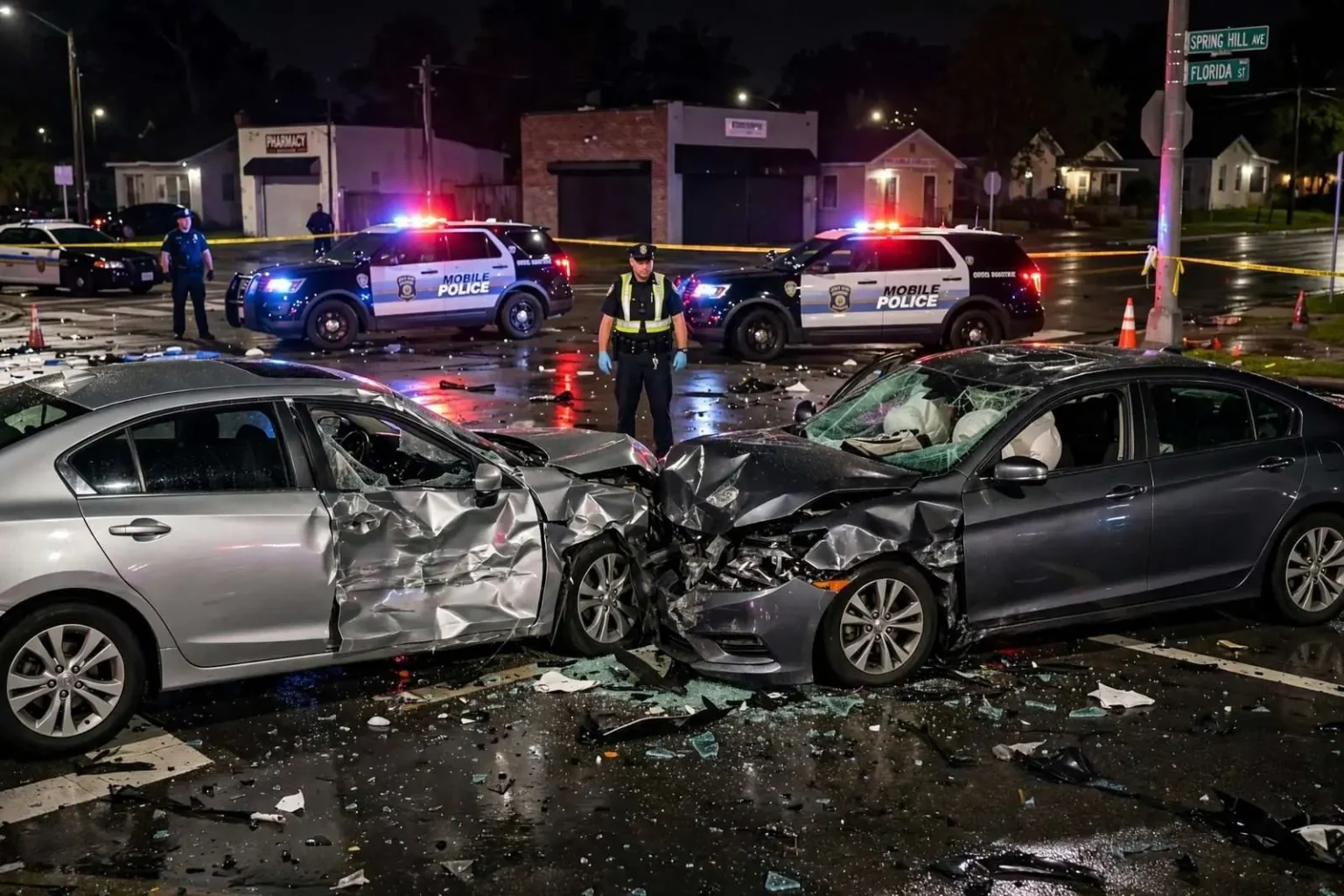
A 27-year-old Mobile man faces multiple charges after a police pursuit along Spring Hill Avenue ended when his vehicle crashed into two other cars, according to the Mobile Police Department. Police said officers tried to pull over a vehicle driven by Donald Campbell-Sykes at Catherine Street and Spring Hill Avenue just before 10 p.m. on a Friday night. The driver did not stop, touching off a chase of roughly a mile and a half down one of midtown Mobile’s busiest corridors before it ended in a collision that involved two civilian vehicles.
How the Pursuit Unfolded
The sequence began when officers attempted a traffic stop near the intersection of Catherine Street and Spring Hill Avenue, a stretch of midtown lined with businesses, churches, and residential streets feeding into the main road. Rather than pull over, police said, the driver accelerated, and the attempted stop became a pursuit that ran roughly a mile and a half west along Spring Hill Avenue. Evening traffic on the corridor is steady even on weekends, with drivers cutting between Spring Hill Avenue and nearby parallel routes such as Dauphin Street and Government Boulevard, which makes any high-speed movement along the roadway hazardous for people who have no connection to the stop.
The pursuit came to an end at Spring Hill Avenue and Florida Street, where police say Campbell-Sykes’ vehicle collided with two civilian vehicles. He was taken into custody at the scene. The stretch near Florida Street sits in the heart of midtown, close to neighborhoods, small shops, and the traffic lights that slow commuter flow through the area. A crash at an intersection like that one, during evening hours when drivers and pedestrians are still moving about, is exactly the outcome pursuit policies are designed to prevent, and it is the reason flight from a traffic stop is treated as a serious offense rather than a minor one.
The Charges
Police charged Campbell-Sykes with reckless endangerment, attempting to elude police, and carrying a concealed weapon without a permit. Each charge maps to a different piece of the night’s events. The attempting-to-elude charge covers the decision to flee from officers who signaled the vehicle to stop, and under Alabama law that offense can rise to felony level when the flight creates a substantial risk of death or serious physical injury to others — a threshold that a mile-and-a-half chase through evening traffic on a busy avenue plainly reaches in prosecutors’ view when charges are presented to a judge.
Reckless endangerment, meanwhile, addresses the risk created for everyone else on the roadway. Alabama’s reckless endangerment statute is written to cover conduct behind the wheel that creates a substantial risk of serious physical injury to another person, and police pursuits along busy corridors like Spring Hill Avenue put other drivers squarely in harm’s way — the scenario the statute is written to address. The weapons charge is separate from the driving offenses: carrying a concealed weapon without a permit is a misdemeanor under state law, but prosecutors routinely add it to charge packets when a firearm is discovered during an arrest, because it stands on its own regardless of how the pursuit resolves.
Spring Hill Avenue and Midtown Traffic
Spring Hill Avenue carries steady evening traffic through midtown Mobile, connecting the Spring Hill neighborhood and the western parts of the city toward the downtown side, and it funnels drivers past restaurants, schools, medical offices, and dense residential blocks. Because it is a main artery rather than a quiet side street, an incident on the roadway draws attention quickly, and a police chase along the route endangers far more than the people inside the fleeing vehicle. Cross streets in the area — Catherine Street and Florida Street among them — feed neighborhood traffic directly onto the avenue, so a crash at either intersection has the potential to involve drivers who had no way of knowing a pursuit was bearing down on them.
Police departments across Alabama weigh the danger of a pursuit against the seriousness of the underlying offense every time a driver flees. Most agencies, Mobile’s included, operate under pursuit policies that instruct officers to consider traffic volume, road conditions, and the reason for the stop, and to break off a chase when the risk to the public outweighs the need to make an immediate arrest. Technology has added alternatives in recent years — license plate readers, aerial support when available, and coordination between patrol units — but the fundamental question remains the same from the first moments of a fleeing vehicle: is continuing the pursuit safer than letting it go and picking the thread up later?
After the Crash
Details about injuries in the crashes were not released by police. That silence is common in the hours and days after an arrest of this kind, both because medical conditions can change and because investigators have not yet pieced together a complete account of the collision. When a pursuit ends in a multi-vehicle crash, the scene typically becomes the responsibility of traffic homicide or major accident investigators, who document skid marks, vehicle damage, and witness statements before any official narrative is released. The civilian drivers involved in the collision may face their own recovery timelines, and their accounts often become central to determining exactly how the final seconds of the chase unfolded.
Mobile police work the midtown corridor out of precinct coverage that has shifted over the years as the department reorganizes patrol zones, but the practical geography has not changed: Spring Hill Avenue remains a main channel for both commuters and neighborhood traffic, and incidents on it ripple outward through the connected streets. Residents in the neighborhoods branching off the avenue — from Spring Hill’s older sections to the midtown blocks nearer downtown — have historically been active in reporting suspicious activity, and that flow of calls shapes where patrol emphasis falls on any given night.
An arrest at the scene does not end the process. Prosecutors review the charging documents, evidence from the pursuit, and any body camera or dashboard video before presenting the case in district court, where initial appearances happen quickly after an arrest. Defendants facing this combination of charges typically see them handled together, with the weapons count folded into the same proceedings as the driving offenses, and bond conditions that take the flight itself into account.
What Happens Next
The charges noted in the police account are allegations, and defendants are presumed innocent unless convicted in court. Campbell-Sykes will have his day in front of a judge, where the state will need to prove each element of each charge. If convicted, the penalties vary widely: the felony version of attempting to elude can bring prison time, reckless endangerment carries its own range of fines and potential incarceration, and the concealed weapon count adds a misdemeanor penalty. Court records in Mobile County will track the case from here, and any resolutions — plea agreements, dismissals, or trial verdicts — will appear in the public docket.
For midtown residents, the incident is a reminder of how quickly an ordinary Friday night drive can turn dangerous. Police routinely ask drivers who see a pursuit approaching to stay alert, pull to the right when safe, and never try to follow or film a chase from close range, since the fleeing vehicle and the officers behind it are moving unpredictably. Anyone who witnessed the crash at Spring Hill Avenue and Florida Street, or who has dash camera footage from the area that night, can provide information to the Mobile Police Department, and such accounts often help investigators complete their picture of a fast-moving incident like this one.
Midtown has seen its share of similar incidents over the years, and neighborhood associations along the corridor have periodically raised questions about pursuit practices and street safety with the city. Those conversations tend to intensify whenever a chase ends in a crash involving innocent drivers, and they feed into the ongoing balance police administrators strike between apprehending suspects quickly and limiting collateral risk. Intersections along Spring Hill Avenue have also been the focus of city traffic studies over time, given the volume of cross traffic and the mix of commercial driveways feeding the main road.
The Mobile Police Department has not announced any additional details about what prompted the original traffic stop, and investigators generally hold that kind of information until the case moves through the court system. What is clear from the department’s account is the sequence: an attempted stop near Catherine Street, a driver who chose to flee down a mile and a half of one of midtown Mobile’s busiest roads, and a violent end at Florida Street that involved two uninvolved vehicles. That choice — a few seconds of acceleration at a traffic stop — set in motion the entire chain of events, and it is the reason fleeing from police remains among the most heavily penalized driving decisions a person can make on an Alabama roadway.