
72-Year-Old Man Dies in Early-Morning Booker Street House Fire in Mobile
A 72-year-old man was found dead after an early-morning house fire on Booker Street in Mobile; officials believe the blaze was accidental.
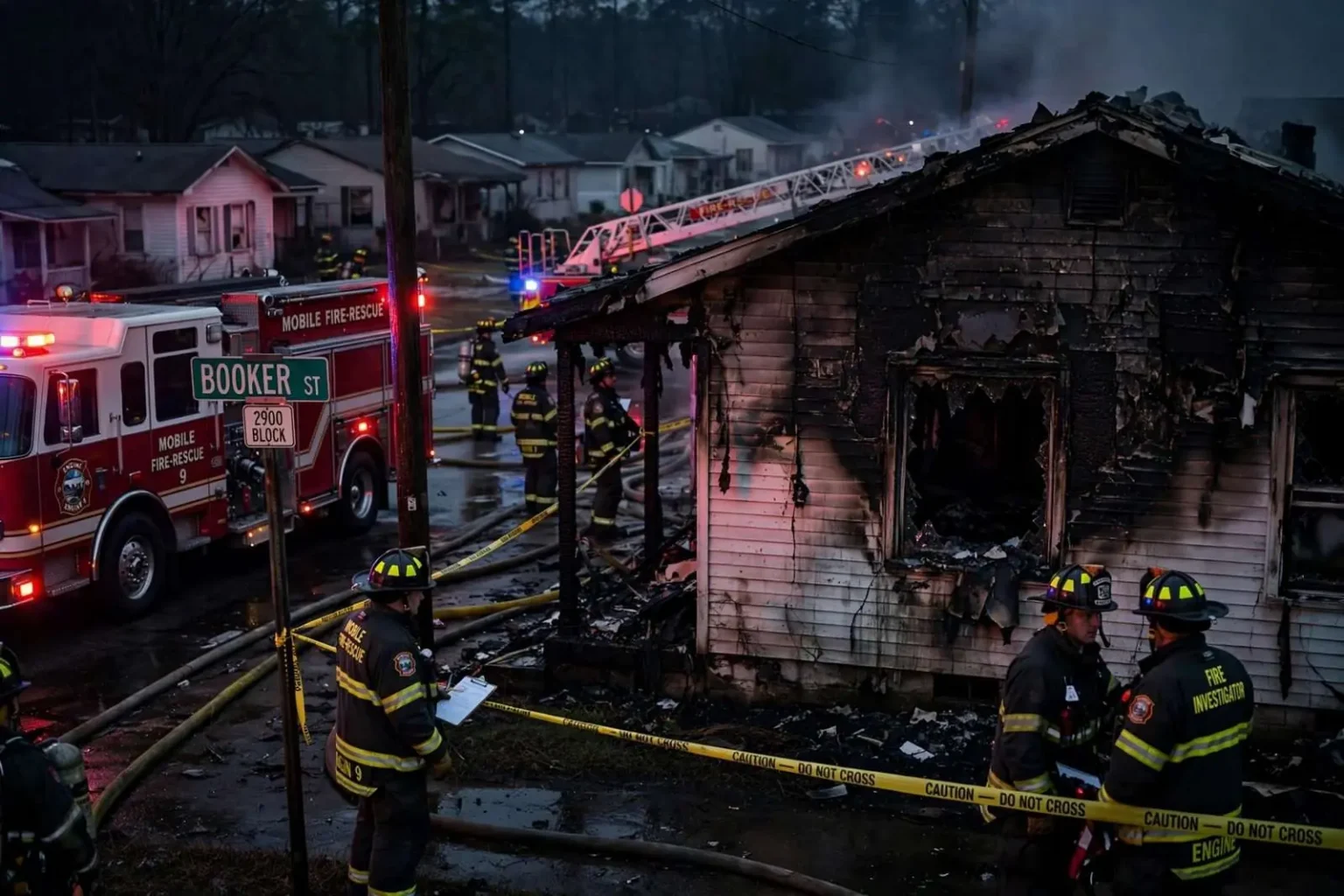
A 72-year-old man died after fire swept through his home on Booker Street in Mobile early on a Saturday morning, according to Mobile Fire-Rescue.
Several crews were called just after 3 a.m. to the 2900 block of Booker Street, a neighborhood near the I-65 and St. Stephens Road interchange, where flames were showing from a window and smoke was billowing from the house. Firefighters arrived to find the man who lived there trapped inside.
After crews extinguished the fire, they found the man’s body inside. Officials said they believe he died in the blaze.
MFRD spokesman Stephen Millhouse said the cause was still under investigation but that investigators believed at this point the fire was accidental.
A Family’s Account
A family member later identified the victim as Charles Standberry, 72, and said he had recently returned home from the hospital after a stroke and had difficulty moving without assistance — which may explain why he could not get out in time.
The family member also said the fire was believed to have involved a space heater, though official investigators had not confirmed a cause. Investigators with the fire marshal’s office routinely spend days examining burn patterns, appliance remnants, and electrical wiring before reaching a determination, and officials cautioned that no finding would be final until that work is complete.
The account, if confirmed, would place the fire among the winter-season heating incidents that fire departments across the Gulf Coast respond to each year. Portable space heaters are a common sight in older Mobile homes, where central heating can be uneven or expensive to run, and they concentrate significant heat into a small area that is often crowded with furniture, bedding, and other combustibles.
How the Morning Unfolded
The 3 a.m. alarm brought multiple engine and ladder companies to the block near the interstate interchange, where crews reported fire visible from a window and heavy smoke pushing from the structure. Firefighters made entry while attacking the flames, searching for the resident who was known or feared to be inside.
Knocking down a structure fire in the middle of the night involves a sequence: first the main body of fire is attacked from outside or through the door, then crews push through the interior to extinguish hidden fire in walls and ceilings, and only then can a thorough search for occupants proceed. In homes where fire has burned for some time before detection, the conditions inside — zero visibility, high heat, collapsed contents — make that search slow and dangerous.
By the time crews reached Standberry, the fire had been extinguished, but the man was beyond help. Officials said they believe he died in the blaze, and the scene was turned over to investigators for the work of determining where and how the fire started.
The Seasonal Risk of Space Heaters
The death underscores the seasonal risk space heaters pose, particularly for older adults living alone; fire officials urge keeping heaters at least three feet from anything flammable and never leaving them running while sleeping.
Fire safety agencies, including national organizations that track home fire data, consistently identify portable heating equipment as a leading cause of home fires during the cold-weather months, and heating-related fires are among the deadliest because they so often ignite at night, while occupants are asleep. A space heater placed too close to a bed, sofa, curtain, or pile of laundry can ignite nearby material within minutes, and a sleeping occupant may never wake before smoke fills the room.
The three-foot rule is the centerpiece of the guidance officials repeat after every such fire. Anything that can burn — furniture, bedding, clothing, papers, holiday decorations — should be kept at arm’s length from the unit, on all sides. Officials also urge buyers to choose heaters that shut off automatically if tipped over, to plug them directly into wall outlets rather than extension cords or power strips, and to place them on flat, stable surfaces away from walkways.
The advice against running heaters while asleep is the guidance most often ignored, and the one investigators most often wish had been followed. Nighttime is precisely when the risk is greatest: the fire starts undetected, smoke alarms may be absent or have dead batteries, and mobility matters most. For an older adult recovering from a stroke, as in this case, escape can be impossible without assistance even with the earliest warning.
Older Adults and Fire Risk
Fire safety research has long shown that older adults face elevated risk of dying in home fires, a pattern driven by mobility limitations, slower reaction to alarms, sensory decline, and a greater likelihood of living alone. Mobile’s population includes a large number of seniors living in older housing stock, much of it built before modern smoke alarm requirements, and fire officials periodically conduct canvasses to install free alarms in homes where none are present.
For families with elderly relatives, the recommendations are practical: check that working smoke alarms are installed on every level and outside sleeping areas; make sure anyone with limited mobility sleeps on the ground floor near an exit; and talk plainly about heating habits, including where a space heater sits and whether it runs overnight. Caregivers are urged to treat a recovering stroke patient’s home the way they would treat a child’s — with hazards removed in advance, because the occupant may not be able to react in time.
Discharge planners and home health workers increasingly include fire safety in conversations with families of patients returning home after major illness, precisely because reduced mobility changes what a survivable fire looks like. In Standberry’s case, the family member’s account — that he could not move without assistance after his recent stroke — captured in one sentence the dynamic that turns an accidental fire into a fatal one.
Mobile Fire-Rescue’s Response Network
Mobile Fire-Rescue operates fire stations spread across the city, and the placement of its companies is designed around response times to densely built neighborhoods like the one off St. Stephens Road. A structure fire report at 3 a.m. typically brings an engine and ladder company first, with additional units dispatched as the incident commander confirms a working fire — a standard upgrade that puts enough personnel on scene to attack the fire, search the structure, and establish a water supply simultaneously.
The department’s investigators work closely with the fire marshal’s office on every fatal fire, documenting the scene in detail before any cause determination is announced. In cases where a specific appliance is suspected, investigators examine the unit itself, its power source, and its position relative to combustible materials, and they interview family and neighbors to reconstruct the hours before the alarm. Those findings matter beyond the individual case: patterns in fatal-fire causes shape where the department directs its prevention campaigns each winter.
MFRD has historically paired its suppression work with aggressive public education, from smoke alarm giveaway programs to door-to-door canvasses in neighborhoods that have experienced fatal fires. The department urges residents to test alarms monthly, to replace units a decade old, and to plan and rehearse two ways out of every room — guidance that assumes the occupants can move quickly, which is why officials tailor additional recommendations for households with elderly or disabled members.
The Neighborhood
The 2900 block of Booker Street sits in a working-class section of Mobile near the interchange of Interstate 65 and St. Stephens Road, an area of modest postwar homes a short drive north of downtown. The neighborhood, like much of the surrounding corridor, is home to longtime residents and a significant number of older homeowners, the demographic profile that fire officials say deserves particular attention during heating season.
News of a fatal fire travels quickly in such neighborhoods, where early-morning sirens wake the block and flames and smoke are visible for streets around. Neighbors gathered as crews worked, and by daylight the house stood behind caution tape, its windows dark — the kind of scene residents of the block have seen before and dread seeing again.
For now, investigators continue their work toward an official cause. Whether the space heater the family member described is confirmed or ruled out, the circumstances of the fire deliver the same warning Mobile’s fire officials deliver every winter: keep heaters clear of everything that burns, make sure the alarms work, and check on the older relatives and neighbors who live alone — because the fire that starts at 3 a.m. does not wait for anyone to wake up.
A Reminder for the Rest of the Season
Fire departments across south Alabama respond to a predictable wave of heating-related calls every year when cold snaps push temperatures low enough for residents to reach for portable heaters. The devices are inexpensive and widely available, and they fill a real need in older homes where central heat struggles or where a single room is occupied. The risk is not the heater itself but its placement and the hours it runs — risks that accumulate in exactly the households least equipped to survive a fire.
Fire officials ask residents to take three steps this week: walk through the home and measure the space around every heater, making sure nothing flammable sits within three feet; press the test button on every smoke alarm and replace any that do not sound or are more than ten years old; and talk with elderly family members and neighbors about how they heat their homes at night. Those conversations, officials say, prevent the fires that alarms alone cannot.
As the investigation on Booker Street continues, officials are expected to release a final cause determination once the scene work and any appliance examination are complete. Until then, the department’s message is the one it has carried through every fatal fire in recent years — the small precautions, repeated after each loss, that make the next 3 a.m. alarm survivable.


