94 Inmates at Loxley Work Release Center Test Positive for COVID-19
State corrections officials confirmed 94 inmates at the Loxley Work Release Center tested positive for COVID-19 in a single round of results, the largest total among four Alabama facilities tested in the latest phase of the state's testing program.
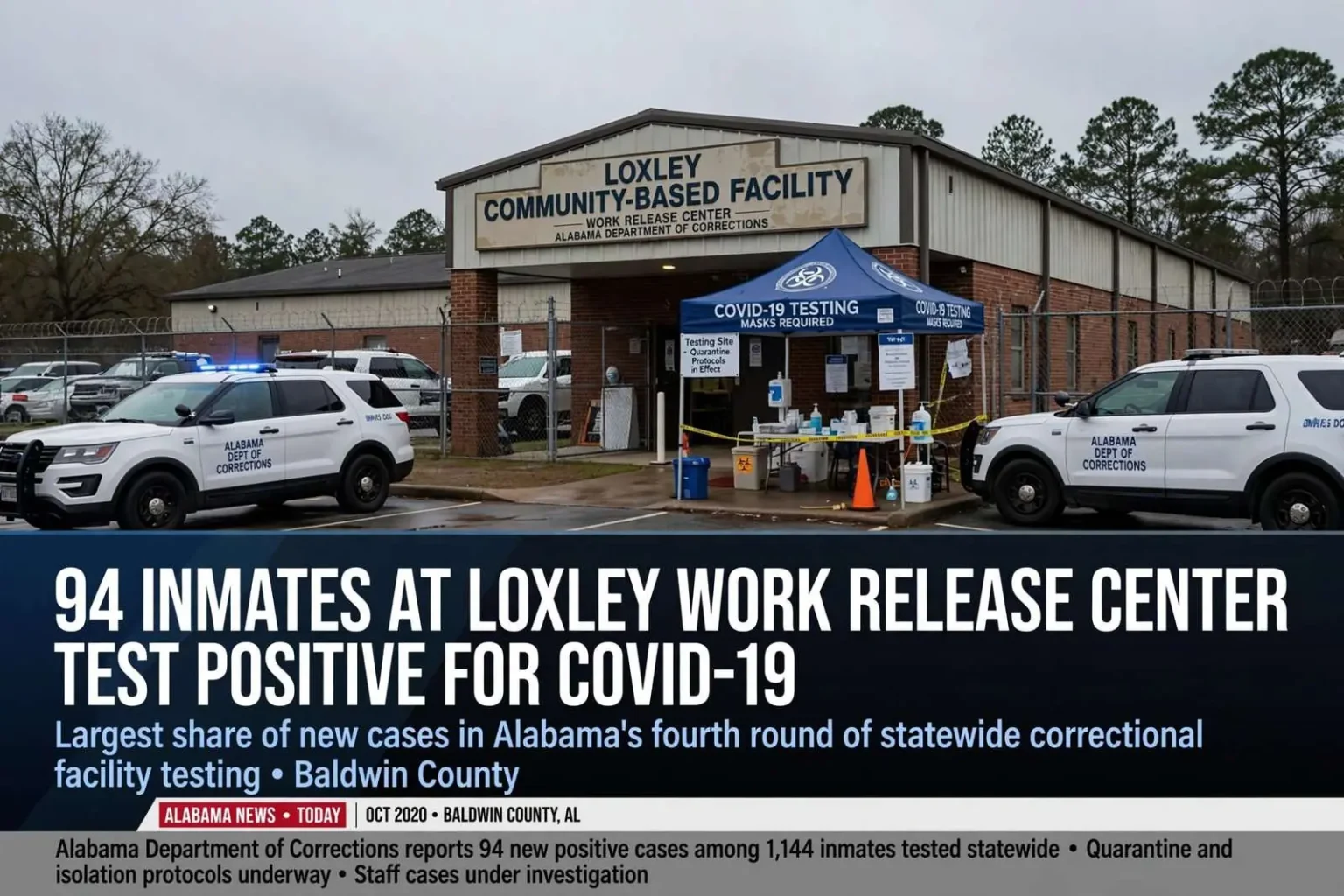
Nearly 100 inmates housed at the Loxley Community-Based Facility, commonly known as the Loxley Work Release Center, have tested positive for COVID-19, according to results from a statewide testing effort covering Alabama’s correctional system. The Alabama Department of Corrections has been rolling out free COVID-19 testing for both staff and inmates at facilities across the state, working through the process in regional groups so that officials can take appropriate quarantine and staffing steps once results are verified.
The Loxley facility, located in Baldwin County, was part of the fourth group of facilities to be tested, alongside Fountain Correctional Facility in Atmore, the North Alabama Community-Based Facility in Decatur, and Kilby Correctional Facility in Montgomery. The grouping stretched across the state — from the Florida line to the Tennessee Valley to the capital region — reflecting the department’s effort to move through its system in manageable batches rather than all at once.
Of the 1,144 inmates statewide who voluntarily took part in the latest round of testing, 163 came back with new positive results. The Loxley facility accounted for the largest share of those cases, with 94 inmates testing positive in a single round of results. The North Alabama Community-Based Facility in Decatur reported the next-highest total, with 69 inmates testing positive.
Concentrations like the one at Loxley are exactly what the testing program was designed to find. Correctional facilities are, by their nature, congregate settings — dormitory-style housing, shared dining and shared work assignments — where the virus can move quickly once introduced. Voluntary testing gives administrators a snapshot of how far an outbreak has progressed, including among inmates who carry the virus without feeling sick, who would otherwise remain undetected in the general population.
State corrections officials said the newly identified cases include inmates who are showing symptoms as well as those who are asymptomatic. Quarantine protocols already in place at the Loxley facility are being maintained for inmates who tested positive, and officials said additional isolation measures are being implemented as recommended by the department’s contracted state medical director wherever needed.
The distinction between quarantine and isolation matters in practice. Quarantine separates inmates who may have been exposed but have not tested positive, while isolation houses those with confirmed cases. Maintaining both tracks at a work release facility presents particular challenges, because the population is smaller and the routines are built around movement to and from outside jobs rather than around confinement in place.
Staff cases and exposure reviews
Staff members at the Loxley facility were also tested as part of the same effort. One staff member at the Loxley Community-Based Facility tested positive, one of five new staff cases confirmed across the group of facilities tested; the North Alabama Community-Based Facility reported four staff cases. All staff members who tested positive were directed to self-quarantine under the guidance of their healthcare providers.
The Department of Corrections’ Office of Health Services said it has opened investigations to determine whether any inmates or employees had direct, prolonged exposure to the staff members who tested positive. Once that review is complete, any employees identified as having had close contact will be advised to reach out to their healthcare providers and begin self-quarantine as recommended.
Those contact investigations are a routine but critical part of managing an outbreak in a correctional setting. Staff members move between housing units, medical areas and administrative spaces over the course of a shift, so identifying everyone who spent prolonged time near a positive case requires a careful reconstruction of assignments and interactions. The same review determines whether any inmates are moved into quarantine as a precaution, even before symptoms or a positive test appear.
Staffing is the other pressure point. When officers and support staff quarantine, facilities must cover their shifts without weakening security or medical operations. The department’s regional approach to testing — announcing results facility by facility, group by group — is intended in part to spread those staffing adjustments out rather than forcing every facility to absorb them simultaneously.
The Loxley Work Release Center houses inmates who are nearing the end of their sentences and are approved to work outside the facility in the surrounding community, an arrangement that has drawn added scrutiny during the pandemic given the regular movement of inmates and staff between the facility and area workplaces. Work release is designed to ease the transition back to civilian life: participants hold jobs with local employers, pay toward their obligations and build a work history before their release.
That same movement, however, means a work release center operates with more contact with the outside community than a closed-security prison. An outbreak at such a facility raises questions that do not arise elsewhere in the system — how quickly work assignments can be suspended, how employers in the community are notified, and how participants who remain healthy are separated from those who test positive.
How work release works in Baldwin County
Community-based facilities like the one in Loxley occupy a distinct niche in Alabama’s correctional system. Unlike the state’s major prisons, which house thousands of inmates each, a community-based facility holds a smaller population classified as lower risk, selected for work release as they approach the end of their sentences. The Loxley center serves Baldwin County and the surrounding Gulf Coast region, an area whose economy — from construction and hospitality to manufacturing and the ports — has long supplied work release jobs for participants.
The model has supporters who credit it with reducing recidivism and critics who question its oversight, but both sides agree on the underlying mechanics: participants leave the facility each workday, are accountable for their hours, and return in the evening. During a pandemic, that daily cycle turns every work site into a potential exposure point in both directions — into the facility and back out into the community — which is why officials treat outbreaks at work release centers with particular urgency.
Kilby Correctional Facility, Loxley’s testing counterpart in Montgomery, serves as the department’s intake and classification center, the place where nearly every inmate entering the state system is processed before being assigned elsewhere. Fountain Correctional Facility sits in Atmore, in Escambia County north of Pensacola. Including facilities of such different missions in the same testing group underscores that the department is sampling the whole system — intake, close custody and community-based operations alike — rather than focusing only on the largest outbreaks.
Baldwin County has otherwise seen a steady stream of COVID-19 case updates throughout 2020 as local health officials have worked to track community spread alongside outbreaks tied to specific institutions. The county’s population growth, its tourism economy along the Gulf, and the constant movement of workers across the Mobile Bay line have all complicated the picture, and institutions like the Loxley center add one more layer that health officials must monitor separately from the general community count.
A system working through the list
State corrections officials have said the rolling, regional testing program is intended to give administrators an accurate, facility-by-facility picture of the virus’s spread so that quarantine housing, staffing levels and medical resources can be adjusted quickly. Rather than waiting for symptoms to surface case by case, the program tests broadly within a group of facilities, then moves the medical response to wherever the results concentrate.
The numbers from the fourth testing group illustrate why that approach matters. A round of testing that found 163 new cases among 1,144 participating inmates — with 94 of them at a single Baldwin County work release center — revealed infections that routine screening would likely have missed, particularly among inmates with no symptoms at all. Each of those cases is now a person in isolation rather than a potential link in a chain of transmission.
Additional groups of facilities are expected to be tested and reported on in the weeks ahead as the department continues working through its statewide system. Until the process is complete, officials caution, the statewide case totals for the prison system remain a moving picture rather than a final count, because facilities not yet tested may be harboring undetected spread of their own.
For the Loxley facility specifically, the immediate work is operational: keeping the 94 positive inmates isolated, maintaining quarantine for those who may have been exposed, covering shifts for the staff member in self-quarantine, and completing the contact investigations opened by the Office of Health Services. Work release assignments, which depend on inmates moving into the community daily, are the piece most closely watched as the outbreak runs its course.
The broader question — how quickly the system can test its way through every facility — will be answered by the groups that follow. What the Loxley results have already shown, though, is the value of looking: in a single round of voluntary testing, one of the state’s smaller facilities produced nearly six in ten of the new cases found in its group.