
951 Government Street Sells for $275,000 With Eight-Story Apartment Conversion Planned
Downtown Mobile's eight-story 951 Government St. building sells for $275,000 to a developer planning apartments, plus more Mobile real estate and business.
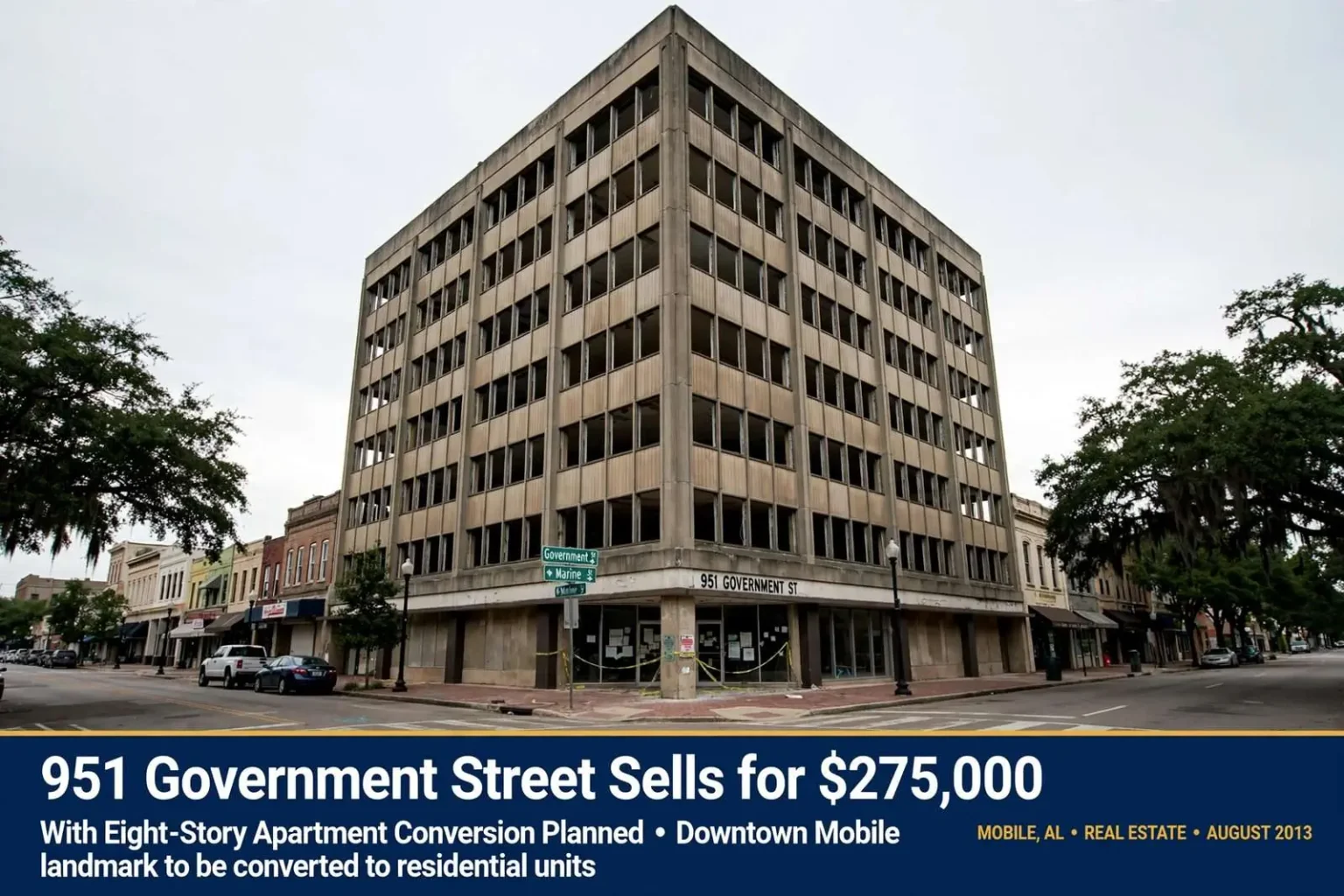
A landmark downtown building is headed for a residential future. Vallas Realty recently sold the property at 951 Government St. — an eight-story, 75,000-square-foot structure on the corner of Government and Marine Streets — to an out-of-state developer who paid $275,000 and plans to convert the building into apartment units.
The price tag is striking for a building of that size, and it illustrates a dynamic that has defined downtown Mobile real estate for years: large, older office towers can change hands for a fraction of what it would cost to build them new, leaving buyers with enormous upside if they can successfully reposition the space. In this case, the plan is to bring residents into a structure that has spent its life serving office users, joining a slow but steady movement of housing into the city’s central business district.
Why the corner matters
The location at Government and Marine Streets places the building along one of downtown Mobile’s most traveled east-west corridors, a few blocks from Bienville Square and within easy reach of the city’s courthouse district, the central business district’s banks and law offices, and the waterfront. Government Street itself carries daily traffic between the Spring Hill Avenue area and the downtown core, and intersections along it have long been considered prime ground for buildings that serve both the daytime office population and the growing number of people who live downtown full time.
Converting an eight-story building to apartments is a substantial undertaking, involving floor plans, plumbing stacks, elevators, life-safety systems and code compliance for residential use. But the economics can work where construction of a comparable new building would not, because the structural shell and the land under it come at a deep discount. Developers across the region have pursued similar adaptive-reuse projects in recent years, turning obsolete offices, warehouses and hotels into rental housing aimed at young professionals, downsizing empty-nesters and workers who want to live near their jobs.
For downtown Mobile, more residents mean more evening and weekend foot traffic for restaurants and shops, more eyes on the street after business hours, and a broader tax base that does not depend solely on the nine-to-five office crowd. City officials have generally welcomed such conversions as a way to keep the historic building stock in productive use rather than sitting vacant or facing demolition.
A busy season for deals around Mobile
The sale was one of several notable transactions around Mobile that summer, a stretch that touched retail, office, restaurant and multifamily property across the city and offered a snapshot of a market moving in several directions at once.
Among the most visible was a short-term seasonal lease of the former Sawyer Furniture Store at 3767 Airport Blvd. to Spirit Halloween, the temporary-costume retailer that pops up each fall in vacant big-box and strip-center space across the country. John M. Delchamps of Merrill P. Thomas Company brokered the deal. Seasonal tenants of this kind have become a familiar part of the retail landscape, allowing landlords to generate income from space that might otherwise sit empty while they search for a longer-term occupant, and giving shoppers a destination for Halloween costumes and decorations that national chains no longer stock in depth.
Local investors also purchased a 10,000-square-foot office building at 3315 Demotropolis Road with renovation plans for tenants, with Joey Betbeze of Betbeze Realty negotiating the deal. Demotropolis Road sits in west Mobile near the Airport Boulevard and Schillinger Road activity centers, an area that grew up with the city’s postwar expansion and remains a strong corridor for professional and medical offices serving the surrounding neighborhoods.
The same buyers also acquired an adjacent vacant lot for additional parking, a detail that matters more than it might appear. Parking is frequently the limiting factor for office properties in built-out corridors, and controlling a neighboring lot gives an owner flexibility to accommodate more tenants or more employees than the existing lot alone would allow. Betbeze represented the purchaser in the lot transaction, and Paul Carter of The Paul Carter Agency represented the seller.
Restaurant activity figured into the season’s deals as well. Marl M. Cummings IV of Cummings & Associates leased the former Jags Grill space at Old Shell and University — 3,210 square feet — to Momma Goldberg’s Deli, with an October opening planned. Cameron Weavil of the Weavil Company represented the tenant. The corner sits in the heart of the Spring Hill College and University of South Alabama retail corridor, an area that lives and dies by second-generation restaurant space, where an existing kitchen build-out can save a new operator months of construction and hundreds of thousands of dollars in startup cost. Momma Goldberg’s, an Auburn-born deli chain known among its fans for its sandwiches and its college-town roots, fits the profile of the corridor’s customer base.
Cummings also represented the buyers of a 4,000-square-foot office building at 2 N. Florida Street, at the northeast corner of Dauphin and Florida Streets. That intersection sits just east of downtown’s core, where Dauphin Street’s commercial spine meets the Medical District’s western edge, and small office buildings there have long housed attorneys, title companies and professional practices that want to be minutes from the courthouses and hospitals without paying downtown’s higher parking and access costs.
A large portfolio changes hands
The biggest single transaction of the season, by dollar value, never touched a single building at all. Provence Real Estate was selected to manage five Mobile apartment communities totaling 2,013 units after their $98 million purchase by Colony Hills Capital of Wilbraham, Massachusetts. The communities include Cabana Apartments, Sandpiper Townhomes, Yester Oaks Apartments, Windsor Place Apartments and The Pathways Apartments, with management effective May 20, 2013, and a local regional office planned.
Deals of that scale are closely watched in apartment-industry circles because they signal how outside capital views the local rental market. A $98 million commitment by a Northeast investor group reflects confidence in Mobile’s job base and rent growth, and the decision to establish a regional office here rather than manage the properties remotely brings management jobs and a local point of contact for thousands of tenants. For the five communities involved, a change in management typically means new staffing, updated maintenance programs and refreshed leasing offices over the following months.
An international chamber chapter takes root
The season’s business news also reached beyond commercial real estate. A chapter of the ASSOCHAM Ladies League was launching in Mobile, with Mobile native Darlene Moore, an actress, screenwriter and producer, appointed as the chapter’s chairperson. The ASSOCHAM Ladies League is the women’s wing associated with the Associated Chambers of Commerce and Industry of India, one of that country’s largest industry bodies, and its chapters work to connect professional women with business, cultural and philanthropic opportunities across borders.
Mobile’s position as a deepwater port with growing international trade ties — from European forest products and German steel investment to Latin American coffee and Asian container traffic — has made the city a natural home for internationally oriented business groups. A women’s league chapter with international reach gives local businesswomen, entrepreneurs and creative professionals a network that extends well beyond the Gulf Coast, and gives visiting delegations a point of contact in the city.
Moore’s own career in film and media reflects the kind of cross-industry connection such organizations try to build. Mobile’s cultural economy, from its historic theaters and film-friendly streetscapes to the annual Mardi Gras season that draws national attention, has steadily attracted producers and creatives who split their time between the Gulf Coast and larger markets.
What the season’s deals say about the market
Taken together, the quarter’s transactions sketch a market with several distinct currents running at once. At the top end, institutional capital is buying Mobile apartments by the thousand units, betting on the region’s long-term job growth. At the middle of the market, local investors are picking up small office buildings and second-generation restaurant space, renovating and re-tenanting them one property at a time. And at the bottom of the price scale, a landmark downtown tower can sell for less than the price of a modest suburban house — because its value depends entirely on what a buyer is willing and able to build there.
For the 951 Government Street building specifically, the apartment conversion plan represents the most common playbook for large vacant offices: keep the structure, replace the use. If the project moves forward, it would put a long-idle building back on the tax rolls, add rental units to a downtown that has been slowly rebuilding its residential population, and preserve a piece of the streetscape at a corner that anchors the western approach to the central business district.
Local real estate professionals say deals like this one tend to move in waves — one successful conversion emboldens the next buyer, and a stretch of seasonal leasing like the Spirit Halloween deal shows landlords are willing to be creative in the meantime. For now, the corner of Government and Marine has a new owner, a plan, and a price that captures both the risk and the opportunity of downtown redevelopment.


