A Christmas Tree Covered in Mementos Keeps Officer Sean Tuder’s Memory Alive
A Facebook-shared Christmas tree covered in mementos shows how Mobile continues to honor Officer Sean Tuder, killed in the line of duty.
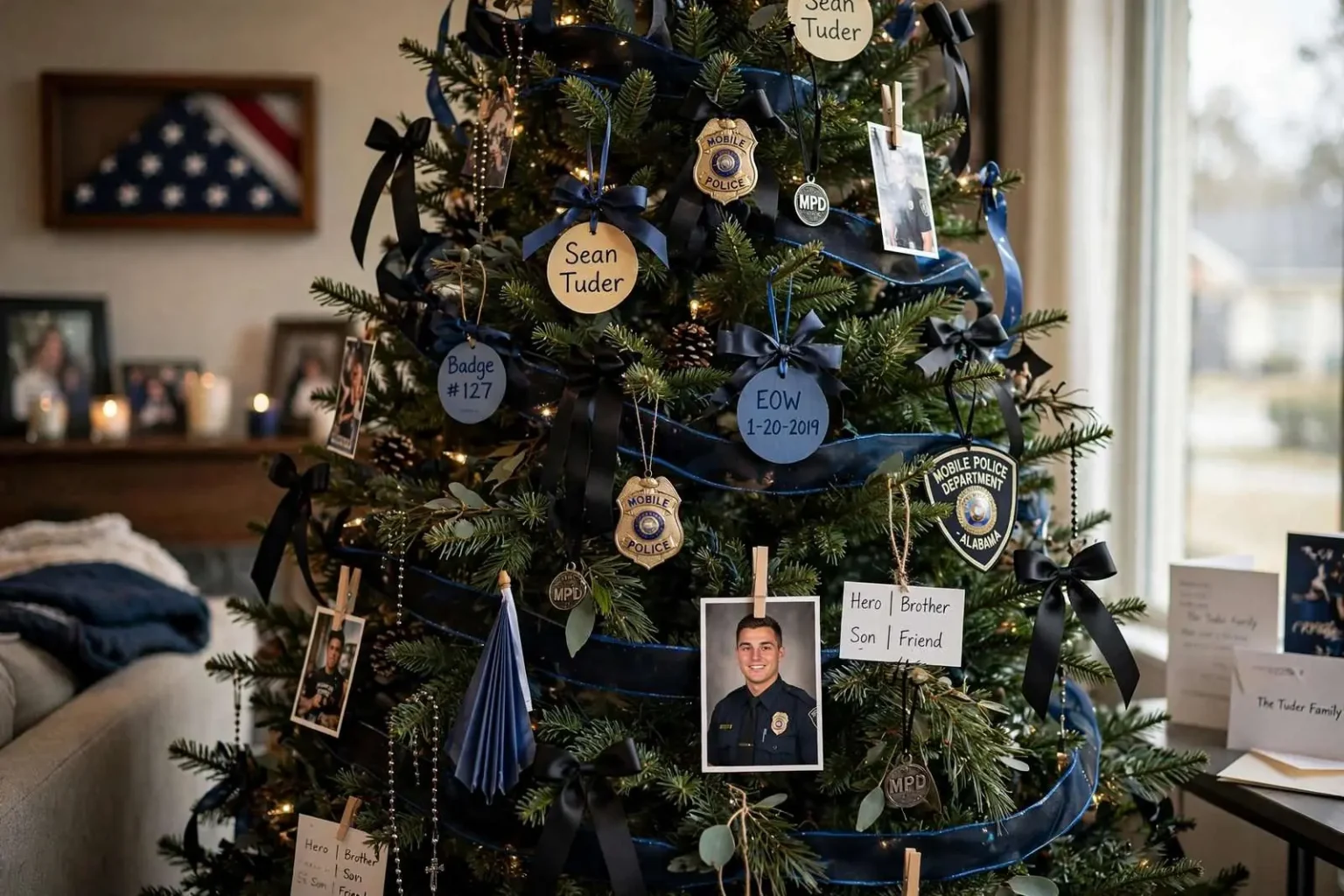
Nearly a year after Mobile Police Officer Sean Tuder was shot and killed in the line of duty, the community found a holiday-season way to keep his memory close. As the holidays arrived that year, a Facebook post showed a Christmas tree draped not in the usual tinsel and baubles, but in memorabilia honoring the fallen officer. Ornaments carried his name and his badge number, along with the blue-and-black colors that law enforcement families across the Gulf Coast use to mark officers lost in the line of duty. The image spread quickly through local social media, where residents paused amid shopping lists and school break plans to remember a police officer many had never met but all seemed to know by name.
Tuder was killed on Jan. 20, 2019, while attempting to arrest 19-year-old Marco Perez. The arrest attempt, carried out by officers with the Mobile Police Department, ended with gunfire that took the young officer’s life and sent a shock through the department and the city. Tuder was in his twenties, at the beginning of what his colleagues described as a promising career, and his death was one of those events that reshapes a police force from the inside. Officers who worked beside him spent the following months adjusting to a roll call that no longer included him, and the department’s chaplains and peer-support networks spent the year attending to the grief that follows such a loss.
In the weeks and months after the shooting, Mobile residents found their own ways to respond. Candles were left at makeshift memorials. Patrol vehicles carried black bands across their badges. Local businesses posted signs of support, and citizens who had never been politically active found themselves attending vigils and fundraisers for the officer’s family. By the time the holiday season arrived, that accumulation of small gestures had become part of how the city processed the loss.
A tree that told a story
The Christmas tree that appeared on Facebook that December was a departure from the customary holiday decor. Rather than glass ornaments and colored lights alone, its branches held mementos connected to Tuder’s life and service. Photographs, badges, memorial ribbons, and other keepsakes were arranged alongside conventional decorations, so that the tree functioned at once as holiday centerpiece and memorial. Friends and family members who saw the post described the effect as both heartbreaking and comforting, a way for a grieving household to include a missing loved one in the season rather than pretend the loss was not there.
Memorial trees of this kind have become an increasingly familiar tradition in American homes that have lost a member of the military or of law enforcement. Instead of hiding grief during a season that prizes cheer, families fold it into the celebration, placing an ornament with a name, a date, or a folded flag where other trees might hold an heirloom ball. The practice acknowledges something that grieving families often say the holidays make hardest: the empty chair at the table and the silence where a familiar voice should be. A tree covered in mementos turns that absence into a presence, at least for a few weeks each year.
For the family and friends of Sean Tuder, the approach of the first holiday season after his death carried a weight that is difficult to overstate. Birthdays and anniversaries of loss are painful in any year, but the first Christmas is widely recognized by grief counselors as one of the steepest tests. Traditions that once took no thought — hanging stockings, wrapping presents, gathering for a meal — must either be reinvented or endured. A memorial tree offers one answer: it lets a family keep the person in the middle of the celebration, in a form that guests and children can see and touch and ask about.
How Mobile remembered its fallen officer
The tree was not the only tribute. Throughout 2019, Tuder’s name appeared on patrol-car decals, at public ceremonies, and in the growing list of Alabama officers honored at the state and national law enforcement memorials. Departments across the region sent honor guards to his funeral, and motorists lined overpass routes as the procession passed. Those public rituals matter to a department, but the private ones — a tree in a living room, a badge on a Christmas ornament — are where the loss is actually lived with, day after day.
Mobile has long been a city where police work is personal. It is a port city with a downtown core, historic neighborhoods, and outlying suburbs, and its officers routinely spend entire careers working the same districts where they grew up. When one of them is killed, the loss registers across a web of family connections, school ties, and church congregations. That closeness helps explain why a single Facebook post of a decorated tree could draw so much attention, and why the comments beneath it read less like reactions to news and more like messages left at a graveside.
While the courts moved forward
The tribute tree offered a small, personal counterpoint to the legal proceedings that continued to move through the courts. The case against Marco Perez remained pending as the holidays arrived, a reminder that for the family, closure in the legal sense was still somewhere in the future. Capital cases move slowly under the best of circumstances, and the months of hearings, filings, and scheduling conferences that follow an officer’s death can stretch the grief across years. Each court date is a fresh confrontation with the events of Jan. 20, 2019.
Against that backdrop, the tree in the Facebook photograph represented something the courtroom cannot provide. It was immediate, personal, and within the family’s control. No judge had to rule on it, and no schedule governed it. It simply stood in a living room, holding the memory of a son, a brother, a friend, and a fellow officer in ornaments instead of legal documents. Residents who shared the post said it reminded them that behind every case number is a household that continues to set one fewer place at the table.
The wider tradition of holiday memorials
The idea of honoring the dead through holiday displays has deep roots in American culture. Families of fallen service members hang battlefield crosses and folded-flag ornaments. Police departments in many states decorate memorial trees each December with an ornament for every officer the state has lost, a practice that turns station lobbies into places of reflection during the holidays. Community groups build Angel Trees for children who have lost parents. In each case, the tree serves the same purpose: it gives grief a visible, shareable form at a time of year when the culture expects joy.
Grief counselors who work with law enforcement families note that holidays are among the most difficult milestones in the first year after a line-of-duty death, alongside the anniversary of the death itself and the fallen officer’s birthday. The sights and sounds of the season — carols, gatherings, photographs — can trigger sudden waves of sorrow, and well-meaning relatives sometimes compound the pain by trying to skip over the loss entirely. Memorial rituals like a tribute tree give everyone in the family, including children, permission to talk about the person who is gone. Experts say that being able to say the name aloud, tell stories, and see the person represented among the decorations helps families move through grief rather than around it.
For the wider community, these displays also serve an educational purpose. Children who see a tree covered in badges and memorial ribbons ask questions, and the answers become a family’s account of what happened and why it matters. Neighbors who might otherwise know only a headline learn who the officer was. In Mobile, where the details of Tuder’s death were followed closely in local news, the tree offered a quieter, more human counterweight to the procedural coverage of arrests and hearings.
Line-of-duty deaths and their long aftermath
The death of a police officer in the line of duty sets in motion a year of firsts for the department as well as the family. The first roll call without the officer. The first time the radio dispatches another call to the same kind of scene. The first academy class that trains without the officer among its instructors or field training officers. Departments across Alabama have developed formal supports for these milestones — peer support teams, chaplain programs, and connections to organizations such as Concerns of Police Survivors, which pairs grieving families with other families who have lived through the same loss.
The holiday season is a focal point for many of those programs. Some departments host memorial ceremonies each December, reading the names of officers lost during the year. Others organize toy drives and scholarship funds in an officer’s name, channeling the community’s desire to help into lasting support for the family. Fraternal orders of police and other associations coordinate assistance across jurisdictions, so that when an officer falls in Mobile or Baldwin County, the response draws on resources from across the Gulf Coast.
What those institutional efforts cannot replicate is the intimacy of a family’s own tribute. A tree covered in mementos is not organized by any agency. It costs nothing, invites no press release, and follows no protocol. It is assembled by people who knew the sound of the officer’s voice and the way he laughed, and it stands in the place where he should be. That is precisely why such displays resonate when they appear online: viewers recognize that they are being allowed to see something private, offered publicly so that others who cared can grieve together.
A season of reflection in Mobile
The reaction to the post reflected how deeply Tuder’s death remained felt across Mobile as families gathered for the season. Comments described prayers for the family, memories of encounters with the officer, and simple acknowledgments that a year had passed without the loss healing. Some commenters wrote that they had followed the case from the beginning; others said the image stopped them mid-scroll and put their own holiday complaints in perspective. A tree, an ordinary object in every living room that month, became a moment of shared stillness.
That is the quiet function of memorial traditions in a city’s life. Headlines move on, court dockets fill with other cases, and the city’s attention shifts to the next storm, the next election, the next season of the year. But the family of a fallen officer lives inside the loss permanently, and a community’s willingness to keep acknowledging that loss — with ceremonies, with badges banded in black, with a tree covered in keepsakes — tells the family that their officer has not been forgotten by the city he served.