A Decade After Deepwater Horizon, Alabama’s Gulf Coast Recovery Is Still a Work in Progress
Ten years after the Deepwater Horizon disaster, Alabama has received more than $790 million in BP-funded restoration and expects over $1.4 billion more — but officials and environmentalists say the Gulf Coast's recovery is far from finished.
Ten years ago this spring, an explosion tore through the Deepwater Horizon drilling platform roughly 41 miles off the Louisiana coast, killing 11 workers and injuring 17 others. In the first 48 hours after the April 20, 2010 blast, it wasn’t yet clear that the disaster unfolding beneath the surface would become one of the worst environmental catastrophes in U.S. history. By the time crews finally capped the ruptured well on July 15 — 87 days later — more than 134 million gallons of oil had poured into the Gulf of Mexico.
A decade later, the spill remains a dividing line in the collective memory of coastal communities from Texas to Florida — a before-and-after moment that residents across the region still refer to simply as “the oil spill.”
“It was a disaster for the families of the 11 men who died on that platform immediately, and while I was certainly worried in the first days, I still didn’t think it was going to be our disaster,” said Casi Callaway, director of Mobile Baykeeper. “I’d been doing environmental work for 20 years, and even I couldn’t fully digest something that terrible happening. But it did, and then it kept happening for 87 days.”
The Long Road to Ecological Recovery
The long-term ecological toll of that three-month spill is still being measured. Nearly two dozen studies conducted by the National Oceanic and Atmospheric Administration have documented crippled Gulf fisheries and widespread deaths among protected marine mammals and sea turtles, whose habitats were contaminated along with the animals themselves. NOAA has estimated it could take close to 40 years for some affected populations to recover to pre-spill levels without aggressive restoration work.
That restoration work has, in fact, been underway for a decade now, funded through billions of dollars in civil and criminal penalties levied against BP and drilling contractor Transocean. Over the past 10 years, BP alone has paid out more than $69 billion toward the region’s recovery — a figure that includes the company’s own emergency response and cleanup costs, resolved economic claims, and money funneled into environmental restoration projects overseen by government trustees. In Alabama specifically, more than $790 million in restoration, conservation and economic development projects have already been completed or funded, and the state is positioned to receive more than $1.4 billion in additional funding over the next 12 years.
Alabama Department of Conservation and Natural Resources Commissioner Chris Blankenship, who led the agency’s spill response a decade ago and now heads the department, said the state’s decision to funnel all of that funding through a single agency has helped it get the most out of the money it has received.
“I think one of the reasons we have such a passion for what we’re trying to do is that we saw firsthand what it was like back then; how desperate the community felt and how concerned we all were with the economic, environmental and ecological losses,” Blankenship said. “I still remember that feeling, and I think we’ve made good use of the funding that’s become available to us so far. We’ve been able to address a number of long-standing environmental issues that I don’t think we could have otherwise.”
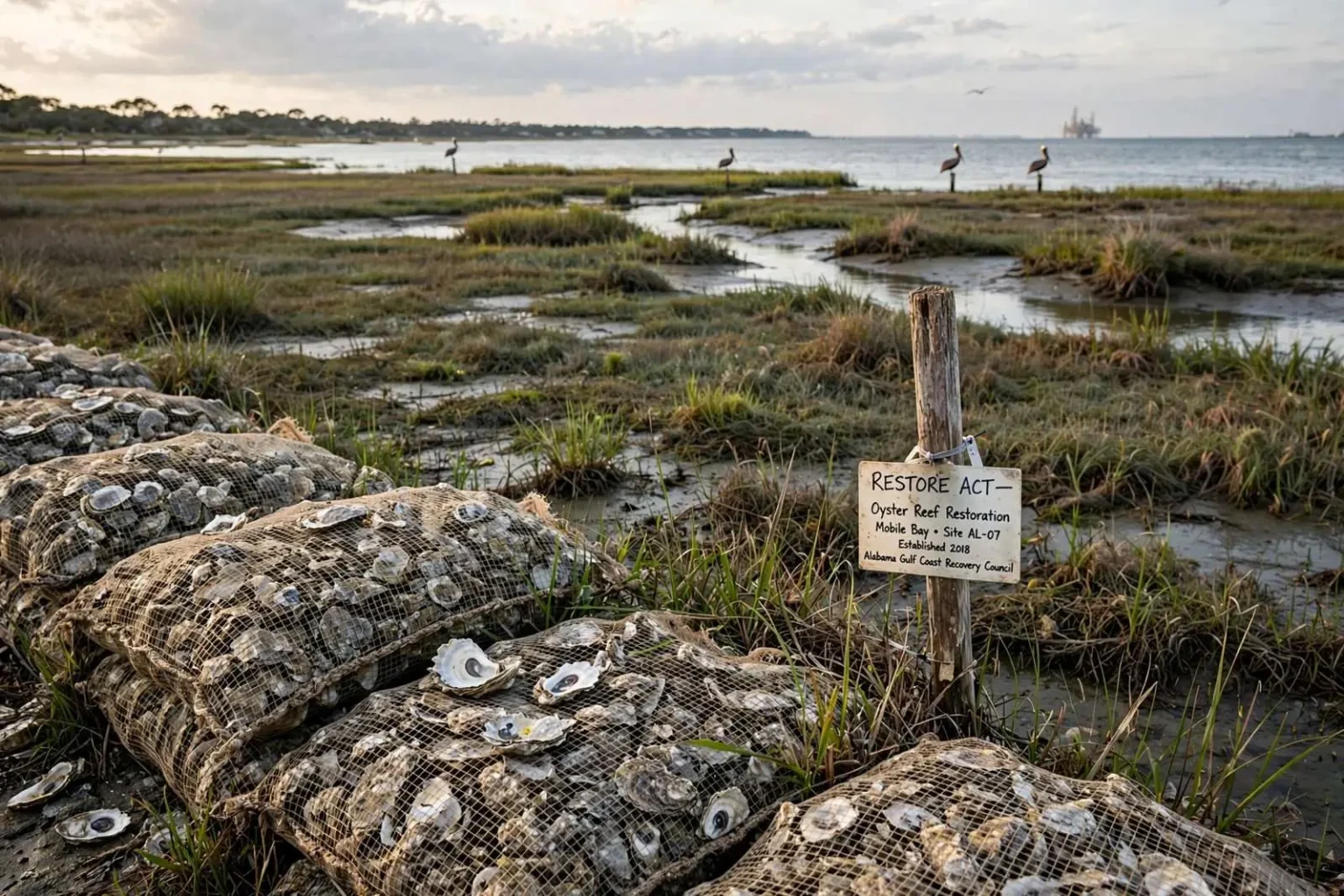
Between 2011 and 2018, Alabama spent roughly 37 percent of its BP funding — the largest single share — on restoring, conserving and enhancing marine habitats along the coastline, with more than $40 million going toward habitats critical to birds, fish, shellfish, marine mammals and sea turtles. Another $11.4 million during that same period funded ongoing oyster restoration efforts in Mobile Bay, one of several projects aimed at rebuilding ecosystems that were battered both by the spill itself and by decades of prior environmental stress.
The RESTORE Act Changes Who Controls the Money
Much of that funding has flowed through the RESTORE Act, a 2012 federal law that marked the first time in U.S. history that local and state leaders in a disaster-affected region were given direct control over how a large share of federal penalty money would be spent, rather than leaving those decisions entirely to Washington. Former U.S. Rep. Jo Bonner, who helped craft the legislation alongside a bipartisan group of coastal lawmakers and now serves as chief of staff to Alabama Gov. Kay Ivey, said he doubts a bill built on that level of bipartisan cooperation could pass through today’s Congress.
“Even with all of its warts and inadequacies, [the RESTORE Act] has still put into place a mechanism where billions of dollars have and will continue to be invested into the recovery of our Gulf states,” Bonner said. “The tourism dollars that come to the state — most of which are generated from Mobile and Baldwin counties — have gone up exponentially over the last five years. That’s in no small part due to our environmental recovery. You can walk on the beaches now and not see tarballs, you can eat the seafood, see the birds flying and enjoy the other symbols of what makes our coastline so special.”
Much of the RESTORE Act money has gone toward the kind of large-scale environmental work conservationists have long pushed for: shoreline restoration, habitat protection, land acquisition, improved stormwater management and long-term ecosystem monitoring. Other funding supported industries devastated first by the spill itself and then by the prolonged tourism downturn that followed — including marketing campaigns aimed at rebuilding confidence in Alabama seafood. All told, the spill’s total economic impact on Alabama was estimated at nearly $1 billion, with much of that damage felt in local communities along the coast.
Economic Development Versus Environmental Spending
Not all of the funding has gone toward projects environmental advocates consider central to ecological recovery, however. A sizable share has instead supported broader “economic development” initiatives, including $56.8 million approved for a suite of Baldwin County projects and $29.6 million allocated to help build a new automotive import and export facility at the Port of Mobile. Callaway said those may well be worthwhile projects, but argued they aren’t the kind of investments that should require a massive ecological disaster to justify.
“This was an environmental disaster that wrecked the Gulf coast’s economy, it wasn’t an economic disaster by itself. There is an intrinsic link between the health of our environment and our economy,” Callaway said. “Early on, [former] Gov. [Bob] Riley told me these funds needed to be used for projects that would be transformational for our communities and for Alabama. Transformational is not building a highway through Baldwin County so that you can open it up to new development.”
There are, notably, restrictions on how much of the RESTORE Act money can go toward economic development rather than direct environmental work — with only one of the funding streams the state oversees allowing unlimited spending on things like public infrastructure. The rest of the funding streams remain, for the most part, dedicated to purely environmental purposes.
Bonner said striking that balance between economic and ecological recovery was always the intent behind the legislation, given how devastating the spill was to coastal livelihoods, not just coastal ecosystems. “I visited the family of a boat captain the day after he took his own life. I had other people tell me their way of life has been destroyed and would never be the same again,” Bonner said. “I respect the critics who say we shouldn’t have balanced things out between economy and ecology, but in my personal view, we had no choice because the two were linked together hand-in-hand.”
Alabama’s Approach to Overseeing Recovery Funds
Alabama took a notably different approach than most other Gulf states in deciding who would oversee its recovery spending. Rather than routing decisions through an existing state agency, Alabama created the Alabama Gulf Coast Recovery Council specifically to review, evaluate and select RESTORE Act projects. Its members include Gov. Kay Ivey, the CEO of the Alabama State Port Authority, the presidents of the Mobile and Baldwin county commissions, and the mayors of Bayou La Batre, Dauphin Island, Fairhope, Gulf Shores, Mobile and Orange Beach, with Bonner serving as a surrogate for Ivey when she’s unable to attend.
That structure has drawn criticism from some who worry that elected officials on the council could be tempted to prioritize projects benefiting their own cities and counties over the broader ecological health of the region. Bonner said he’s heard those concerns but believes putting the decision-making power in local hands was still the right call — pointing to the Alabama Legislature’s 2016 decision to redirect $1 billion of the state’s economic settlement with BP toward patching holes in the Medicaid budget and paying down debt, rather than keeping it along the coast, as a cautionary example of what can happen when the state decides for local communities.
“I don’t know anybody who lives in our area that doesn’t still have a bad taste in their mouth from that decision, and that to me underscores the point that if we had left it up to the state legislature as some states did, I dare say we would have gotten a fraction of what we have gotten,” Bonner said. “This is where the damage was done. Our area is where the impact of this spill was felt the most.”
Drilling Expands as Safety Rules Are Rolled Back
Offshore drilling in the Gulf, meanwhile, has continued to expand in the decade since the disaster, apart from a recent dip in oil prices tied partly to the COVID-19 pandemic. According to the federal Bureau of Ocean Energy Management, there are now 2,827 active oil leases covering more than 15 million acres of the Gulf of Mexico, with drilling activity pushing into areas closer to Alabama’s shoreline than before the spill. Last year, the Trump administration expanded access to offshore oil and gas drilling in nearly all U.S. coastal waters, while also rolling back some of the industry safety regulations put in place after the 2010 disaster.
Callaway credited leaders across the political spectrum — including Blankenship, Bonner and former Gov. Bob Riley — with helping the region come together after the spill to carry out meaningful restoration work and establish new safety standards for the drilling industry. But she said some of those hard-won protections have since been weakened.
“They weren’t great, but there were some good laws meant to help prevent us from seeing another environmental disaster of that magnitude, but over the last three or four years, we’ve weakened those laws or undone them entirely,” Callaway said. “I worry that we’re forgetting.”
For its part, BP has said the company “transformed itself” in the years following the spill, introducing new training programs, deploying updated safety technology and instituting a policy allowing any employee or contractor to halt a job “if something isn’t right.” The company said it has met all of its critical safety metrics over the past nine years, and that the number of its most serious safety incidents worldwide — those involving unplanned or uncontrolled releases of materials — has dropped by roughly 65 percent.
“In 2010, we committed to helping restore the Gulf region economically and environmentally as well as to become a safer company,” BP said in a statement. “The Gulf has recovered well and the lessons we learned and the changes we made — from tougher standards to better oversight — are the foundation of our culture of care. A decade later, we are proud of how we honored our commitments but remain keenly aware that we must always put safety first.”
Callaway said she remains hopeful the spill will stay a “once in a lifetime event” for the Gulf, though she worries that regulators at both the state and federal level still tend to treat environmental protection and economic growth as competing priorities rather than complementary ones. Even after a decade of restoration spending, she said, there’s little chance the Gulf of Mexico could ever be considered fully “made whole” — in part because some of the ecological communities affected by the spill were never well understood to begin with, making it difficult for scientists to measure exactly how much damage was done.
That’s part of why she has pushed for continued BP funding to support ongoing data collection and environmental monitoring, so researchers can build a clearer picture of the Gulf’s overall health and the spill’s long-term impact. A decade after the disaster began, she said residents along the coast should stay engaged in how the remaining recovery money gets spent.
“There are more dollars to be spent from the BP oil spill and the public should be paying attention to make sure what they believe is right is what is actually getting funded,” Callaway said. “We need more access points, more walking, biking and hiking and trails… little places along the water for people to see the beautiful resources we have in coastal Alabama. The more we know about what we have, the more connected we are to it, the smarter we’re going to be about protecting it.”