A Foodie’s Year in Review: New Restaurants That Shaped Mobile and the Eastern Shore in 2018
From Section Street Pizza to The Cheese Cottage, look back at the Mobile and Eastern Shore restaurants that opened, closed and defined the 2018 food scene.
MOBILE, Ala. — Pop the bottles and light the fireworks: 2018 was a solid, if not spectacular, year for Gulf Coast food. From Government Street to the Eastern Shore, new restaurants opened, old favorites closed and the local dining scene kept finding its footing.
The year began with Arroy Thai Cuisine debuting on Government Street and The Cheese Cottage showing Mobile what it had been missing in specialty cheeses. El Papi found its stride early, and Baumhower’s Victory Grille opened at the Shoppes at Bel Air ahead of Texas de Brazil, the churrascaria chain whose arrival had been among the most anticipated openings in the city’s retail scene.
West Mobile welcomed LoDa Bier Garten at Schillinger and Cottage Hill, while Kraver’s Seafood drew acclaim nearby. The openings continued a pattern that has defined Mobile’s suburban growth: each new commercial corridor brings its own wave of restaurants, and by year’s end the neighborhoods west of the city had more options than ever.
The Eastern Shore Blossoms
The Eastern Shore blossomed with new options: Cactus Cantina and Section Street Pizza in Fairhope, Yinzer’s Pizza fronted by Mark Bentz, Buster’s Brick Oven next to Manci’s Antique Club, and Southwood Kitchen near downtown Daphne.
Fairhope’s additions fit the town’s evolving identity. The bluff-top community has spent years building a dining reputation to match its arts scene, and new kitchens along Section Street and the surrounding blocks gave visitors and locals more reasons to make the trip across the bay. Buster’s Brick Oven took its place beside Manci’s Antique Club, the century-old Daphne landmark whose own bar remains a destination, tightening the cluster of dining stops along the U.S. 98 corridor.
Southwood Kitchen’s spot near downtown Daphne put it at the center of that city’s own dining growth, in a stretch where new development has gradually given the Eastern Shore’s largest city a walkable dining district of its own.
Farther south, OWA landed Crazy Donuts and a second Trattoria Pizza location, and Tex-ar-bama Barbecue planted a brick-and-mortar spot in downtown Fairhope. The OWA arrivals — at the entertainment destination that draws families to Foley — underscored the theme of the year: food followed foot traffic, wherever the crowds gathered.
Food on the Go
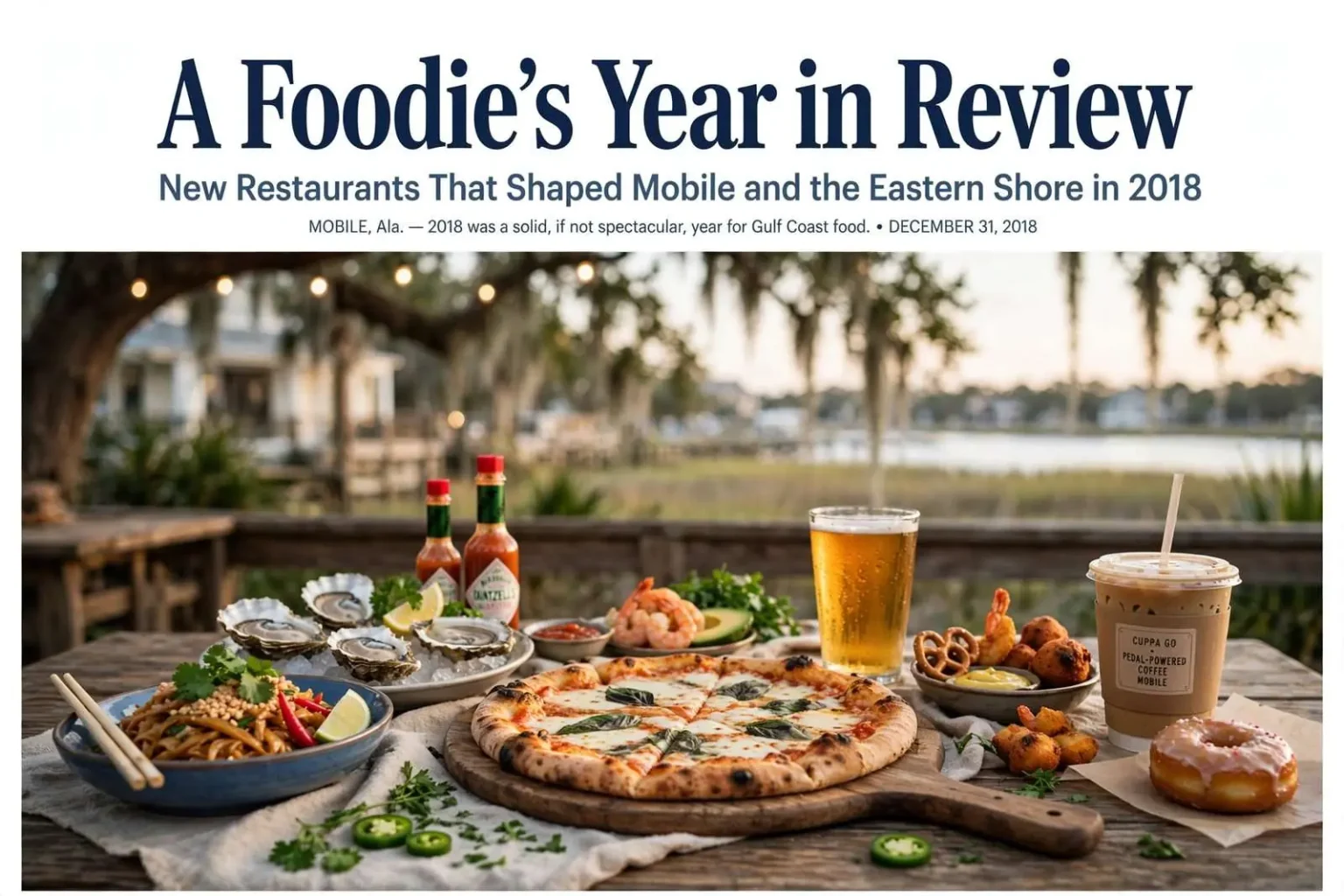
Food on the go gained ground with the Hotdoggery, Tin-tin’s Rock and Roll Food Truck and Cuppa Go, a pedal-powered coffee shop. The mobile side of the industry kept expanding across the coast, with trucks and carts appearing at breweries, office parks, festivals and private events — a low-overhead entry point that let operators test concepts before committing to brick and mortar.
In other coffee news, Chaleur moved from Glenwood to Dauphin and Semmes. The coffee roaster’s expansion reflected the region’s growing cafe culture, which has quietly become one of the most competitive corners of the local food scene, with each neighborhood supporting its own morning crowd.
The Ruby Slipper Café slipped onto Royal Street, and a long-awaited Publix finally arrived at Old Shell and Florida, ushering in Taco Mama and Simple Greek. The grocery-anchored development filled a gap in midtown’s retail landscape, and the attached restaurants gave the corner the kind of daily traffic that sustains a block.
The Year’s Losses
The year also brought losses. Chat A Way Café, Grimaldi’s Pizza, Fuzzy’s Tacos and PDQ all closed, and Kitchen on George shut abruptly before the holidays. Each closing removed a different piece of the local table — a neighborhood breakfast stop, a pizza standby, two chains and an midtown kitchen that had built a loyal following along George Street.
The churn is familiar to anyone who follows the restaurant business. Independent kitchens operate on margins thin enough that a slow season, a lease dispute or a staffing shortfall can end a run, and even well-loved names are not immune. The 2018 closures touched midtown and the suburbs alike, a reminder that openings in one part of town often come at the expense of diners’ attention elsewhere.
Mobile lost icons too: chief oyster shucker Willie Brown of Wintzell’s fame died in the spring, and the region mourned beloved figures Mary Scarcliff and Queen G. Brown’s career behind the oyster counter at Wintzell’s Oyster House made him a one-man institution — the kind of personality a city associates with a single barstool and a shucker’s knife — and his passing drew tributes from across the Gulf Coast food world.
Scarcliff and Queen G each left their own mark on the region’s tables and gathering places, and the tributes that followed them reflected the personal quality of Mobile’s food culture: in a city this size, the people who feed the town become part of its civic memory.
Where the Scene Is Heading
By one local reckoning, the food scene trends positive — shorter menus, fewer tables, more places to eat. The pattern reflects national shifts arriving on the Gulf Coast: smaller kitchens with tighter concepts, menus that change with what is available and owners who would rather do one thing well than a dozen things adequately.
For diners, the arithmetic works in their favor. More places to eat means more reasons to explore, and the 2018 openings stretched from midtown Mobile to Foley, spreading the region’s dining energy across a map that no longer begins and ends downtown.
The 2019 resolution, as one writer put it: “Go small or go home.” The line captured both the year’s lesson and its promise — that the Gulf Coast’s food future belongs less to sprawling menus and big dining rooms than to focused kitchens run by people who know exactly what they do best.
A year in review is really a map of a community’s habits: where it shops, where it celebrates and what it mourns. The 2018 version of that map — Arroy Thai on Government Street, a burger grill at Bel Air, doughnuts in Foley, oysters at Wintzell’s — showed a coast still growing, still eating and still saying goodbye to the people who made its tables memorable.
Government Street and Midtown’s Momentum
The openings along Government Street and in midtown deserve a closer look, because they illustrate how neighborhoods change. Arroy Thai Cuisine’s debut added a Southeast Asian option to a corridor long known for its mix of older establishments and new arrivals, and The Cheese Cottage gave home cooks and gift shoppers a specialty shop that had no local equivalent. Small businesses like these anchor a street differently than chains do — they draw destination traffic, they personalize service and they give a block a reason to be talked about.
El Papi’s early stride suggested that the corridor’s appetite for modern Mexican cooking was real, and its momentum through the year made it one of the openings diners mentioned most. Meanwhile the Shoppes at Bel Air transformation, anchored by the arrivals of Baumhower’s Victory Grille and Texas de Brazil, restored a shopping center whose restaurant lineup now draws evening crowds as reliably as its stores once drew shoppers.
The pattern repeated across the market. LoDa Bier Garten’s westside location brought the downtown brewery-garden concept to a Schillinger Road audience that no longer had to cross town for it, and Kraver’s Seafood demonstrated that a straightforward plate of Gulf fish still draws acclaim without a downtown address.
What the Openings Say About the Economy
Restaurant growth tracks confidence. Kitchens open when operators believe there are enough diners to fill them, and the breadth of 2018’s openings — from downtown Fairhope to Foley — signaled a Gulf Coast economy generating new households and new spending power along the whole Interstate 10 corridor. The region’s population growth has been among the fastest in Alabama for years, and each year’s restaurant class is both a consequence of that growth and an accelerant of it.
The year’s mobile food operators told the same story from a different angle. The Hotdoggery’s elevated take on the humble hot dog, Tin-tin’s music-themed truck and Cuppa Go’s pedal-powered coffee cart all operated with models that favor flexibility over overhead, letting owners go where the crowds are. Expect more of that, not less, as the region’s food entrepreneurs keep looking for openings that a traditional restaurant cannot fill.
Chaleur’s move from Glenwood to Dauphin and its expansion into Semmes showed an established operator betting on both sides of the bay, while the Ruby Slipper’s arrival on Royal Street extended a Gulf Coast breakfast brand deeper into downtown. The Publix development at Old Shell and Florida, arriving after years of anticipation, turned a long-vacant corner into a daily-traffic engine — and Taco Mama and Simple Greek were positioned to catch the overflow.
Every year in a food scene brings openings no one predicted and closures no one wanted. What distinguishes a healthy market is the balance between the two, and on that measure 2018 tilted positive for the Gulf Coast: more doors opened than closed, more concepts launched than folded, and the region ended the year eating better than it began.