A recent installment of a long-running local history and nostalgia column took Mobile readers on a detour through the city’s past, mixing colorful personal recollection with an open question that historians say is trickier to answer than it sounds. In a few column inches, the piece touched three separate threads of local memory: a street-level character from the golden age of downtown, the location of the site where French colonists first planted a settlement on the Gulf Coast, and a generations-old slight against one corner of the metro area.
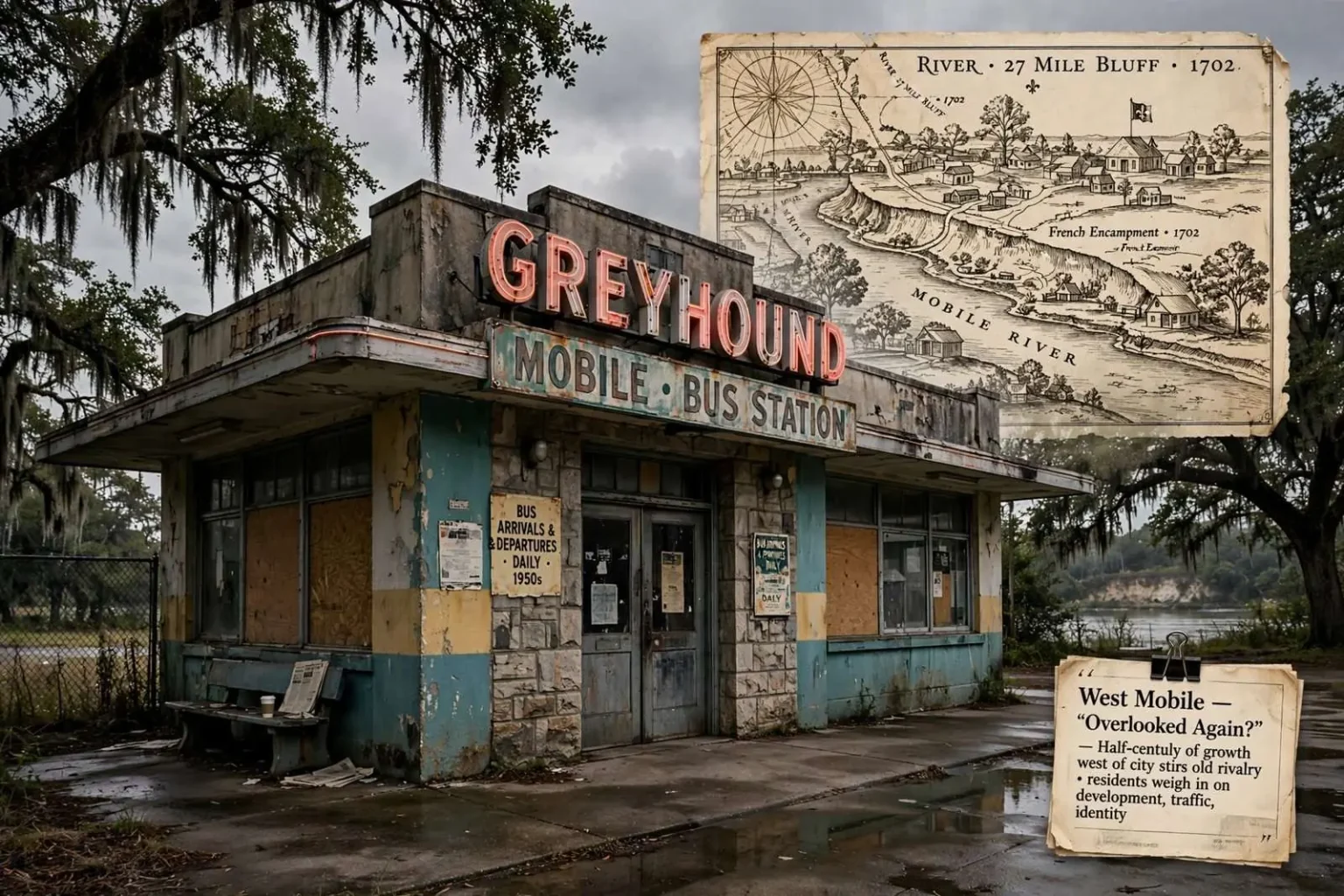
The column recalled a colorful character known only as “Bobby,” a self-described hustler who was said to have haunted the old Mobile Greyhound Bus Station in its heyday. Stories like his are the raw material of urban memory, the unofficial landmarks that never make the historical markers but stick in the minds of the people who were there.
Bus stations of that era were, in cities across the country, gathering points for a cross-section of urban life, and downtown Mobile’s station was no exception. Soldiers passing through on their way to coastal postings, traveling salesmen, students heading home for the holidays and night-shift workers all moved through the same waiting room, and the depot counters and coffee pots served as informal meeting points where the whole city briefly crossed paths.
For longtime residents, the mention of the station is itself a marker of a downtown that looked very different from today’s version, before decades of redevelopment, highway construction and suburban growth reshaped the city center. The rise of the automobile and the interstate system drained ridership from intercity bus lines nationwide, and depots that once anchored busy blocks were closed, repurposed or demolished as their neighborhoods changed around them.
The Puzzle of Twenty-Seven Mile Bluff
The column also waded into a long-simmering local puzzle: the exact location of Twenty-Seven Mile Bluff. The name itself is a clue, borrowed from the distance the site sits up the river from the present-day city, but the centuries have blurred the details that historians and surveyors still argue over.
The bluff holds an outsized place in Mobile-area history. It is generally understood to be the site where French colonists established a settlement in 1702, more than a century before New Orleans existed and years before Mobile itself moved to its current location on the Mobile River. The French presence on the Gulf Coast in those years was part of the broader colonial scramble for North America, and the Mobile settlement served as the capital of the vast French claim called Louisiana in its earliest years.
That 1702 settlement is also credited with hosting one of the earliest Mardi Gras celebrations in what would become the United States, a claim the city of Mobile has continued to promote as part of its identity as the birthplace of American Mardi Gras. The celebration that began as a small colonial observance eventually grew, after the city’s move downriver and through the 19th century, into the masked societies and parade traditions that now fill downtown Mobile’s streets every Carnival season.
Despite the site’s significance, its precise present-day location along the river bluffs north of the city has been debated by local historians for years, since the settlement was later abandoned in favor of the current downtown site after repeated flooding. The low ground near the river made an easy landing for boats but a poor home for a town, and when floodwaters repeatedly inundated the original site, the colonists relocated to the spot where downtown Mobile stands today. Archaeological interest in the bluff country north of the city has never fully gone away, and the exact ground the first colonists walked remains a matter of scholarly and amateur debate.
Questions like that one are common in Gulf Coast history. Documents and maps from the colonial era are scarce, place names shifted between French, Spanish, British and American rule, and rivers changed course over the centuries. Twenty-Seven Mile Bluff is precisely the kind of site where the written record and the landscape do not quite line up, which is why the debate keeps resurfacing in local columns, museums and historical society meetings.
Rounding out the column was a reference to an old published slight against residents of West Mobile, the kind of good-natured, or not-so-good-natured, rivalry between different pockets of the metro area that longtime residents will recognize. Arguments over which part of town has been slighted, overlooked or misunderstood by the rest of the city are themselves a form of local tradition, one the column appeared to be leaning into rather than resolving.
West Mobile’s growth over the past half-century gives the rivalry real substance. The area west of the city core grew from farmland and piney woods into one of the metro area’s busiest residential and commercial zones, and residents there have long traded jokes and grievances with counterparts downtown and across the bay in Baldwin County about traffic, development and who really represents the heart of the city.
The bus station story fits the same pattern of memory under pressure. As anyone who rode a Greyhound in the mid-century decades can attest, the depot was more than a place to buy a ticket, and the characters who orbited it, from porters and taxi drivers to fixtures like Bobby, were part of the daily texture of downtown. When buildings like it disappear, columns and readers become the only archive left, which is why nostalgia pieces about them routinely draw waves of responses from readers adding their own recollections.
Mobile’s colonial-era story has received renewed attention in recent decades as archaeologists and historians reexamined the French presence on the Gulf Coast, from the early settlements to the trade networks that tied the region to French colonial ambitions across the lower Mississippi valley. Each reexamination tends to revive interest in the bluff sites north of the city, where the colony’s first chapter began and where answers may still lie in the ground.
Why These Small Questions Matter
Columns like this one serve a function beyond entertainment. As downtown Mobile continues to change, with older buildings renovated, repurposed or lost altogether, the effort to pin down details like the fate of the Greyhound station or the true location of Twenty-Seven Mile Bluff becomes part of the broader work of preserving local memory.
Local historians and history-minded columnists alike have long argued that these small, sometimes unresolved questions matter because they are the threads that connect the Mobile of today to the Mobile of earlier generations. A depot’s address, a bluff’s location and an old newspaper jab are entry points into bigger stories about transportation, colonization, urban growth and civic identity, and they reach readers who might never open a formal history book.
Mobile has more formal anchors for that memory than most Southern cities its size. Historic districts downtown and in neighborhoods like Oakleigh preserve 19th-century architecture, and museums and Carnival organizations keep the city’s founding story in regular circulation, especially each Mardi Gras season when the 1702 origins come up again. But the informal record, the remembered characters and neighborhood arguments, lives almost entirely in columns like the one that recalled Bobby and the old bus station.
Nostalgia also does quiet economic and civic work. Preservation-minded redevelopment downtown has leaned on the city’s historic fabric as an asset, drawing visitors and residents back to a city center that emptied out in the decades after mid-century. Every generation that learns why Twenty-Seven Mile Bluff matters, or what a Greyhound depot meant to a mid-century downtown, has more reason to care about what gets saved and what gets torn down.
The column’s unresolved questions, fittingly, are the point. Local history in Mobile is less a settled record than an ongoing conversation, carried out in newspapers, museum exhibits, Carnival traditions and kitchen-table arguments about which side of town got the better deal. As long as readers keep asking where the first settlement actually stood and what became of the places they remember, the conversation keeps the city’s past close enough to touch.
For now, the bluff keeps its secret somewhere along the river north of the city, the old depot lives on in memory, and West Mobile can add another published slight to its collection. In Mobile, all three count as history.
The pattern repeats across the Gulf Coast, where fast-growing cities often outrun their own histories. Mobile is old enough to have centuries of record but young enough, in spirit, to still be deciding what deserves saving, and the tension shows whenever a mid-century building faces the wrecking ball or a colonial site surfaces in a development review. A nostalgia column is one of the few regular places where those decisions get aired before they are made.