Thomasville High Graduate Returns Home as a Math Teacher Four Years After Walking the Stage
Abigail Thompson, a 2022 Thomasville High School graduate, is coming back to her alma mater this fall to teach mathematics after earning two degrees from Auburn University.
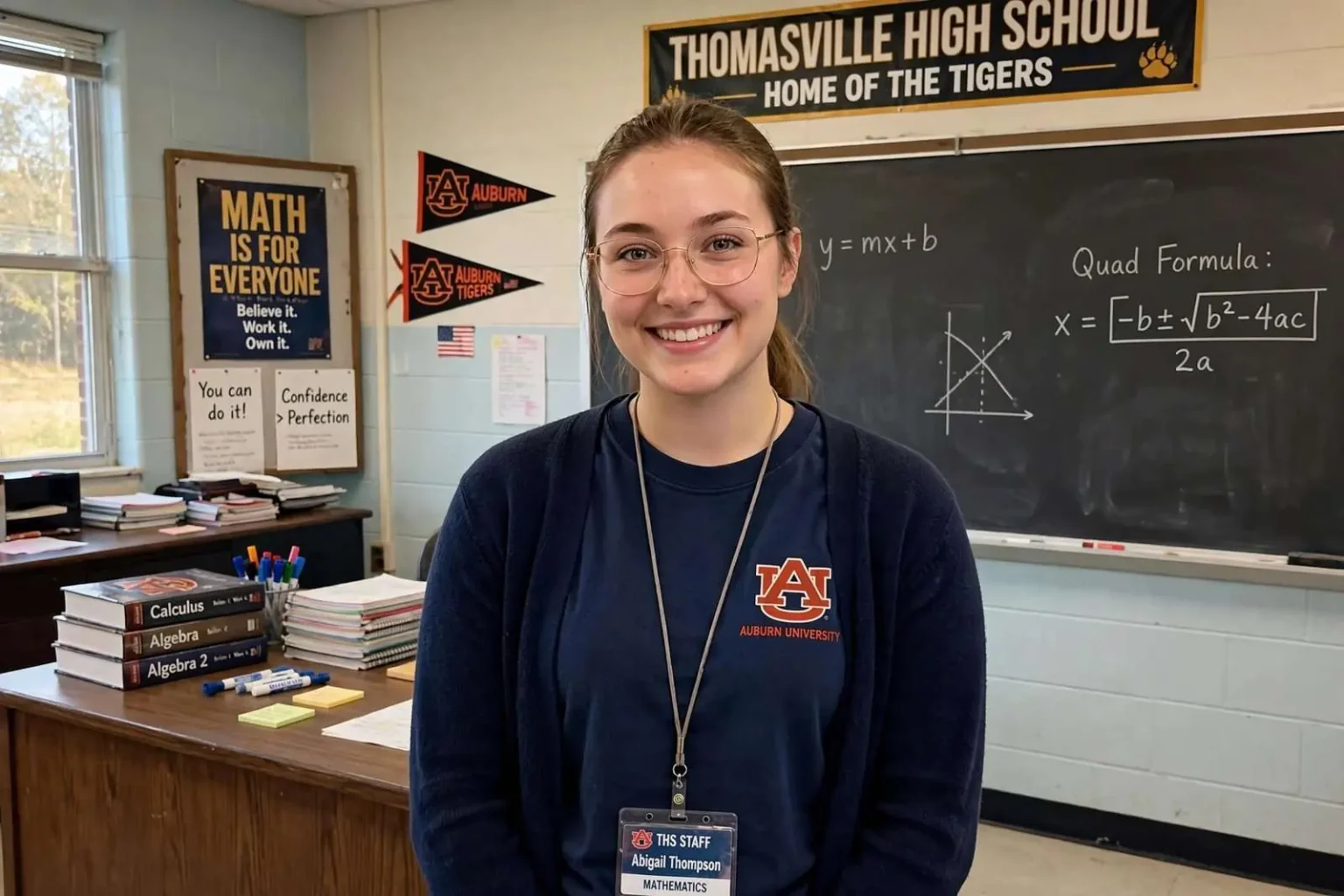
Four years after crossing the stage as a Thomasville High School senior, Abigail Thompson is walking back through the doors of her alma mater. This time she will be standing at the front of the classroom.
Thompson, a 2022 THS graduate, will join the school’s mathematics department for the 2026-27 academic year. She recently completed her undergraduate work at Auburn University, earning bachelor’s degrees in both mathematics education and mathematics.
“I am thrilled to be returning as a Thomasville Tiger,” Thompson said.
A Mission Rooted in Confidence, Not Just Content
Thompson said her time at Auburn sharpened not only her command of mathematics but her thinking about how students relate to the subject. Math occupies an unusual place in American education: it is the discipline in which otherwise capable students are most likely to declare themselves permanently incapable, often before high school even begins.
Thompson framed her goal as an educator in direct response to that pattern.
“My goal as an educator is to help create a positive perception of mathematics and inspire students to recognize the opportunities it can provide both inside and outside the classroom,” she said.
That framing is worth sitting with. Research on mathematics achievement consistently finds that a student’s self-concept, their belief about whether they are a “math person,” predicts performance nearly as strongly as prior achievement does. A teacher who treats confidence-building as part of the curriculum rather than a side effect of it is addressing one of the discipline’s genuine structural problems.
Why the Return Matters
Rural school districts across South Alabama face a persistent recruiting challenge, and it is most acute in exactly the subject Thompson teaches. Mathematics and science teachers are among the hardest positions to fill statewide, because graduates with those degrees have well-compensated options outside the classroom in engineering, finance, data analysis and software.
Districts in smaller communities compete for that same shrinking pool against larger systems that can offer higher salaries, bigger departments and more amenities. The result is that rural schools frequently rely on long-term substitutes, out-of-field teachers or emergency certifications to cover math courses.
A homegrown hire changes that calculus. Teachers who return to their own communities:
Stay longer. Retention is markedly higher among educators with existing family and social ties to the area, and teacher turnover is one of the strongest negative predictors of student achievement.
Understand the students. Thompson sat in the same classrooms and knows what the path from Thomasville to a four-year university actually requires, because she walked it.
Serve as living proof. A student who is unsure whether a place like Thomasville can send someone to Auburn and back with two math degrees now has an answer standing at the whiteboard.
Two Degrees, and What They Signal
Thompson earned degrees in mathematics education and mathematics, which is a heavier undergraduate load than certification alone requires. A mathematics education degree provides the pedagogical training and state certification needed to teach. A separate mathematics degree signals depth in the subject itself, including coursework well beyond what a high school curriculum demands.
For students in Thomasville, that combination is practical rather than decorative. It means the teacher handling upper-level courses has the content mastery to push advanced students, support dual-enrollment and Advanced Placement work, and answer the question that every strong math student eventually asks: what is any of this actually for?
Coming Home
Thompson said returning to Thomasville High as a member of the faculty carries a particular weight for her.
“It is an honor to now serve the same community that played such an important role in shaping who I am today,” she said.
For a small Clarke County city, that sentiment reflects something the community has invested in for generations. Schools in towns of Thomasville’s size are not simply institutions; they are the primary engine of local opportunity. Every graduate who leaves for a university represents an outward investment, and every one who chooses to come back represents a return on it.
The Broader Stakes for Rural Alabama Schools
Thompson joins the THS mathematics department as the district continues staffing for the fall term. Students returning for the 2026-27 year will find a teacher who was, not long ago, sitting where they now sit, and who came back on purpose.
Why Alabama’s Teacher Pipeline Needs Homecomings Like This
The significance extends beyond one classroom. Across Alabama, the pipeline that produces qualified math teachers is thin, and the communities that feel the shortage most acutely are often the smallest ones. When a graduate of a local high school earns two mathematics degrees from a major public university and then chooses to return, it strengthens the case that rural schools can be both a starting point and a destination for talented educators.
Auburn University, where Thompson completed her degrees, is one of Alabama’s two land-grant institutions and a primary source of certified teachers for the state’s public schools. The mathematics education program there prepares candidates for the full range of high school instruction, from foundational courses through advanced placement and dual-enrollment offerings. Thompson’s return to Thomasville therefore represents not only a personal homecoming but also a concrete example of how Alabama’s teacher-preparation pipelines can flow back into the very communities that need them.
For the students who will file into her classroom this fall, the message is practical: the person at the front of the room believes mathematics is for them, and she is living proof that a Thomasville Tiger can leave, earn two degrees, and come home to teach the next generation.
Thompson’s First Year and a Message to Students
The 2026-27 school year will be Thompson’s first as a full-time teacher, and her arrival comes as Thomasville High continues to build out its academic offerings. Advanced Placement and dual-enrollment courses have become an important pathway for rural Alabama students who hope to earn college credit before graduation, and a teacher with deep content mastery in mathematics is well positioned to support those programs. Strong math preparation also underpins success in science, engineering and health-care fields that are in high demand across the Gulf Coast region.
Thompson’s return is also a quiet rebuttal to the narrative that small towns lose their best and brightest for good. She left Thomasville, earned two degrees at Auburn, and chose to come back. For the students who will sit in her classroom, that arc is its own lesson: a Thomasville education can be the beginning of a serious academic journey, not a limitation on one.
Thomasville, in Clarke County in southwest Alabama, sits along the U.S. 43 corridor between Mobile and the state line with Mississippi. The town of roughly 4,000 residents is the commercial center for the surrounding rural area and home to Thomasville High School, the public school whose mathematics department Abigail Thompson is joining.
Auburn’s Role in Training Alabama’s Teachers
Auburn University, where Thompson completed her degrees, is one of Alabama’s two land-grant institutions and a primary producer of certified teachers for the state’s public schools. Auburn’s College of Education offers undergraduate and graduate programs in mathematics education, science education, elementary education and other fields, with strong partnerships across Alabama school districts for student teaching and clinical placement.
Rural school districts across Alabama have faced persistent teacher recruitment challenges, particularly in mathematics, science and special education. Districts in smaller communities often rely on out-of-field teachers, long-term substitutes or emergency certifications to fill vacancies, and competitive recruitment by larger suburban and urban systems can drain the pool of available candidates.
Teacher retention is a significant predictor of student achievement, and teachers who return to their home communities tend to stay in the profession longer than those who relocate. The phenomenon has been documented in research on rural education across the country, with homegrown hires often bringing stronger community ties, deeper cultural understanding and longer career commitments.
Clarke County’s Long History of Producing Educators
Clarke Preparatory School, where Abigail Thompson graduated in 2010, is an independent school serving students from across Clarke County and surrounding communities. The school’s small size means that graduates who go on to notable accomplishments are remembered and recognized by faculty and classmates for years afterward. The school’s first West Point appointment was a notable milestone for the institution as well as for Thompson.
Mathematics teacher recruitment has been a particular challenge across rural Alabama, with smaller districts often struggling to match the salaries and resources offered by larger systems. Teachers who return to their home communities bring valuable perspective, and their presence can encourage other graduates to consider teaching as a career. The impact of a single homecoming hire often extends well beyond the individual classroom.
Alabama’s teacher certification process requires completion of an approved educator preparation program, passage of required subject-matter exams, and a background check before candidates can receive their initial professional certificate. Auburn’s mathematics education program covers both content and pedagogy, with clinical placements in partner schools providing hands-on classroom experience before graduation. Thompson’s completion of the program reflects the successful navigation of that process.
The Clarke County School District serves students across a rural county in southwest Alabama, with schools in several communities including Thomasville, Grove Hill and Jackson. The district’s high schools have long sent graduates to Alabama’s public universities, and the return of teachers to their home schools is celebrated locally as evidence that small communities can produce graduates who excel and choose to give back.