‘Diminished Capacity’: Suspended Judge’s Answer to 60 Charges Took an Unusual Turn
Facing a 113-page ethics complaint, Clarke County Circuit Judge Stuart DuBose denied every count and argued that his mental and physical condition had impaired his ability to make rational decisions.
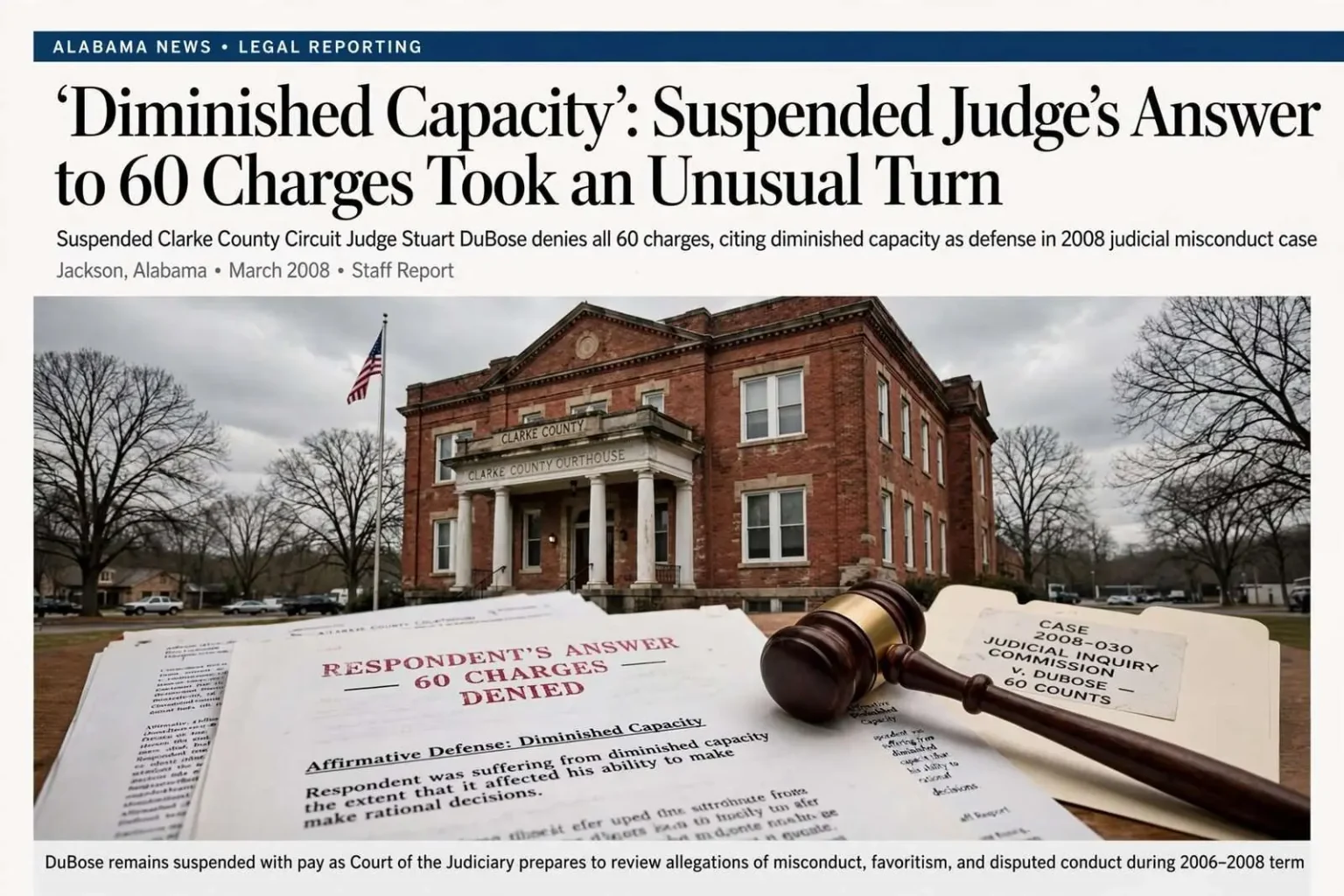
Suspended Clarke County Circuit Judge Stuart DuBose answered the 60 charges of judicial misconduct against him in March 2008 by denying every one of them — and by arguing, in the alternative, that he had been suffering from diminished capacity throughout the period in question.
DuBose “was suffering from diminished capacity to the extent that it affected his ability to make rational decisions,” his answer stated, referring to the entire span during which the Alabama Judicial Inquiry Commission alleged he had acted unethically. He denied each count and demanded strict proof of the allegations.
The dual posture — denying the facts while simultaneously contending that his condition made them irrelevant — gave the case its unusual character. An answer in a judicial discipline proceeding normally contests what happened. DuBose’s answer contested what happened and, all at once, asserted that even if everything the commission alleged were true, it should not govern the outcome because of the state of mind he was in while it happened.
The defense
His attorneys, from Calera and Birmingham, raised five affirmative defenses, all grounded in DuBose’s mental or physical condition. They contended his state interfered with rational communication about the charges and with his ability to comprehend them. Treatment and evaluation were described as ongoing, and the defense reserved the right to supplement the answer as his condition was further assessed.
The prosecutor assigned to the case, a former district attorney from Dothan serving as a supernumerary prosecutor, noted the relative rarity of a diminished-capacity defense in a judicial ethics proceeding. He said he would confer with the commission before deciding whether to respond.
The rarity was the point. Judicial discipline in Alabama is not a criminal case; the Court of the Judiciary sits to protect the public and the integrity of the courts, not to assign guilt in the penal sense. Defenses built on mental state appear regularly in criminal courts, but a judge’s answer that he could not rationally manage his own conduct while holding office raises its own question: if the assertion is accepted, what does it say about the two years of rulings, orders and confrontations the commission had catalogued?
What the complaint alleged
The 113-page complaint painted a portrait of a judge who believed himself under siege and who used the powers of his office accordingly. The core accusation was that DuBose used his position to protect himself politically and personally, through favoritism and intimidation.
Among the specifics: a bitter estate dispute with a former client, in which he had acted as attorney for both the beneficiary and the estate itself. Another circuit judge, finding DuBose had violated a settlement agreement, ordered him to pay the ex-client $1.19 million and convey three parcels of land. DuBose called the order illegal and immoral, said it must not become public or he would be ruined, and — according to the commission — communicated with the judge privately in an attempt to influence the court, then lied about it to investigators.
The estate matter was the complaint’s centerpiece because it showed the alleged misconduct beginning in DuBose’s private capacity — a dual representation that would be problematic for any lawyer — and then escalating into the machinery of the bench: a sitting circuit judge pressuring the colleague who ruled against him, and denying that pressure under questioning by investigators.
A second episode involved a property dispute with Alabama Power Company, which claimed condemnation rights through land DuBose owned in Clarke County. In a filing he signed as circuit judge, DuBose attacked the utility’s law firm in extraordinary terms and declared that Alabama Power “may run a lot of things in this state, but they do not run the First Judicial Circuit Court.”
The filing drew attention less for its substance than for its voice — a sitting judge deploying the style and the station of his office in a personal land fight with one of the state’s largest utilities. Clarke County, timber country along the Tombigbee and Alabama rivers, is no stranger to utility and industrial land disputes, but the complaint treated DuBose’s use of his judicial signature in the fight as a textbook breach of the rule that a judge’s office is not an instrument for private battles.
The commission also described threats and profane outbursts directed at a court reporter and at a Mobile attorney, whom DuBose allegedly instructed to carry a message to Mobile judges that they should stop interfering with him. The alleged intermediary — a lawyer from outside the First Judicial Circuit who was told to relay a warning — gave the account its most unusual detail, a sitting judge allegedly using a visiting attorney as a courier of intimidation.
The commission said DuBose denied portions of these accounts and characterized his denials as misrepresentations of fact. That characterization mattered: in disciplinary practice, lying to investigators is itself an independent ground for sanction, often the ground that proves most damaging, because it converts a he-said, she-said dispute about temper and tone into a question about candor that the tribunal can resolve on documents.
The road to the bench
DuBose won a hotly contested Democratic primary in 2006 against a fellow Jackson attorney and faced no Republican in the general election. But disputes from his private practice followed him. The state bar had accepted a conditional guilty plea over his preparation of a will for a wealthy man he never met, with a 45-day license suspension timed to fall between his election and his swearing-in — because only a licensed attorney can be elected and take office as a judge.
The Alabama Supreme Court, which reviews bar discipline, found the punishment insufficient and sent the matter back. In the interim DuBose was sworn in, which threw into doubt whether the bar — which disciplines lawyers, not judges — still had jurisdiction over him at all.
That sequence — a discipline case timed precisely to the gap between election and inauguration, a supreme court rejection of the negotiated sanction, and a swearing-in that promised to moot the whole proceeding — meant that DuBose arrived on the bench already at war with the institutions that regulate his profession. The commission’s 60 charges, filed barely a year into his term, were the continuation of a conflict that predated his judgeship rather than a fresh investigation of it.
The two-track problem — bar discipline against DuBose the lawyer, commission charges against DuBose the judge — is one Alabama’s system handles with a division of labor. The state bar polices attorneys through its grievance process, with punishments ranging from reprimand to disbarment, and the Alabama Supreme Court reviews those sanctions. The Judicial Inquiry Commission polices judges, investigating complaints and, when it finds probable cause, filing formal charges with the Court of the Judiciary. A lawyer who becomes a judge does not shed one regulator; he simply acquires a second one, and DuBose was answering to both at once.
What came next
The case moved toward trial before the Alabama Court of the Judiciary, the tribunal empowered to censure, suspend or permanently remove a judge. DuBose remained suspended with pay. Prosecutors would argue that diminished capacity was not an acceptable defense to the charges.
The tribunal — a mixed body of judges, lawyers and lay members — hears discipline cases with less formality than an appellate court but with the full weight of a career at stake. Its options ran from a public censure, which a judge can survive, to suspension without pay to permanent removal from the bench. Given 60 charges spanning his entire time in office, the realistic range under discussion by the spring of 2008 began well above censure.
Later that month, his personal circumstances deteriorated further when his wife filed for divorce and obtained a restraining order. The filing put before the public record, in a different courtroom, the same themes the commission’s complaint had alleged — a household and a career under strain — and it handed the defense’s diminished-capacity argument its own complications, since the condition the attorneys described would now be litigated in two venues at once.
The Court of the Judiciary removed him from the bench before the year was out. The end was swift by the standards of judicial discipline, where contested cases can grind on for years through motions and interlocutory appeals. Sixty charges, an answer that denied everything while pleading incapacity, and a tribunal unmoved by the combination produced the cleanest possible institutional verdict: the First Judicial Circuit would finish the decade without Stuart DuBose on its bench.
For Clarke County, the episode’s legacy was practical. The county’s circuit seat — the court that tries its felonies, settles its estate disputes and hears its family cases in Jackson — spent much of DuBose’s tenure operating under a suspension, with the caseload carried by visiting and senior judges while the question of the judgeship itself worked its way through Montgomery.