Nine Judges Were Pressed Into Service to Cover a Suspended Judge’s Docket
With Clarke County Circuit Judge Stuart DuBose suspended and facing a 60-charge ethics complaint, judges from Washington, Choctaw, Monroe and Marengo counties were assigned to keep his courtrooms running.
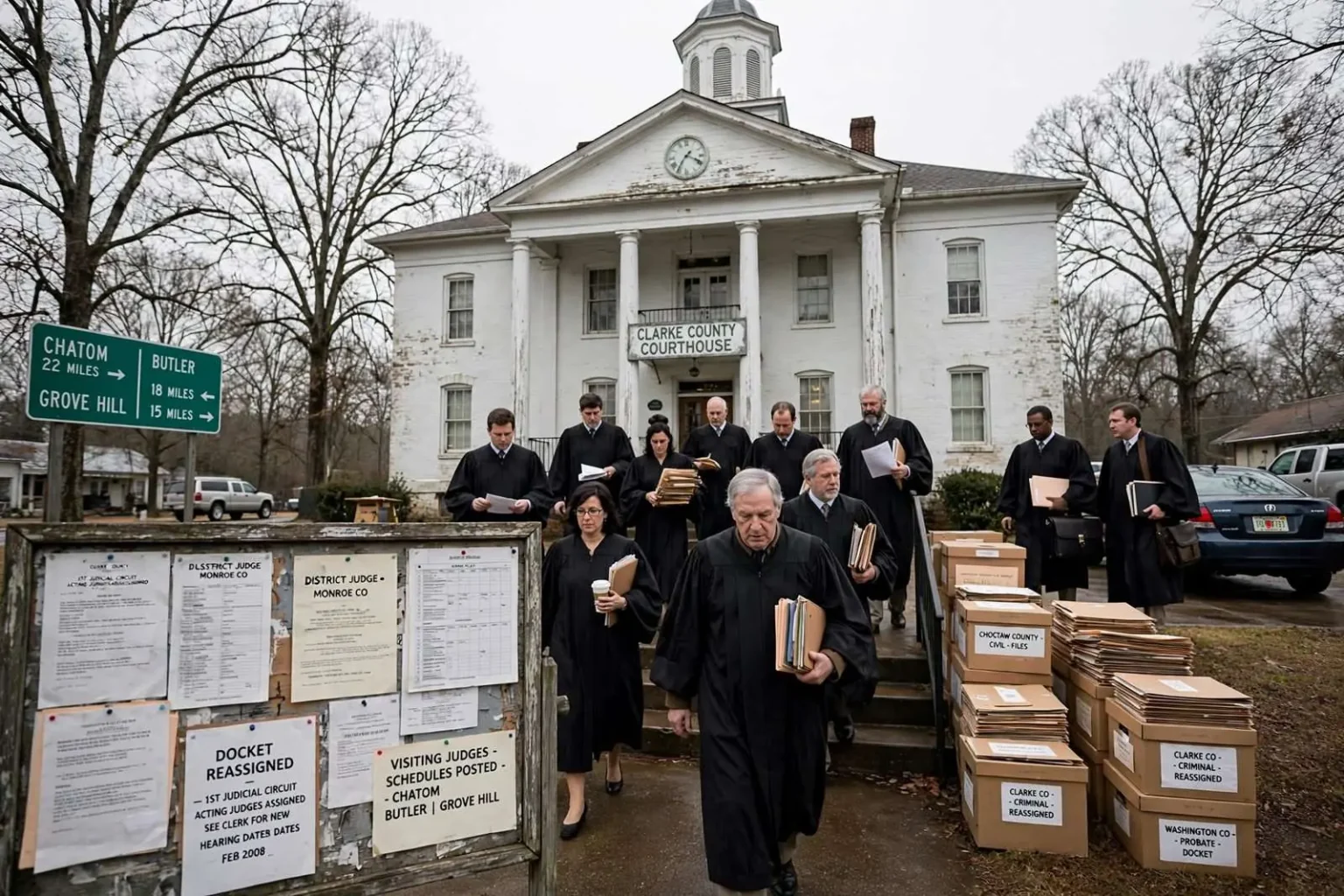
When a circuit judge is suspended, the cases do not stop. Divorces still need decrees, criminal defendants still need trial dates, and estates still need administering. In the winter of 2008, keeping the courts of Alabama’s 1st Judicial Circuit open required an unusual number of borrowed judges.
Clarke County Circuit Judge Stuart C. DuBose had been suspended with pay while he faced a 113-page, 60-charge complaint from the Alabama Judicial Inquiry Commission alleging ethical misconduct. The 1st Circuit takes in Choctaw, Clarke and Washington counties — a large, rural territory served by only a handful of judges. Losing one of them left a hole that had to be filled from outside.
The arithmetic of a rural circuit explains why. In Alabama’s metropolitan circuits, a single suspended judge is one absence among dozens; dockets shift, and the system absorbs the loss. In a three-county circuit like the 1st, each judge carries a share of every kind of business the courts handle — felony trials, divorces, juvenile matters, probate disputes, civil suits — across thousands of square miles. There is no slack to absorb a vacancy, because there was never much slack to begin with.
The geography compounds the problem. The 1st Circuit’s three county seats — Butler, Grove Hill and Chatom — sit well apart from one another in Alabama’s southwestern timber country, and judges there have always spent a significant part of the week on the road between them. A circuit judge’s calendar is a travel schedule as much as a legal one, and every day borrowed away from one county seat is a day its courthouse holds fewer hearings. When the vacancy came, it was felt in all three counties at once.
Who Was Called In
Presiding First Circuit Judge Thomas Baxter tapped several district judges to sit as acting circuit judges: District Judge Jerry L. Turner of Washington County, District Judge William E. Kimbrough of Clarke County and Choctaw County District Judge D.P. Scurlock III. Alabama Supreme Court Chief Justice Sue Bell Cobb assigned others: retired Circuit Judges Harold Crow and Braxton Kittrell, Monroe County Circuit Judge Dawn Hare — the presiding judge of the 35th Judicial Circuit — and Monroe County District Judge George K. Elbrecht. Marengo County District Judge Wade Drinkard was also brought in.
Count them up and the total was striking: nine judges pressed into service, in some combination, to cover one suspended judge’s docket.
The arrangement drew on two standard mechanisms in Alabama’s court system. A presiding circuit judge may assign district judges within the circuit to handle circuit-level matters, and the chief justice may assign active or retired judges from anywhere in the state to fill temporary gaps. Neither is unusual on its own. Deploying nine of them to cover one judge’s docket was.
Each mechanism has its logic. District judges within the circuit already know the local bar, the clerks and the courthouses, so elevating them temporarily is the smoothest option — but it pulls them away from their own district dockets, which do not pause either. Retired and out-of-circuit judges bring fresh capacity, but they arrive cold, needing time to learn the files. The 2008 arrangement used both tools at once because the vacancy demanded it.
The Case Behind the Vacancy
DuBose had been granted an extension until Wednesday, March 12, to file an answer to the Judicial Inquiry Commission’s complaint.
The commission investigates allegations of misconduct against Alabama judges and, when it finds cause, files charges before the Alabama Court of the Judiciary, a special tribunal with the power to censure, suspend or permanently remove a judge from the bench. A judge is automatically suspended, with pay, once charges are filed.
The two-body structure is designed to separate investigation from judgment. The Judicial Inquiry Commission acts as the gatherer of evidence — receiving complaints from litigants, lawyers and the public, and deciding whether they rise to the level of formal charges. The Court of the Judiciary, a mixed panel of judges, lawyers and lay members, then sits as the tribunal that hears the evidence and imposes whatever discipline the facts support. That discipline can range from a reprimand to removal, and the automatic suspension rule exists so that a judge facing formal charges does not keep deciding cases while the process runs.
A Democrat, DuBose had won the judgeship in 2006 after a bitter primary against another Jackson attorney, and he arrived on the bench with unresolved disputes from his private practice already trailing him. His first year in office produced further turmoil, culminating in the commission’s complaint.
The episode illustrates how little buffer exists between a rural lawyer’s practice and a rural judge’s bench. In a small circuit, the candidate pool for a judgeship is drawn from the same handful of attorneys who practice before it, and the disputes of a private career do not stay behind when the robe goes on. Opposing parties, former clients and former adversaries all end up appearing before their one-time peer — a dynamic that small circuits manage through recusal norms and, when necessary, through the assignment machinery that outside judges provide. In DuBose’s case, those threads of private-practice friction wound together with first-term controversies into the largest judicial complaint the circuit’s voters had ever seen.
The complaint’s scale — 113 pages, 60 charges — marked it as far from a routine disciplinary matter. Complaints against Alabama judges typically involve a handful of allegations; a document of that size described a pattern, and the process it triggered would consume much of the year ahead.
What It Meant for the Counties
The practical burden fell on some of the least populous counties in Alabama. Grove Hill, Chatom and Butler are small county seats where the courthouse is the center of civic life and where a single judge handles an enormous range of business.
In counties like these, the circuit judge is not a distant officialdom. Residents appear before the same judge for the divorce that ends a marriage, the adoption that builds a family and the felony case that empties a courtroom. When that judge is absent, the community feels it directly — in postponed hearings, in lawyers’ schedules, in the pace at which justice gets done.
Clerks’ offices felt it too. A docket is not an abstraction; it is a stack of files, each with a party waiting on the other side of it, and each reassignment means new signatures, new notices and new dates to be set. Court administrators spent the spring of 2008 doing quietly heroic work: matching cases to whichever visiting judge would be within driving distance on a given week, and notifying everyone whose hearing had moved yet again.
Judges driving in from Monroeville, Linden and beyond to hear cases were donating time from their own crowded dockets.
For litigants, the consequences were measured in delay. Cases were reassigned. Hearings were rescheduled around the availability of judges who had other courts to run. Lawyers found themselves arguing before jurists who had inherited a file cold.
The costs were real even when invisible. A criminal defendant held in jail waits longer for a trial date when the judge’s calendar is borrowed from elsewhere. A family waiting on an estate to be settled marks time. Court reporters, clerks and sheriffs’ deputies — the machinery that moves a courtroom — reshuffle their weeks around visiting judges’ travel schedules. None of it appears in a disciplinary file, but all of it lands on the people the courts exist to serve.
The arrangement held for months. DuBose remained suspended with pay while the case against him moved toward trial before the Court of the Judiciary — a proceeding that would take much of 2008 to resolve, and which ended with his removal from the bench.
In the meantime, the courts of Choctaw, Clarke and Washington counties stayed open, held together by a rotating cast of judges from four surrounding circuits.
The episode is worth remembering for what it showed about Alabama’s court system at the edges. The assignment mechanisms worked — the circuit’s presiding judge, the chief justice and the Court of the Judiciary’s procedures together kept three counties’ courts functioning through a year-long vacancy. But they worked only because nine other judges absorbed the load, and because the system’s small counties were willing to accept visiting jurists, delayed hearings and borrowed justice as the price of one judge’s suspension.
For the people of Grove Hill, Chatom and Butler, 2008 was the year the courthouses stayed open on borrowed time. The files kept moving, the dockets kept getting called, and the constitutional promise that the courts would be there — in good times and in bad — was kept by judges who never ran for office in the counties they served, driving in on borrowed dockets to keep someone else’s courtroom running.