Nearly 80 Years On, Thomasville’s American Legion Fourth of July Barbecue Still Packs the Post
Hundreds turned out at American Legion Post 112 in Thomasville for a barbecue tradition dating to 1947, where volunteers cooked 1,800 pounds of Boston butts to raise money for the high school marching band.
Some traditions survive because someone keeps showing up. In Thomasville, that someone is a rotating cast of volunteers who have kept the American Legion’s Fourth of July barbecue going for nearly eight decades, and on July 3 they did it again in front of hundreds of neighbors.
The annual American Legion barbecue at Post 112 drew a large crowd for an event that has been a fixture of Clarke County life since 1947. Hosted by the Legion post in partnership with the Veterans of Foreign Wars and the City of Thomasville, the barbecue is equal parts fundraiser, reunion and civic ritual. Thomasville, the seat of Clarke County in southwest Alabama, sits along U.S. Highway 43 between Jackson and Grove Hill, and its small downtown fills up fast when the post throws a party.
The menu, by the numbers
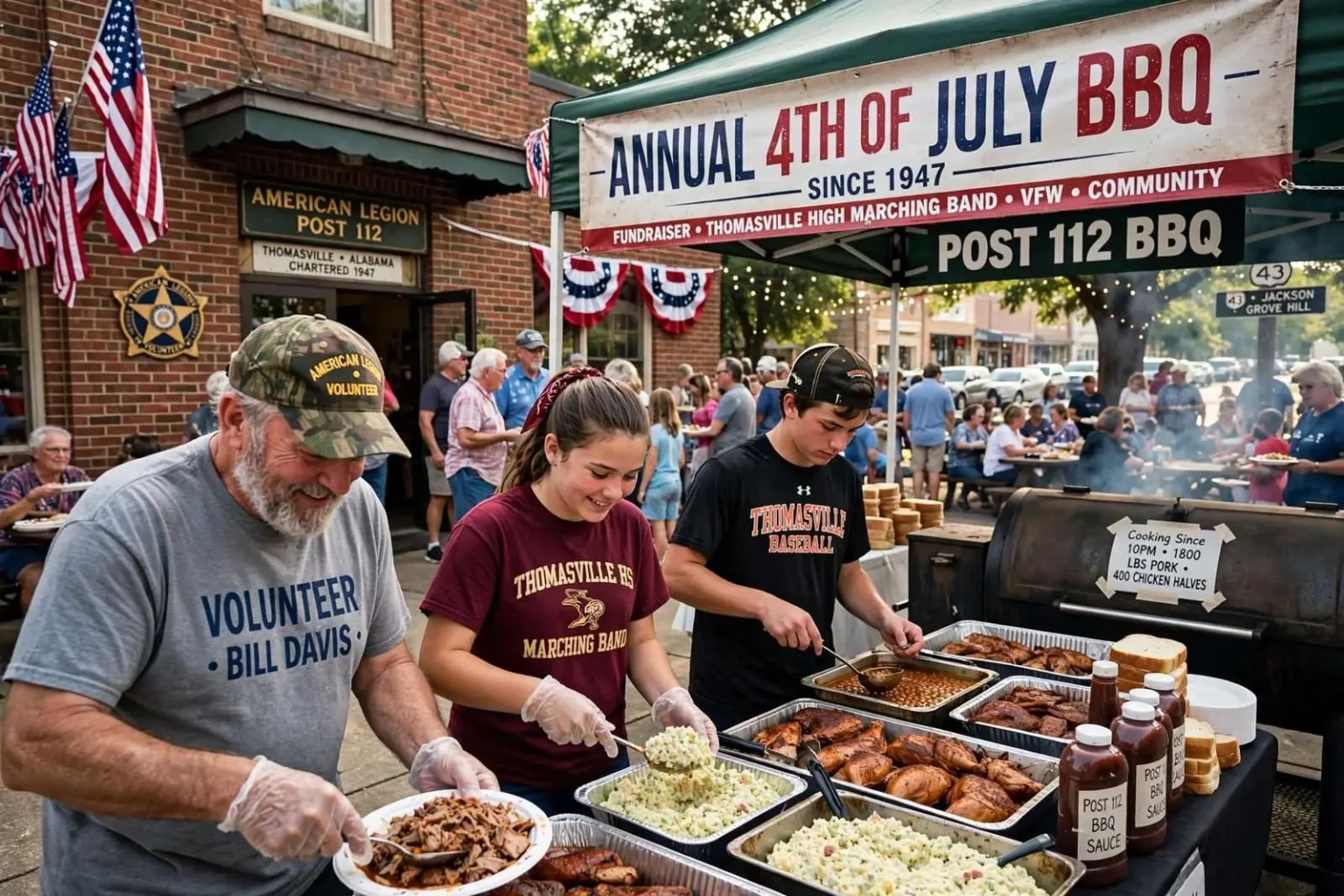
Feeding a crowd of that size is a logistical undertaking, and volunteer Bill Davis said the preparation stretches across months. We cooked 1,800 pounds of Boston butts, 400 chicken halves, 25 gallons of barbecue sauce, potato salad, beans and bread, Davis said. We got all the food you need.
Plates featured barbecue pork, chicken halves, baked beans, potato salad and bread. For anyone doing the arithmetic, 1,800 pounds of pork shoulder represents an enormous amount of low-and-slow cooking, a process that typically requires 10 to 14 hours per batch at low temperature. That is not an afternoon’s work. It is a multi-day effort by people who are not being paid for it. The cooks begin overnight, with the first loads going on the night before the event and replacements rotating onto the pit through the early morning hours.
For Davis, the payoff is not measured in pounds. I love doing this, he said. I get to talk to people and see faces I haven’t seen in a while. It’s just a pleasure to see everyone.
Where the money goes
Proceeds from the barbecue support the Thomasville High School marching band and help fund future community events. That connection is not incidental. Marching band programs carry real costs, from instrument repair and uniforms to travel expenses for competitions and away games. In smaller school systems, those costs often exceed what a district budget can absorb, and community fundraisers become the difference between a band that travels and one that does not.
Thomasville High is a small public school that draws students from across rural Clarke County. Its marching band is one of the visual centerpieces of football season and a point of regional pride. Funding the band through an annual barbecue is the kind of public-private arrangement that has become a quiet backbone of small-town Alabama life, and the American Legion Post 112 barbecue is one of the larger such events in southwest Alabama.
This year’s event added a new revenue stream in the form of Comfort Colors T-shirts printed with a historic photograph of the Thomasville American Legion taken in the 1950s, showing World War II veterans who were then in the prime of their lives. It is a fitting artifact for an event founded in 1947, only two years after the war ended, by the men who came home from it.
Run almost entirely by volunteers
The barbecue is staffed nearly top to bottom by volunteers, and a substantial share of them are students. Members of the Thomasville High School marching band and baseball team worked the event alongside Legion and VFW members.
Marching band volunteers included Emerson Stinson, Katie Harrington, Jacob Garza, Levi Butler, Tensley Stauffacher and Zoey Garza. Baseball team volunteers included Christian Draper, Gunnar Lewis, Paxton Kennedy, Brayden Williams and Ronald Johnson. The serving table was staffed by Alex Woodard, Peyton Baugh and Kyle Woodard, who helped distribute meals throughout the day.
There is a quiet logic to having band students help raise the money that funds their own program. It teaches the students that the community’s support is not automatic, and it puts them face to face with the neighbors who are paying for their uniforms and their bus rides. It is the kind of inter-generational exchange that small-town organizations depend on for survival.
A raffle rounded out the day, with Jessica Brooks taking home a Winchester Super X 12-gauge shotgun.
Why Post 112 endures
American Legion posts across rural America have struggled in recent decades as the World War II and Korea generations passed and younger veterans proved harder to recruit into traditional membership organizations. Many posts have closed or merged. Membership numbers have dropped. Buildings that once hosted weekly meetings now sit dark for weeks at a time.
Thomasville’s Post 112 has bucked that trend, and the barbecue is a significant reason why. An event that has run continuously since 1947 builds its own gravity. Families who attended as children bring their own children. Businesses plan around it. The high school treats it as part of the summer calendar. To skip a year would be to break something that the community has decided matters.
It also gives the post a visible, useful role in the life of the city beyond commemoration. The Legion is not merely a place where veterans gather; it is the organization that feeds hundreds of people and writes a check to the band every summer. That is a durable form of relevance, and it is why volunteers like Bill Davis keep showing up to cook nearly a ton of pork in the Alabama heat.
Looking toward the 80th
With the 2026 edition now in the books, the countdown to the 80th anniversary of the tradition in 2027 has quietly begun. Organizers said they expect to mark the milestone with an expanded menu, additional raffle prizes and an effort to invite alumni of the original 1947 event, or their descendants, to share memories from the early years. The Comfort Colors T-shirt with the 1950s Legion photograph is already being collected by families who have attended the barbecue for two generations.
For a small city in southwest Alabama, the annual gathering has become as much a part of summer as thunderstorms and high school football. The next time the post parking lot fills up, on July 3, 2027, the cooks will be doing the same work their predecessors did in 1947, only with more chicken halves on the pit and a longer line at the serving table.
Clarke County and the rhythm of summer
Clarke County is one of the older counties in Alabama, carved out of Washington County in 1812 and named for the Revolutionary War general Elijah Clarke of Georgia. Its economy has long rested on timber, pulp and paper, with the river towns along the Tombigbee doing the heavy lifting in the early decades. Today, the county seat at Grove Hill and the small cities like Thomasville and Jackson have settled into the slow pattern of rural southwest Alabama, where summer gatherings tend to be the most reliable form of public life.
The Fourth of July falls in that pattern naturally. Families who have spent the school year driving between ballgames, school programs and church events look forward to a Saturday or weekday evening when the entire community shows up at one place, eats the same food and talks to the same neighbors. The American Legion barbecue has occupied that slot in Thomasville’s calendar for so long that even longtime residents have trouble remembering a year when it did not happen.
How the kitchen runs
Inside the cookhouse on the morning of July 3, the crew worked in shifts. The first batch of Boston butts had been loaded onto the pits the night before, around 10 p.m., by a skeleton crew of two or three volunteers who stayed up overnight to monitor the temperature and feed fresh wood into the burn boxes. By sunrise, the first butts were probed for tenderness and moved to a holding table. New loads went on. The sauce, a thin tomato-and-vinegar blend, simmered in a series of stockpots that had been started at the same time the meat went on. Chicken halves were brined the previous afternoon and went onto the grill mid-morning.
The line itself was staffed by the band and baseball volunteers, who learned the rhythm of taking plates, scooping beans and potato salad, and adding bread without breaking the flow. A few adult volunteers rotated onto the line to spell the students. Drink coolers were filled and refilled throughout the day. A separate table inside the post hall handled carryout orders, of which there were many in the early afternoon as people stopped by on their way to family gatherings elsewhere in the county.
A tradition that prints itself on the town
By the end of the day, the parking lot had hosted a thousand or more visitors over the course of the event, with cars arriving from as far away as Mobile, Pensacola and Meridian. The band had earned another season of competition travel. The Legion had reinforced its position at the center of Clarke County’s civic life. And a stack of receipts in a folder on the post commander’s desk would, over the following weeks, be turned into a check to the high school.
For a town the size of Thomasville, that is no small thing. It is the kind of arrangement that has quietly held small-town Alabama together for the better part of a century, one Fourth of July at a time.