
Acclaimed Singer-Songwriter Richard Buckner Plays Satori Coffee House in December 2012
Critically acclaimed songwriter Richard Buckner played Mobile's Satori Coffee House Dec. 5, 2012 — free for USA students, $5 for all others.
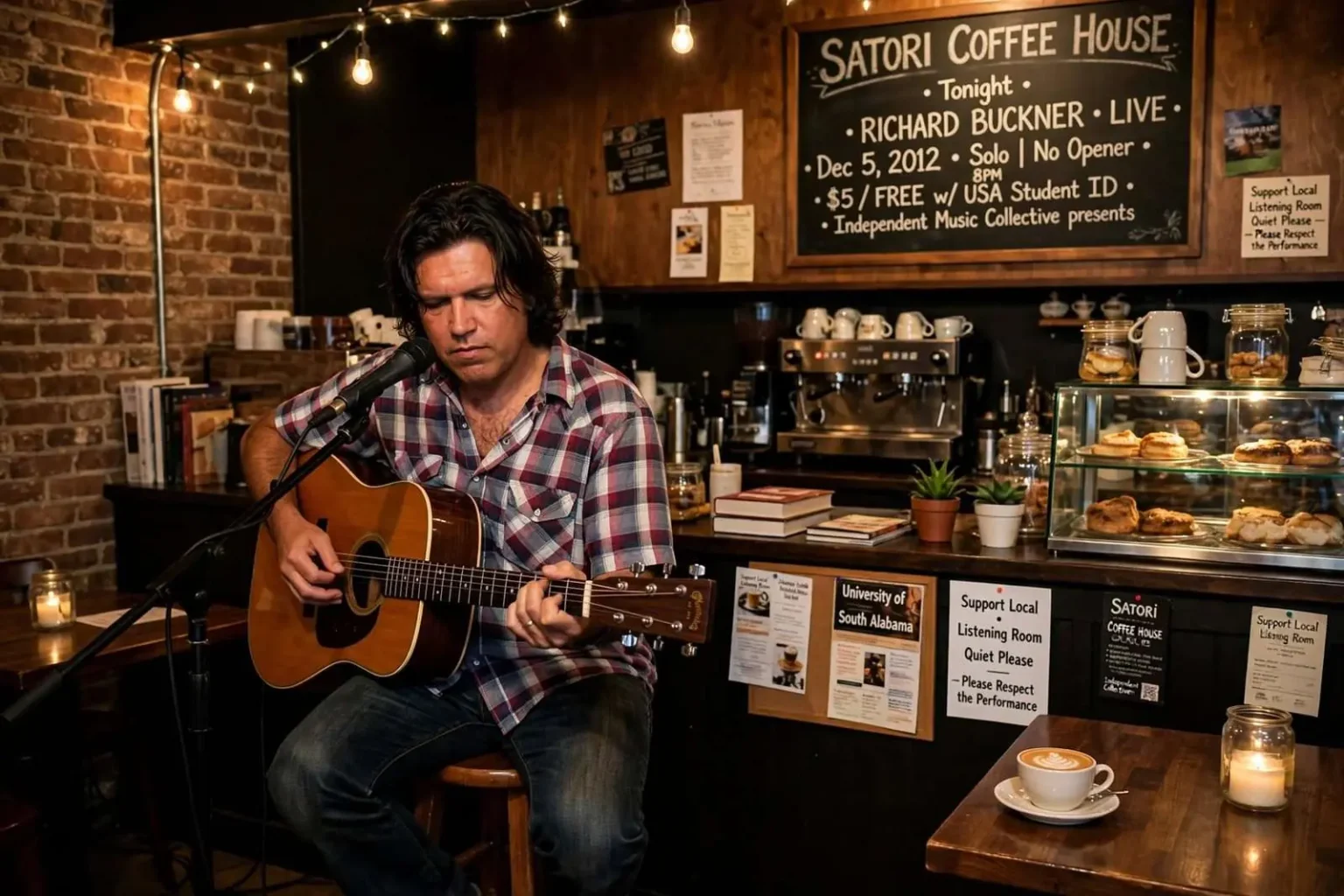
Critically acclaimed singer-songwriter Richard Buckner brought his spare, literary songcraft to Mobile’s Satori Coffee House on Wednesday, December 5, 2012, for an intimate solo engagement presented with the Independent Music Collective. Doors opened at 7:30 p.m. with the show starting at 8 and no opening act on the bill — a stripped-down evening built entirely around one songwriter and his catalog, in one of the smallest and most beloved rooms on Mobile’s independent music map.
The price of admission made the night a striking bargain. Admission was free for University of South Alabama students with a valid student ID, and just $5 for everyone else — a nominal cover for an artist whose catalog had earned national critical praise for two decades. The student discount reflected the booking’s ties to the college community and the Independent Music Collective’s long-running effort to bring nationally regarded songwriters to Mobile rooms at prices that put the front row within reach of anyone interested enough to show up.
Satori Coffee House has spent years as a home for exactly this kind of show. The Old Shell Road coffeehouse sits near the University of South Alabama campus and has built its reputation as much on its stage as on its espresso, hosting singer-songwriters, indie acts and spoken-word nights in a listening-room setting where the audience sits close enough to hear an acoustic guitar without amplification doing the work. For a songwriter whose material thrives on quiet and detail, the room offered the right conditions: low stage lights, a hushed crowd and no barrier between performer and audience.
A Critics’ Favorite With a Deep Catalog
The New York-born, Kingston-based songwriter had long been a critics’ favorite even without mainstream radio play. Buckner emerged in the mid-1990s with a run of albums that established his signature style — a weathered baritone, fingerpicked guitar figures and songs that read like short stories stripped to their bones. Across his career he has been grouped with the America underground’s most literary songwriters, artists whose records reward close listening the way a collection of stories rewards a second read.
The praise had come from the country’s most exacting outlets. NPR called him “an immensely gifted artist,” while The New York Times found him “riveting” and lamented his “unjustly modest reception” — a pointed observation about an artist whose critical standing had always outpaced his commercial profile. The New York Times’ phrasing captured a paradox that followed Buckner throughout his career: songwriters’ songwriters rarely top the charts, and audiences who discovered him tended to describe the discovery the way people describe finding a favorite novel in a used-book store.
Pitchfork scored his latest album, Our Blood, an 8 out of 10, writing that Buckner was “one of the most intriguing songwriters working,” and noting that his style seemed more likely to appear in anthologies of 20th-century literature than in typical indie-rock liner notes. The review placed Our Blood among the year’s most respected releases and confirmed that Buckner’s late-career output carried the same density as his early work. For Mobile audiences, the Satori date offered a chance to hear that material in the setting it was arguably built for — one voice, one guitar and a room that listens.
Solo and Unplugged on Old Shell Road
The solo format shaped what the audience heard. Without a band, Buckner’s shows strip his songs to their structural core — the guitar patterns, the vocal phrasing and the narrative lines that give the songs their shape. Longtime listeners know that his solo performances treat recorded arrangements as suggestions rather than requirements, with familiar songs reworked in tempo and mood from night to night. In a coffeehouse the size of Satori, the format turned the evening into something closer to a reading than a rock show, with the crowd close enough to catch the asides and pauses that disappear in larger venues.
The no-opening-act bill also gave the night a focused arc. Rather than padding the evening with a support slot, the presentation put Buckner on stage at 8 and left the rest of the night to him, a structure that suits songwriters whose sets build their own momentum. It also respected the room’s character — Satori shows tend to run on conversation and coffee as much as music, and a single-act night kept the focus where the promoters wanted it.
The Independent Music Collective’s involvement tied the show to one of Mobile’s longest-running grassroots booking efforts. The collective has spent years bringing touring singer-songwriters and indie acts to small Mobile venues, building a local audience for music that rarely gets commercial radio support, and its partnership with Satori has produced some of the city’s most memorable listening-room nights. The December 5 date fit the collective’s model precisely: a nationally respected artist, a modest cover charge, and a room where the music is the evening’s only business.
A December Stop on a Working Songwriter’s Route
Buckner’s stop in Mobile came as part of the touring rhythm that has defined his career — steady runs of small venues across the country, strung together between album releases, that keep his songs in front of live audiences year after year. December dates in the Southeast typically route performers through the Gulf Coast corridor between larger markets, and Mobile’s coffeehouse circuit has historically caught acts that skip the city’s bigger rooms. For the singer-songwriter economy, rooms like Satori function as the infrastructure that sustains careers between records.
The early-December timing also gave Mobile’s music calendar a quiet counterweight to the season’s louder offerings. With holiday events crowding the weeks ahead, a Wednesday-night listening-room show offered an alternative evening — no costumes, no cover bands, just a songwriter whose two-decade catalog had earned some of the strongest reviews in American independent music. At $5, or free with a University of South Alabama student ID, the night stood as one of the best values on the city’s December calendar.
For the audience at Satori, the show delivered the kind of encounter that has kept the coffeehouse’s stage busy for years: a writer of national reputation performing at whisper distance, in a room built for exactly that exchange. Buckner’s catalog had earned its praise from NPR, The New York Times and Pitchfork on the strength of songs that hold up in daylight and on headphones alike, and the December 5 engagement let Mobile hear them where they work best — up close, unamplified, and in a single unbroken set with nowhere to hide.
The Setting: A Coffeehouse That Doubles as a Listening Room
Satori Coffee House’s role in Mobile’s music scene explains why a booking like this lands there. The shop sits along the Old Shell Road corridor near the University of South Alabama, an area where student traffic and neighborhood regulars mix, and it has cultivated a stage policy that treats quiet songs as something worth protecting. audiences who attend shows there learn the unwritten rules quickly — conversations move to the counter, bar service continues through the set, and the performer works without the wall of noise that greets bands in bar rooms across the city.
That environment has made Satori a preferred stop for touring songwriters crossing the Gulf South. The economics of small-venue touring run on rooms exactly like this one: modest guarantees, attentive crowds and owners who promote the show themselves rather than depending on a marquee. For an artist with Buckner’s profile — critically decorated, commercially modest, and built for listening rooms — the pairing of venue and promoter matters as much as the city on the itinerary, and the December 5 date reflected a routing decision that Mobile’s coffeehouse scene has earned over years of similar nights.
The University of South Alabama connection ran through the free student admission as well. The Independent Music Collective’s shows have long drawn from the campus community, and waiving the cover for students with valid IDs extended the audience to listeners who might not otherwise spend an evening on a songwriter they had never heard. For students willing to take the chance, the night offered a first encounter with an artist whose catalog spans more than a dozen records and whose style has influenced a generation of quieter, more literary songwriters behind him.
Why Buckner’s Catalog Rewards a Room Like Satori
Buckner’s material has always lived somewhere between folk song and fiction. His records since the mid-1990s have been built on elliptical narratives — characters glimpsed mid-sentence, stories told in fragments, choruses that function more like refrains in a long poem than hooks in a pop song. That density is exactly what Pitchfork meant when it placed his style closer to literature than to liner notes, and it is what made the solo coffeehouse format such a natural fit: in a quiet room, the words do the work the production does on record.
Listeners who came to the show through Our Blood — the album Pitchfork scored an 8 out of 10 — heard its songs reshaped for a single guitar and voice, while longtime fans heard the older material that established Buckner’s reputation in the first place. The set drew from a career that critics at NPR and The New York Times had followed for years, and the absence of an opening act meant every minute of the night belonged to that catalog. In a listening-room setting, the songs’ details — the low-register vocal lines, the fingerpicking patterns, the narrative turns — read as clearly as they do on the records themselves.
The December 5 show closed with the same qualities that have kept Buckner’s audience loyal through two decades of modest commercial returns: songs built to last, delivered without theatrics, in a room sized to the music. Mobile’s independent music scene has hosted its share of nationally recognized songwriters over the years, but few engagements matched the combination the Satori date offered — a New York Times-praised, Pitchfork-scored songwriter, a $5 cover, and a coffeehouse where the front row costs nothing but attention.


