
ADEM Grant Helps Mobile County Schools Swap Diesel Buses for Cleaner Propane Fleet
ADEM awarded Mobile County Public Schools $304,467 to replace ten old diesel school buses with cleaner propane models meeting EPA standards.
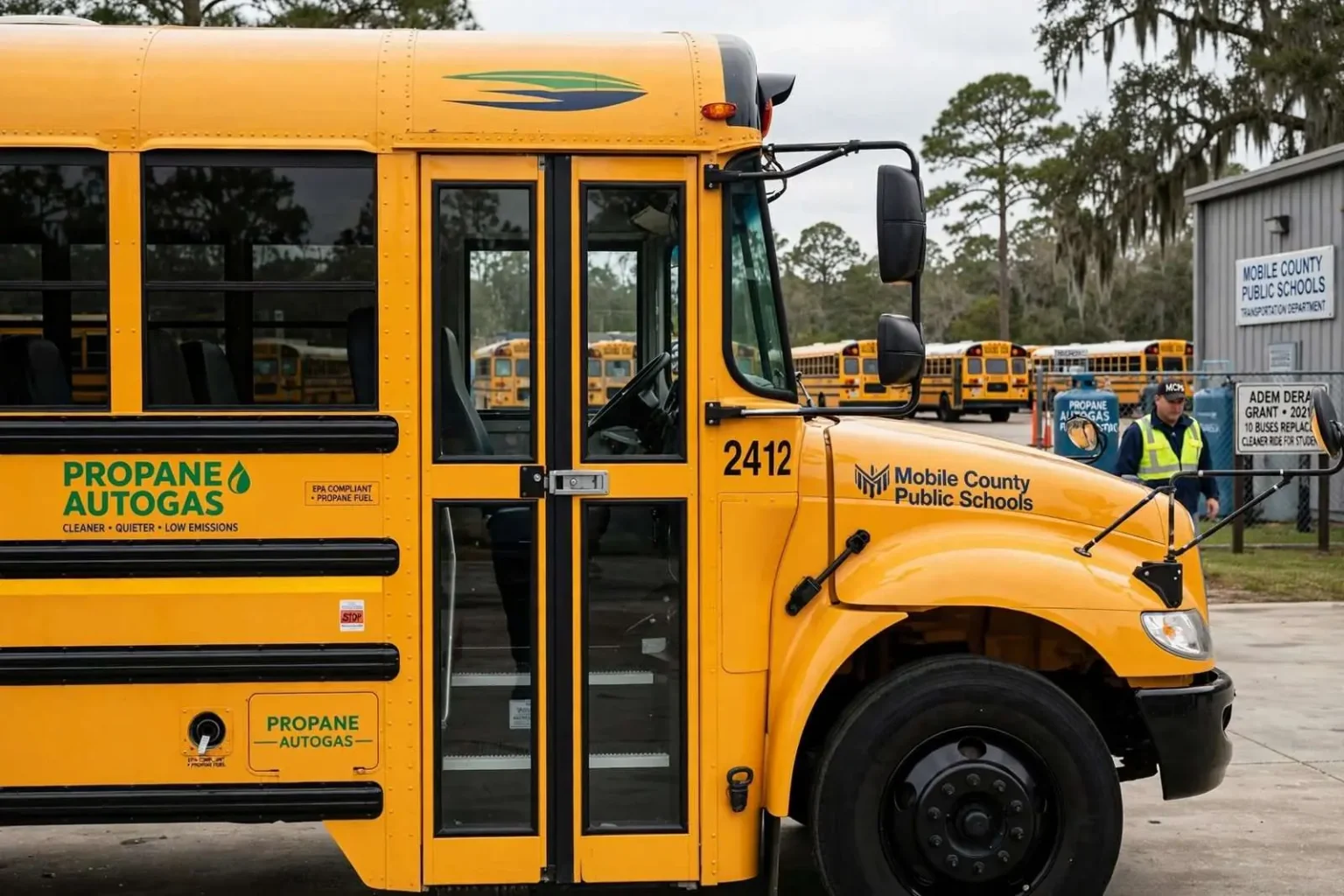
MOBILE COUNTY, Ala. — Mobile County Public Schools is retiring a portion of its oldest diesel fleet under a state-funded replacement project aimed at cutting harmful exhaust from the district’s daily routes, a change that will put cleaner-burning buses on some of the busiest school routes in Alabama.
The Alabama Department of Environmental Management awarded the district $304,467 through federal Diesel Emission Reduction Act funding appropriated in 2021. The grant helps pay for new, cleaner-burning school buses to replace aging diesel models that have logged years of service on the county’s roads.
Under the project, the district will replace ten older diesel buses with new propane-powered models. All of the replacement buses must meet current Environmental Protection Agency emission standards before they can enter service, a requirement written into the program to ensure that federal dollars are buying a genuine improvement in what comes out of the tailpipe.
Why the swap matters for students
State environmental officials say the swap matters most for the students riding the buses. Older diesel engines emit exhaust containing fine particulates and other pollutants, and children are particularly vulnerable to that exposure because they breathe faster than adults and their lungs are still developing. A child riding an aging diesel bus for an hour each way to school inhales more of what the engine produces than an adult driver would over the same route.
Fine particulate matter — the component of diesel exhaust that public health agencies worry about most — is small enough to penetrate deep into lung tissue, and researchers have linked long-term exposure to respiratory problems, aggravated asthma and reduced lung function in children. School buses concentrate that exposure because riders sit close to the engine and the exhaust system, often for years of twice-daily trips.
Mobile County Public Schools operates one of the largest student transportation programs in Alabama, covering a county that stretches from the city of Mobile out to communities like Citronelle, Mount Vernon and Grand Bay. Every mile of that network that shifts from old diesel to cleaner technology reduces the cumulative exposure for the thousands of students who ride.
How the grant program works
The Diesel Emission Reduction Act, passed by Congress as part of the Clean Air Act amendments, funds projects across the country that retire or retrofit older diesel engines. ADEM administers the program in Alabama, reviewing applications from school districts, transit systems and other fleet operators and awarding grants on a competitive basis.
The funding appropriated in 2021 flows through the state environmental agency to projects like the Mobile County bus replacement, with the district covering the remainder of the cost of the new buses beyond the grant amount. Diesel buses that are retired under the program are typically scrapped or disabled so that the dirtiest engines genuinely leave the road rather than being resold into service elsewhere.
School bus replacement is one of the most common uses of DERA money in Alabama because the benefits are easy to quantify: older model-year buses produce far more emissions per mile than modern engines, and districts can show exactly which routes and students the change will affect. For a district the size of Mobile County’s, ten buses represent a meaningful slice of the oldest equipment still running daily routes.
Why propane has caught on with school districts
Propane school buses have become an increasingly common choice for districts working to reduce emissions without overhauling their operations. The fuel burns significantly cleaner than diesel, producing far less of the exhaust linked to respiratory problems in children, and it delivers that improvement without requiring districts to change much about how they run their transportation departments.
Propane autogas buses refuel from on-site stations much like gasoline or diesel vehicles do, and the fueling infrastructure has matured to the point that districts across the Southeast have built their own propane stations at transportation yards. Maintenance is generally simpler than with modern diesel engines, which rely on emissions after-treatment systems that add cost and complexity, and propane engines avoid many of those components entirely.
Alabama has been among the states where propane school bus adoption has grown steadily, with districts citing lower fuel costs and quieter operation in addition to the emissions benefits. Propane is produced domestically in abundance, and the Gulf Coast region is one of the country’s major production and storage hubs, which helps keep supply stable and prices less volatile than diesel.
What it means for Mobile County families
For families along the affected routes, the change will be most visible in the buses themselves. Propane buses run noticeably quieter than their diesel predecessors, and they lack the plume of dark exhaust that older engines produce on startup and acceleration. Students will board vehicles that meet the EPA’s current emission standards rather than standards that were in force when the retired buses were built decades ago.
The improvement compounds over a school year. A diesel bus on daily routes covers thousands of miles between August and May, and multiplying the exhaust of an old engine by that mileage — across ten buses — illustrates why environmental agencies target school fleets for replacement funding. Each cleaner bus on the road means less particulate matter in the neighborhoods those routes pass through, not just inside the bus itself.
District transportation officials have generally found that drivers and mechanics adapt quickly to the new fuel, and the buses use conventional transmissions and chassis familiar to the county’s maintenance staff. The transition is designed to be operationally invisible: same routes, same stops, same schedule, with cleaner air as the difference.
The bigger picture on school bus emissions
The Mobile County project fits into a broader national push to modernize school transportation. Beyond propane, districts across the country are beginning to adopt electric school buses with the help of new federal funding, though the upfront costs and charging infrastructure remain significant hurdles for large rural districts. Propane has positioned itself as the practical middle path — cleaner than diesel, far cheaper than electric, and proven at scale.
Environmental agencies at both the state and federal level continue to prioritize school buses because of the population they serve. Children ride for years, often beginning in kindergarten, and the health argument for removing the oldest engines from service is among the most straightforward in air quality policy. Programs like the one funding Mobile County’s replacement buses are built on that logic.
With the $304,467 award in place, the district will move the ten new propane buses into its fleet as they arrive, retiring the ten diesel units they replace. The change will roll out across the county’s vast transportation network, one route at a time, in a project that state environmental officials describe as a direct investment in the health of the students who ride.
The scale of the district’s transportation challenge
Mobile County Public Schools is the largest school system in Alabama, serving a county that geographically is bigger than some states in New England. Getting students to class each day means running buses from downtown Mobile to the Mississippi line, from the bayfront communities of the Eastern Shore to the rural crossroads of the county’s northern tier. A fleet of that scope ages slowly and unevenly, and transportation directors must decide each budget year which vehicles to replace and which can safely stay on the road another season.
Grants like the ADEM award change that calculus. A district can only stretch so far on local funding, and the per-bus cost of a new propane model runs well into six figures. State-administered federal money aimed specifically at diesel replacement lets a district target its oldest, dirtiest buses first, which is where the public health payoff per dollar is highest. The ten buses in this project were chosen because they rank among the oldest and highest-emitting units in daily service.
The timing of the 2021 appropriations matters as well. Diesel Emission Reduction Act money flows to states in cycles, and districts that apply in a given window compete against school systems and fleet operators statewide. Mobile County’s successful application placed the district among the Alabama fleets chosen to retire legacy diesel equipment during this funding round.
Health context behind the policy
Public health agencies have spent years documenting why diesel exhaust deserves the attention it now receives. The fine particulates in diesel emissions are associated with aggravated asthma, bronchitis and other respiratory conditions, and the World Health Organization’s cancer research agency has classified diesel engine exhaust as a known human carcinogen. Children, whose respiratory and immune systems are still developing, sit at the front line of that exposure.
The physiology is straightforward: children breathe more air relative to their body weight than adults do, and they breathe faster, so any pollutant in the air around them enters their systems at a higher rate. Add the fact that a school bus cabin places riders close to the engine bay for thirty to sixty minutes at a stretch, twice a day, and the case for cleaning up school bus fleets writes itself.
That is why environmental officials describe projects like Mobile County’s as investments in student health rather than simply fleet upgrades. The measure of success is not just the number of buses swapped but the reduction in tons of emissions over the remaining years each new bus will serve, a figure the state tracks as part of its reporting on the federal program.
What happens to the old buses
Under DERA rules, the diesel buses being replaced must be rendered unusable so their engines cannot simply migrate to other users and keep polluting somewhere else. Districts typically scrap the chassis and disable the engine, and the scrappage is documented for the granting agency. That requirement is what gives the program its environmental teeth — the emissions reduction is permanent, not just displaced down the road.
For Mobile County, the retirement of ten of its oldest diesel units will continue a gradual modernization of a fleet that serves students across the county’s cities, suburbs and rural communities. As the propane buses enter service, the district joins a growing group of Alabama systems that have made the switch, and the routes they cover will be measurably cleaner from the first day of operation.
State officials expect districts across Alabama to continue applying for replacement funding in future rounds, and the experience of large systems like Mobile County’s with propane technology will inform how the state weighs future projects. For now, the focus is local: ten cleaner buses, ten fewer aging diesel engines, and thousands of students riding with less exhaust in the air around them.


