ADPH Confirms Eight Mile Residents Still Affected by Lingering Mercaptan Odor
<p>State health officials say Eight Mile residents are being affected by a persistent odor tied to a 2008 mercaptan spill at a Mobile Gas facility, though they stopped short of confirming the smell has caused specific illnesses.</p>
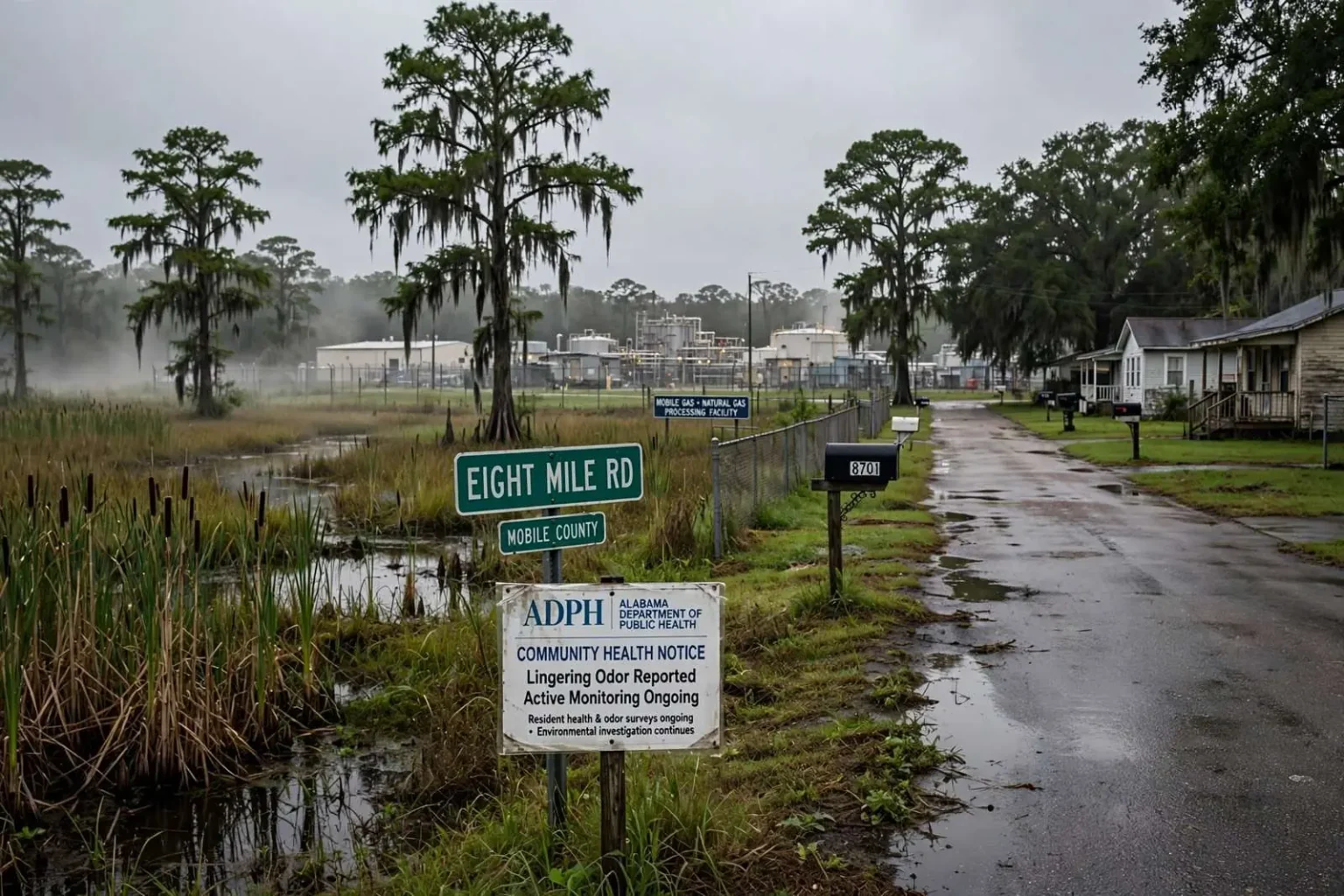
State health officials have concluded that residents of the Eight Mile community in north Mobile County are still being affected by lingering odors tied to a natural gas additive that spilled from a processing facility in the area nearly a decade ago, marking a significant shift after years of resident complaints.
The Alabama Department of Public Health said this week that available scientific evidence supports what hundreds of Eight Mile residents have reported for years: a persistent, foul-smelling odor in the community that has affected their quality of life.
The finding follows a survey submitted to the agency roughly a year ago in which more than 1,300 residents described a range of health symptoms they attributed to the smell. That volume of response — from a community of a few thousand households — made the complaints impossible to dismiss as anecdote, and the department’s statement effectively validated the organizing effort behind them.
Where the Odor Came From
The odor traces back to a 2008 incident in which a lightning strike triggered a leak of tertiary butyl mercaptan at a natural gas processing facility operated by Mobile Gas in the Eight Mile area. Mercaptan is a sulfur-based compound routinely added to natural gas, which is otherwise odorless, so that leaks can be detected by smell. Utility crews and residents alike often describe the compound’s distinctive odor as similar to rotten eggs.
The irony built into the chemical’s purpose has defined the community’s experience. The additive exists to protect people — it is the safety signal in every gas line in the country — but a large enough release of the signal itself becomes its own hazard, saturating soil and water with a smell that announces itself every day without offering any leak to fix.
In the years since the spill, the chemical has migrated beyond the immediate facility site and into the surrounding groundwater and topsoil, according to state officials. Mobile Gas began actively treating the affected groundwater with ozone in 2013 in an effort to break down and neutralize the mercaptan, and officials say detectable concentrations of the chemical have declined since that treatment began.
Even so, many residents near the facility say the smell has never fully gone away. Declining concentrations and disappearing odors are not the same measurement, and the community’s daily experience has kept the dispute alive through years of testing reports and treatment updates.
What the Health Department Said
“Based on the current scientific evidence and available information, we believe that the community is affected by the odors. These odors may impact residents’ sense of well-being and quality of life,” Dr. Mary McIntyre, chief medical officer for the Alabama Department of Public Health, said in a statement.
“Mercaptan causes irritation to mucous membranes and has been associated with some of the symptoms reported by the residents of Eight Mile.”
The statement was measured, but in the context of the years-long dispute it represented real movement. State agencies generally refrain from validating environmental complaints until the data supports them, and Eight Mile residents had grown accustomed to hearing that their reports could not be confirmed. The department’s acknowledgment shifted the burden of the argument.
Health officials also pointed to a separate, naturally occurring source that could be contributing to the smell: the breakdown of organic material in marshland near the Eight Mile community. ADPH officials said that process could be “another factor” behind the odor complaints, independent of any mercaptan still present in the soil and groundwater.
That qualification was scientifically fair and, for residents, frustrating in equal measure. Coastal wetlands do produce sulfurous odors naturally, and any honest assessment had to account for them. But residents argued the distinction did not change their central point — that the smell arrived after the spill, concentrated near the facility, and had never existed in the community’s memory at its current intensity.
Despite acknowledging the community’s odor complaints as legitimate, the agency stopped short of drawing a direct medical causation between mercaptan exposure and the specific symptoms residents have reported over the years. Officials said the kind of environmental health assessments conducted in Eight Mile are useful for identifying exposure and community impact, but are not designed to definitively prove that a specific chemical caused a specific illness.
“Unfortunately, health assessments alone do not address the question of association or causation,” McIntyre said. “Even though unpleasant odors can impact residents’ quality of life, not all odors are toxic. We continue to work with the Eight Mile community.”
The distinction between proving exposure and proving illness is a real one in environmental health, but it has done little to ease the community’s frustration. Residents live with the symptoms and the smell together, and they experience the scientific caution as institutional hesitation — one more year in which the harm feels obvious at home and unprovable on paper.
A Community’s Long Campaign
Eight Mile, an unincorporated community just north of Prichard in Mobile County, has grappled with the fallout from the spill for years, with residents raising concerns at public meetings and through petitions to state and local officials.
Unincorporated status has shaped the fight. Eight Mile has no mayor or city council of its own to press its case, leaving residents to work through the county commission, the health department and whatever attention state agencies could be persuaded to give. Organizing across hundreds of households — collecting more than 1,300 survey responses — required a persistence that few communities sustain, and the survey itself became the evidentiary backbone of everything that followed.
The latest findings from ADPH represent one of the clearest acknowledgments yet from the state that the community’s complaints are grounded in real environmental conditions, even as questions about long-term health effects remain open.
For residents, the acknowledgment is a milestone in a fight that has been fought in meeting rooms: public forums with utility representatives, petitions to Montgomery, and years of asking officials to smell what the neighborhood smells. The validation does not end the odor, but it changes the standing of the people complaining about it — from a community disputing a utility’s assurances to one the state’s own health department has confirmed is affected.
State health officials said they intend to continue monitoring conditions in the area and working directly with residents, businesses and Mobile Gas as remediation efforts continue.
What Comes Next
Practically, the acknowledgment raises the stakes for the cleanup. A community officially recognized as affected has stronger footing in demanding continued treatment, expanded testing and communication about what concentrations remain and where. Ozone treatment has reduced detectable levels since 2013, but the department’s position now implies the work is not finished until the odor question is answered, not merely the chemistry.
How Mercaptan Became a Neighborhood Crisis
Understanding the Eight Mile dispute requires understanding what tertiary butyl mercaptan is and why a leak of it behaves differently from a leak of the gas it flavors. Natural gas itself dissipates upward and dissipates quickly; mercaptan compounds are denser, absorb into soils and dissolve into water, and can hold their odor for years in groundwater and damp ground. A spill of the additive is not a one-day event but a long-term contamination, which is why ozone injection into the aquifer became the remedy of choice — the treatment works underground, over seasons, breaking the compound down molecule by molecule.
The 2008 lightning strike set that machinery in motion. What began as an industrial accident at a facility on the community’s edge became, over the following years, a chronic condition: odor complaints clustering around particular streets and weather patterns, residents reporting headaches and irritation alongside the smell, and a utility company whose test results and a neighborhood’s lived experience refused to line up.
Between the spill and this week’s statement came nearly a decade of escalation. Residents organized. Attorneys and environmental groups took interest. State legislators carried petitions to Montgomery. The health department’s environmental staff conducted assessments, and each round of testing produced numbers the community found insufficient — detectable concentrations that were declining, officials said, even as the smell persisted.
The department’s current position threads that history carefully. It accepts the community’s experience as real and supports it with the available evidence; it stops short of the medical verdict residents ultimately want, on the grounds that the assessment tools used cannot deliver one. Both halves of that formulation will be quoted for years to come — by residents citing the validation, and by anyone arguing the agency still has not said whether the exposures made anyone sick.
For now, the practical truth is the one the department stated plainly: the community is affected, the odors may impact well-being and quality of life, and the work of monitoring and remediation continues with the state’s attention finally fixed on the neighborhood that has been asking for it since 2008.