AFC Mobile to Move Up to National Premier Soccer League for 2020 Season
AFC Mobile will leave the Gulf Coast Premier League to join the National Premier Soccer League for the 2020 season, anchoring a new conference with familiar Gulf Coast rivals and a path to the US Open Cup.
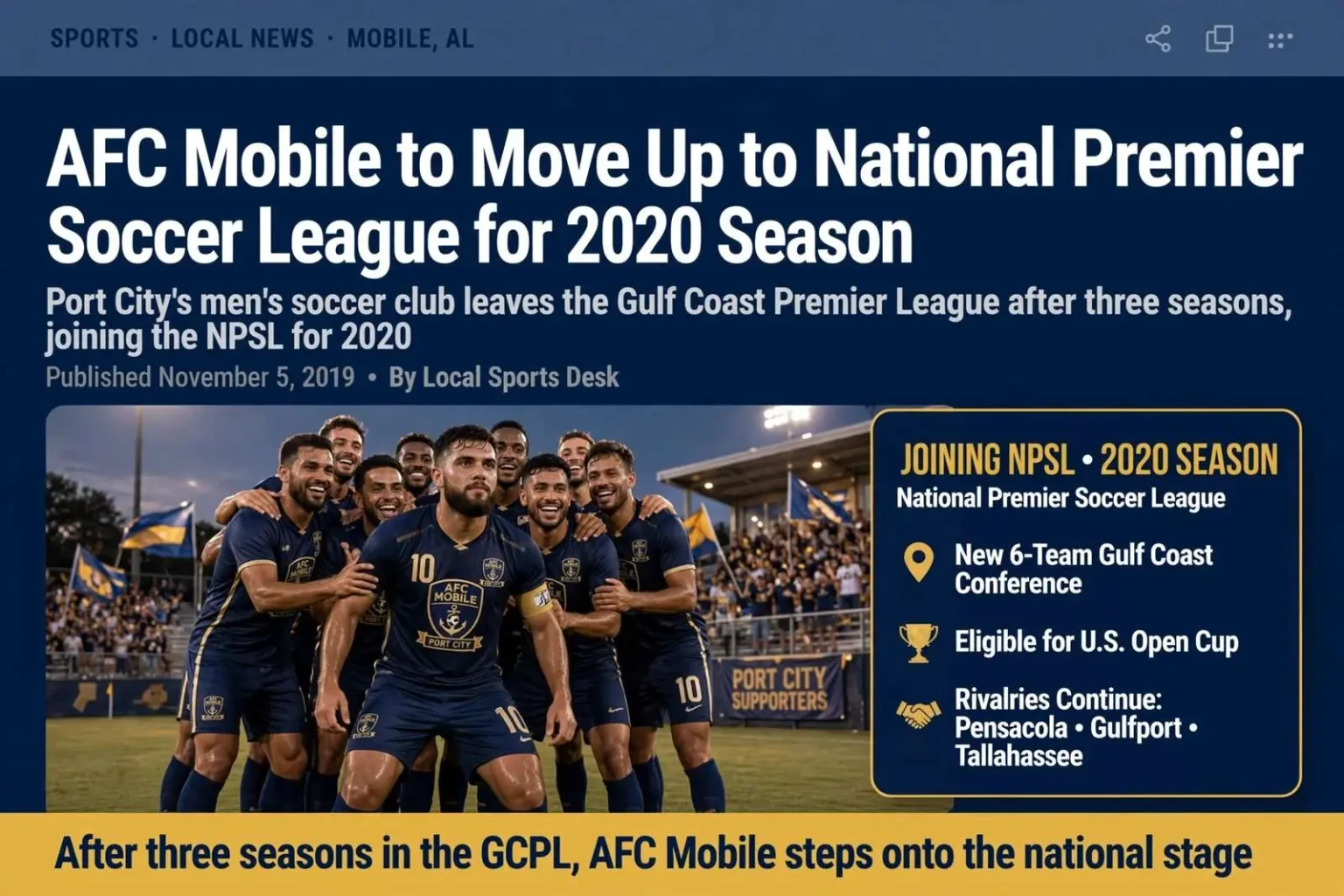
AFC Mobile, the Port City’s local men’s soccer club, is stepping up to a bigger stage. The team announced this week that it will leave the Gulf Coast Premier League (GCPL) after three seasons and join the National Premier Soccer League (NPSL) beginning with the 2020 season, putting Mobile on a path that could eventually lead to matchups against some of the country’s top professional clubs.
The move ends a three-year run in the GCPL, the regional league that helped organize competitive soccer across Louisiana, Mississippi, Alabama and the Florida Panhandle, and begins a new chapter in a national competition whose footprint spans the entire country. For a club built on volunteer energy and local identity, the jump represents the most significant structural upgrade in its history.
What the NPSL offers
The NPSL is one of the largest men’s amateur soccer leagues in the country, fielding more than 90 teams across numerous conferences nationwide. The league is affiliated with both the United States Adult Soccer Association and the United States Soccer Federation, giving member clubs a direct line into the sport’s national infrastructure.
That affiliation is more than paperwork. Because the NPSL sits within the recognized pyramid under the United States Soccer Federation, its clubs are eligible for the Lamar Hunt U.S. Open Cup — the century-old national tournament open to every affiliated team in the country, from amateur sides to Major League Soccer franchises. It is through the Open Cup that a club like AFC Mobile can, in the right draw and with the right run of results, find itself hosting or visiting professional opponents: USL Championship sides, or in the later rounds, MLS clubs. The league’s scale matters too. With more than 90 teams, the NPSL offers geographic clustering that keeps travel costs manageable while still providing a national platform — the balance that smaller clubs need to survive.
“It’s an exciting step for the club. Joining the NPSL gives us the opportunity to compete on the national stage and raises the profile of soccer in this area,” AFC Mobile head coach Steve Wieczorek said in a statement released Tuesday afternoon.
The new conference
Rather than starting from scratch in an unfamiliar league, AFC Mobile will anchor a newly formed NPSL conference alongside several familiar faces from its GCPL days, including Tallahassee SC, Pensacola FC and Port City FC of Gulfport. Rounding out the six-team grouping will be the New Orleans Jesters and Jacksonville Armada, a club with roots in the former North American Soccer League.
The composition of that conference is the quiet genius of the move. AFC Mobile’s rivalries — Mobile against Pensacola, Mobile against Gulfport — were the heart of its GCPL existence, and they survive intact. Fans who packed the ends of the ground for derby days along the Gulf Coast will see the same opponents, now under a national banner. And the two additions raise the stakes: New Orleans brings a club with a long history in Gulf Coast soccer, while Jacksonville Armada’s lineage in the NASL — a second-division league that once sat directly below MLS — gives the conference a member with professional-club infrastructure and ambition.
“With a fully professional league office, a national footprint, a direct pipeline to competing against USL and Major League Soccer clubs in the US Open Cup, and the ability to keep our rivalries against Port City FC, Pensacola FC and Tallahassee SC intact, NPSL offers us a great platform to continue to advocate for the people and culture of Mobile through our club,” AFC Mobile chief financial officer Sean Landry said. “We’re eternally grateful to the GCPL for their support over the last three years, and we look forward to working with them as we continue to build our club and soccer on the Gulf Coast.”
The GCPL years
AFC Mobile’s three seasons in the Gulf Coast Premier League built the foundation that makes the NPSL jump possible. The GCPL, organized to serve clubs along the Gulf Coast from New Orleans to the Florida Panhandle, gave the region’s amateur teams a structured schedule, playoff competition and a championship identity without imposing the travel burden of national league play. For a young club in a city whose soccer history had run mostly through youth leagues and school programs, that structure was exactly the right size.
The league years also built the local culture that Landry referenced in his statement. AFC Mobile has made itself as much a community institution as a sports team — a supporters’ culture, local partnerships and an open, accessible matchday experience at its Mobile home ground. Matchdays along the Gulf Coast have grown into social occasions that draw fans who may never have followed the sport before, and the club’s identity as “the Port City’s” team is central to how it presents itself.
Leaving the GCPL after three seasons is, by every indication, a departure in good standing. The club’s statement expressed gratitude and pledged continued cooperation with the regional league, which retains its role organizing competitive soccer for the Gulf Coast’s many other clubs. The relationship matters: the GCPL remains the proving ground for the region’s players and the feeder of talent toward higher levels, and clubs that ascend from it — as AFC Mobile now has — carry its reputation with them.
Soccer’s rise on the Gulf Coast
The move reflects broader growth in the sport across coastal Alabama. Youth soccer participation has expanded steadily across Mobile and Baldwin counties for a generation, with club programs drawing players who once had to look out of state for serious competitive pathways. The University of South Alabama and Spring Hill College field collegiate programs, high school rivalries draw genuine followings, and the region’s proximity to professional soccer markets — New Orleans, Pensacola, Atlanta’s MLS franchise — has fed local appetite for the game.
What the region lacked was a local senior men’s club competing at a genuinely national level. Amateur clubs in Alabama have historically operated below the radar of the average sports fan, appearing on community sports pages rather than the main section. A spot in a 90-team national league, with Open Cup qualification attached, changes the frame: suddenly Mobile has a senior club whose results matter in a national table and whose cup runs could produce the kind of giant-killing story that turns a local team into a regional talking point.
The Open Cup is the mechanism by which that could happen. Every year, amateur clubs from NPSL-type leagues reach the tournament’s early rounds and occasionally stun professional opponents in front of delirious home crowds — the kind of upset that makes national news precisely because it pits ordinary part-timers against full-time pros. AFC Mobile’s leadership, in Landry’s statement, explicitly framed the NPSL move as the pipeline to those occasions, and the club’s chance to test itself against USL or even MLS opposition now depends only on results.
What changes on the field
The practical differences between GCPL play and NPSL play are significant for Wieczorek’s roster-building. NPSL competition draws players from a wider talent pool: college players returning for summer competition, aspiring professionals keeping their form visible to scouts, and the best of the local amateur scene. The NPSL’s national affiliations also mean results and statistics are tracked within the sport’s recognized structure, giving individual players a legitimate platform from which to be seen.
The conference format shapes the season. A six-team grouping means a tight schedule of home-and-away series against five opponents — Tallahassee, Pensacola, Gulfport, New Orleans and Jacksonville — with conference results determining playoff qualification within the NPSL’s national framework. The travel map is manageable: every destination is within a reasonable bus ride of Mobile, which keeps costs in line with a community club’s budget while the level of competition rises.
The presence of Jacksonville Armada raises the competitive bar. Clubs with professional roots typically bring deeper rosters, better facilities and higher expectations, and conferences containing such sides tend to lift the standards of everyone else. For AFC Mobile’s players, measuring themselves against that level week after week is the clearest gauge of how far the club has come and how far it can go.
What it means for Mobile
For the city, the announcement lands at an opportune moment. Mobile has invested heavily in downtown revitalization, sports tourism and quality-of-life amenities over the past decade, and a senior soccer club on a national platform adds to the portfolio of attractions that make the city feel larger than its census count. Matchdays at a community ground offer the affordable, family-friendly atmosphere that minor-league and amateur sports provide across the South, and soccer’s demographic reach — among young families, among the Port City’s international community tied to the port and its industries — fits the city’s present.
The club’s own framing matters as much as the league move. Landry’s statement described the team as an advocate for “the people and culture of Mobile,” a mission statement that treats the club as a civic voice as much as a competitive team. Amateur clubs that succeed at this level tend to be the ones rooted in something beyond results — the supporters’ groups, the local charities, the neighborhood partnerships — and AFC Mobile’s leadership has consistently placed those elements at the center of the club’s identity.
The 2020 season’s schedule, kickoff dates and home venue details follow in the months ahead, as the club completes the transition and the NPSL finalizes its conference alignments. What is already decided is the direction: after three seasons building the foundation in the Gulf Coast Premier League, AFC Mobile will compete in 2020 on a national stage, with its Gulf Coast rivalries intact, its Open Cup ambitions on the table and the profile of soccer in Mobile riding on how far the step up takes the Port City’s club.
For the opponents who shared the GCPL with AFC Mobile — Pensacola, Gulfport, Tallahassee — the familiarity cuts both ways: they know exactly how dangerous the Mobile side can be, and they will now meet it in a league with a much bigger spotlight. For the New Orleans Jesters and Jacksonville Armada, the addition of Mobile extends the Gulf Coast soccer map that now stretches, in one conference, from the Mississippi River to the Atlantic. And for the city’s soccer community, a decade of grassroots growth finally has a senior club playing where the rest of the country is watching.