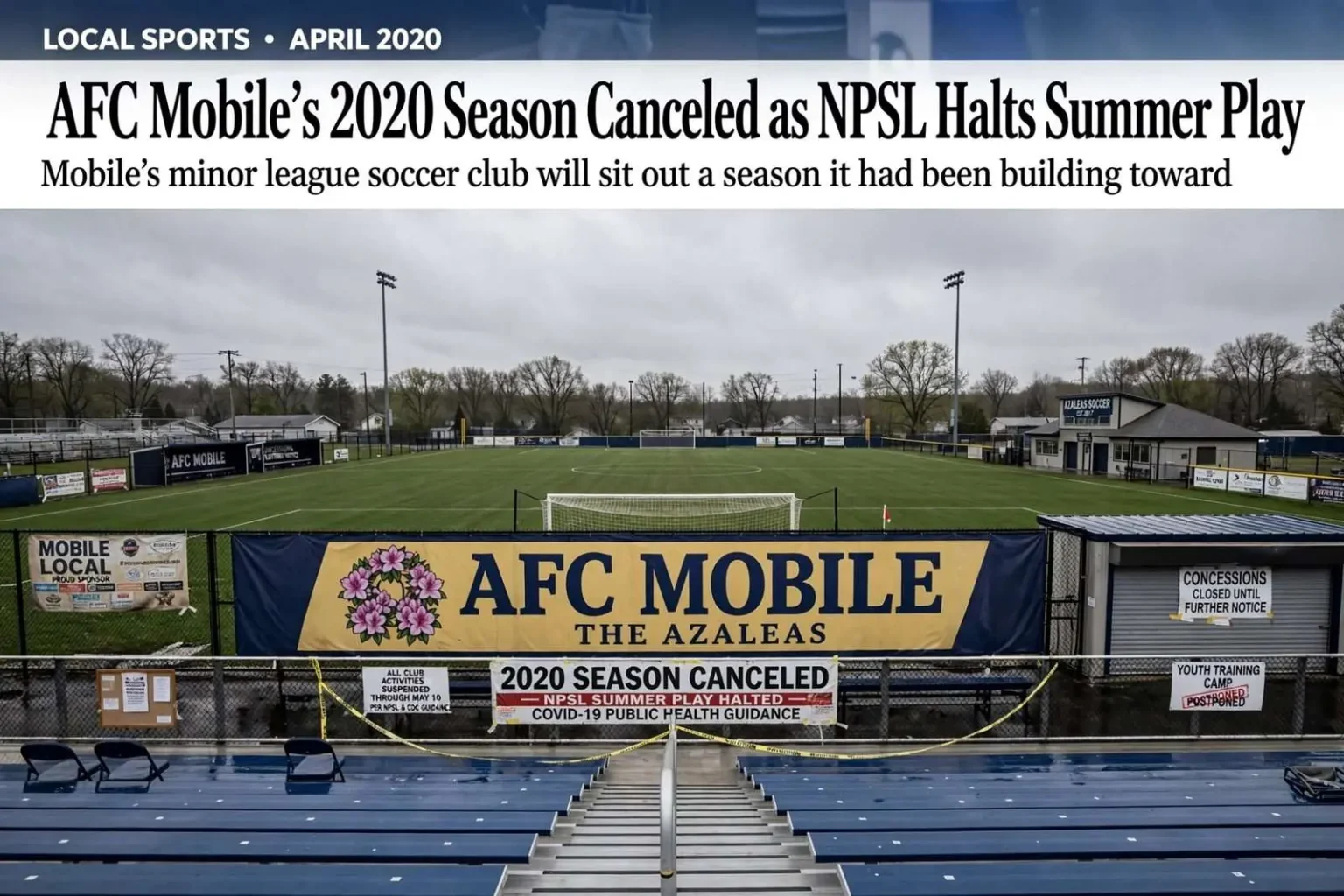
Mobile’s minor league soccer club will sit out a season it had been building toward. AFC Mobile’s first campaign in the National Premier Soccer League was called off after the league notified member teams that its 2020 summer season was canceled. The club had spent three years in the Gulf Coast Premier League before moving up to the NPSL.
The announcement ended months of uncertainty for a club that had spent the offseason preparing for its debut at a higher level of amateur soccer. Roster building, scheduling, sponsor outreach, and facility arrangements had all been pointed toward a summer kickoff, and the league’s decision froze those plans just as the coronavirus pandemic was shutting down sports across the country.
NPSL Chairman Kenneth Farrell cited federal and health guidance in a league-wide statement, noting a U.S. Adult Soccer Association ban on activity through April 30 and Centers for Disease Control recommendations against group gatherings for roughly eight weeks, lining up with May 10. “Given these circumstances, the 2020 NPSL summer season, under its current competition structure, has been canceled,” Farrell wrote, adding the board acted unanimously.
A League Out of Time
The arithmetic behind the decision was unforgiving. The NPSL’s summer season — a compact schedule played from May through July, timed to the college offseason that supplies most of its rosters — left no room to maneuver. A ban on activity through April 30 and CDC guidance against group gatherings running to about May 10 consumed the season’s runway before a single match could be scheduled. Waiting longer would have meant compressing the season into July’s worst heat, and league leadership concluded there was no responsible way to salvage a competition.
The NPSL sits among the top national amateur leagues in the United States, a summer competition where college players keep sharp between semesters alongside other aspiring professionals, and where clubs like AFC Mobile compete for regional titles and a place in the national playoffs. Moving up from the Gulf Coast Premier League — the regional competition where the Azaleas spent three seasons building their identity — was the club’s statement of ambition, making the cancellation all the harder to absorb.
Across the country, the league’s member clubs received the same news in the same week, part of a wave that claimed seasons in every American sport at every level. Professional leagues would eventually craft restart plans inside bubbles and empty stadiums; amateur summer soccer, which depends on community venues, volunteers, and ordinary crowds, had no such options.
The Right Call, Still a Hard One
AFC Mobile board member and chief financial officer Sean Landry called it the right call. “It’s unfortunate that it’s come to this point, but this is the right decision by the NPSL,” he said. “It would be irresponsible right now for us to ask our fans to gather, players to travel and Mobile’s small businesses to support us to the degree required to produce an NPSL season we can all be proud of.”
Landry said the club hopes to still run its summer training and youth programming — including AFC Mobile’s annual free youth training camp — once it is safe. “We’re hopeful that we’ll find a way to compete this summer, and we plan to use this time to focus on supporting our partners, players, and fans in Mobile in new and exciting ways,” he said.
Landry’s statement put the club’s values on display. Minor league soccer operates on thin margins, dependent on the same small businesses — restaurants, shops, local sponsors — that the pandemic was strangling, and on fans willing to buy tickets and families willing to shuttle players. Asking any of them to take on risk for the sake of a season contradicted what a community club claims to be. The club’s leadership chose to say so plainly rather than hold out hope for a delayed schedule that would probably have collapsed anyway.
The cancellation carried particular weight for the players. Many were college players returning home for the summer who had earned their spots in tryouts, and others were local talents for whom the NPSL debut represented a chance to test themselves against stronger competition. For a club that had marketed the season as a new era, the loss was felt as much in the locker room as on the ledger.
The cancellation ends what would have been the Azaleas’ debut in a higher tier of amateur soccer, but the organization says it plans to support its players, partners and fans in Mobile in new ways during the shutdown.
What the Azaleas Mean to Mobile
AFC Mobile has grown into a genuine community institution in its short life. The club’s matches drew a devoted following to its home grounds, complete with supporters’ traditions, local sponsors, and the kind of matchday atmosphere that bigger cities reserve for their professional teams. The Azaleas nickname ties the club to the city’s identity — Mobile’s iconic spring blooms — and the team has worn it into rivalries that gave the GCPL’s Gulf Coast schedule some of its sharpest edges.
That community base is why the club’s response to the cancellation leaned into support rather than shutdown. The organization’s promise to find new ways to stand behind its players, partners, and fans during the shutdown reflected the reality that a club like AFC Mobile is less a business than a civic project — one that exists because Mobile’s soccer community built it, and that owes that community something in a crisis.
The club’s summer training and youth programming, which Landry hoped could proceed when safe, represents the other half of that mission. Youth camps and training sessions are where minor league clubs connect with the next generation of players and fans, and in Mobile — a city with a deep youth soccer scene feeding high school and club programs across the area — that pipeline matters to the sport’s future as much as any first-team schedule.
Soccer in the Pandemic Era
The 2020 shutdown hit amateur soccer harder than most sports. Unlike professional clubs, summer-league teams have no broadcast revenue to fall back on, no wealthy ownership groups to absorb losses, and rosters that disperse to colleges when the summer ends. A canceled season cannot simply be resumed; it simply vanishes, and the clubs that survive do so on community goodwill and careful management of the kind AFC Mobile’s board demonstrated.
The GCPL years gave the club a foundation to return to. Three seasons of regional competition had built rivalries, a roster network across Gulf Coast college programs, and a fan base that knew the players by name. When soccer eventually resumed, the club’s NPSL ambitions remained intact — deferred rather than abandoned — and the organizational experience gained in three years of building a club from scratch positioned it to pick up where the pandemic left off.
For Mobile’s sports fans, the lost season removed a summer ritual before it began: warm evenings at the grounds, the supporters’ section in full voice, and a team wearing the city’s name at a higher level of play than ever. The pandemic took that from every amateur club in the country at once, and AFC Mobile could take comfort only in the company — and in the certainty that soccer, in Mobile as everywhere, would come back when it was safe.
Until then, the Azaleas’ first NPSL campaign waits on the shelf — a debut season postponed, with its club still standing behind the players, partners, and fans who built it.
The league’s statement made clear that no club was being singled out. Farrell’s message went to every member team simultaneously, and the unanimous board vote signaled that the decision was about public health arithmetic rather than any individual market’s situation. Clubs that had already announced schedules, sold season tickets, or held signing events — as AFC Mobile had across the spring — were left to unwind those plans with their own communities, which is precisely what the Azaleas’ leadership set about doing.
The timing also cut short the club’s competitive preparation at an awkward moment. First seasons in a new league typically require the steepest adjustments: longer travel, stronger opposition, and a step up in organization that separates national amateur competition from regional play. The canceled campaign would have been the shakedown year — the season in which mistakes were affordable and lessons were cheap. When the NPSL debut finally happens, it will arrive without that practice run.
Supporting the Community During the Shutdown
The club’s pledge to support its players, partners, and fans in new ways put those relationships into practice. Community-oriented clubs across the country responded to the shutdown with online content, youth engagement, charity tie-ins, and support for the local businesses that sponsor them — and AFC Mobile’s leadership signaled its intent to be part of that effort rather than go quiet for the summer. In a crisis, a club’s value shows in what it does without a season to sell.
The pandemic’s disruption of the spring and summer sports calendar remains without precedent in modern American life. From professional leagues to youth associations, competition stopped on the guidance of public health officials, and the USASA’s activity ban through April 30 — which the NPSL chairman cited directly — meant the shutdown reached all the way down to adult amateur play. The CDC’s recommendation against group gatherings through roughly May 10 extended it, and by then the compact summer schedule had no room left to give.
For the Azaleas, the organization’s message to Mobile was consistent with its three years of building: the club exists for the city’s soccer community, and that community’s health comes before any schedule. The NPSL will still be there when soccer returns, the roster plans will be rebuilt, and the debut the club spent years working toward will arrive in due time. What the 2020 season became instead was a test of the club’s character without a ball in play — and by the standard its board set in canceling responsibly and pledging support, it passed.