Africatown Heritage House Named Among 6 Best Museums in U.S. for 2023 by National Geographic
Africatown Heritage House in Mobile was named one of six best museums in the U.S. for 2023 by National Geographic, honoring the Clotilda descendants.
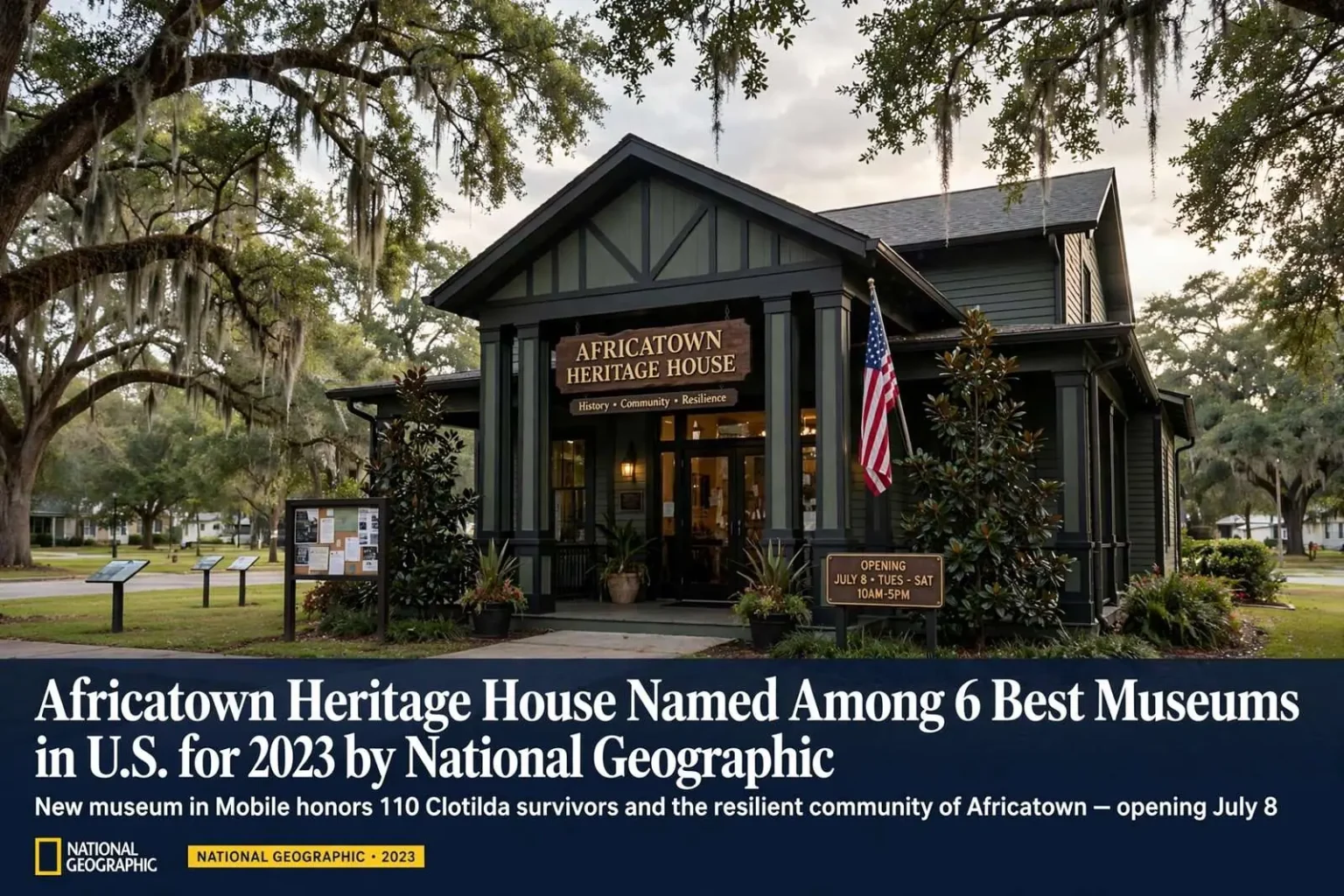
The Africatown Heritage House in Mobile has been named one of the six best museums in the United States for 2023 by National Geographic, an honor that spotlights a community founded by the survivors of the Clotilda, the last known slave ship to arrive in America. The recognition arrived just ahead of the museum’s public debut and has drawn national attention to a story that Mobile’s Plateau neighborhood has carried for more than 150 years.
The museum is slated to open on July 8 and will welcome visitors Tuesdays through Saturdays from 10 a.m. to 5 p.m. Its new exhibition will detail the stories of the 110 African men, women, and children brought to Mobile aboard the Clotilda — who they were, where they came from, what they endured on the voyage and in bondage, and how they built a free community of their own on the northern edge of the city after emancipation.
“The History Museum of Mobile has developed this exhibition in close collaboration with community partners in Africatown and with the descendant community, both local and national,” said Dr. Meg McCrummen Fowler, Director of the History Museum of Mobile. “Now, as an international community anticipates the exhibit’s opening, we remain focused on sharing the stories of the 110 men, women, and children and of Africatown in a way that honors their perseverance and resilience,” Fowler added.
The Story the Museum Tells
The Clotilda arrived near Mobile Bay in 1860 — decades after the United States outlawed the international slave trade in 1808 — on a clandestine voyage financed by a wealthy Mobile businessman who bet that he could smuggle a cargo of captive Africans into the country without being caught. The plan succeeded, in defiance of federal law, and after the captives were transferred up the river, the schooner was scuttled and burned in the waters of the Mobile-Tensaw delta to hide the evidence of the crime.
When emancipation came, the Clotilda’s survivors — many of them from West African communities with distinct languages, skills and traditions — pooled their wages and bought land north of downtown Mobile, establishing the settlement they called African Town, known today as Africatown. It remains a singular place in American history: a community founded, built and governed by the very people who survived the last slave voyage to the United States, who preserved memories, names and cultural practices from their homelands and passed them down through generations.
For decades the location of the sunken ship was one of the Gulf Coast’s great historical mysteries. That changed when remains in the Mobile River were confirmed in 2019 as the Clotilda, a finding announced by the Alabama Historical Commission after exhaustive analysis. The discovery electrified descendant families, researchers and the national media, and it energized preservation and heritage tourism efforts across the region — including the push to build a museum worthy of the story.
A Collaborative Effort to Honor Resilience
The Heritage House is deliberately not a traditional museum project. From its earliest planning stages, the exhibition has been shaped by the descendant community — the families of the Clotilda survivors who still live in and around Africatown — alongside historians, archivists and the staff of the History Museum of Mobile. That collaboration was intended to ensure the exhibition presents the 110 men, women and children as people with names, origins and agency, not merely as cargo in a criminal voyage.
The National Geographic recognition places the Heritage House alongside other top museum destinations across the country, an unusual distinction for a small community museum in a historic neighborhood, and one that organizers hope will translate into sustained visitation. Museums that open to national acclaim face both an opportunity and a burden: visitors will come from across the country expecting an experience that matches the billing, and the community will watch to see whether the attention brings lasting benefit to Africatown itself.
For Mobile, the honor reinforces a growing identity as a heritage tourism destination. The city’s story — French colonial origins, antebellum commerce, the Civil War, the civil rights era and now the Clotilda narrative — has increasingly drawn travelers interested in history that is difficult and honestly told. Africatown’s place in that story is central, and the museum gives visitors a reason to travel north of downtown to the neighborhood where the history actually happened.
What Visitors Will Find
The exhibition walks visitors through the full arc of the Clotilda story: the West African communities from which the captives were taken, the Middle Passage voyage, the illegal transaction in Mobile, the years of enslavement, and the founding and flourishing of Africatown. Artifacts, documents, interpretive panels and immersive elements guide the experience, and the museum has been designed to serve as both a tourist destination and a place where descendant families can engage their own history.
The opening hours — Tuesdays through Saturdays from 10 a.m. to 5 p.m. beginning July 8 — reflect the museum’s role as a community institution as much as an attraction. Local schools, churches and civic organizations have been part of the planning conversation, and the facility is expected to host programming that extends beyond the exhibition walls: lectures, commemorations, and gatherings of the descendant community that keep the story living rather than fixed.
The national spotlight also returns attention to the community itself. Africatown has long contended with the pressures that historically Black neighborhoods near industrial corridors have faced — encroaching industry, infrastructure needs and the economic headwinds of disinvestment. Heritage tourism has been promoted as one path toward renewal, and the museum stands as its anchor: a nationally recognized institution rooted in the community that the Clotilda survivors built, telling their story in their own neighborhood, in a manner designed to honor the perseverance and resilience that carried 110 people from captivity to freedom to a home of their own.
The Wreck Discovery and What It Changed
The confirmation of the Clotilda’s remains in 2019 did more than settle a historical question — it gave the community physical proof of the story that had been handed down for generations. Descendants had always known what happened to their ancestors; the wreck’s verification transformed that family knowledge into documented, nationally recognized history. Investigations of the vessel’s timbers, dimensions and construction matched the records of the schooner, closing the case that historians had chased for decades along the riverbanks and bayous of the delta.
The discovery prompted a wave of institutional response. State and local officials committed resources to preservation, researchers began studying how best to protect the wreck in its watery grave, and planning accelerated for the kind of interpretive facility the community had long sought. The Heritage House emerged from that momentum, its exhibition conceived while the wreck was still making international headlines, its purpose anchored in the conviction that the story belongs with the people who lived it.
For descendant families, the museum’s opening carried emotional weight that out-of-town visitors can only partially appreciate. The names on the exhibition walls are family names. The community outside the door is the one their ancestors founded with wages earned in freedom after arriving in chains. A national magazine honoring the museum as one of the country’s best is, in a sense, the country finally paying attention to a story the community never stopped telling.
Planning a Visit
Travelers planning a visit will find the Heritage House in the Africatown community north of downtown Mobile, close to the sites associated with the Clotilda story — the waterfront where the captives came ashore, the churchyards where survivors are buried, and the streets laid out by the founders themselves. Visitors are encouraged to allow time for the neighborhood as well as the exhibition, since the landscape itself is part of the story the museum interprets.
The museum’s Tuesday-through-Saturday schedule is designed around staffing and community use, and interest generated by the National Geographic honor is expected to make early weeks busy. Organizers have encouraged groups to plan ahead, and the exhibition has been built to accommodate a steady flow of visitors through gallery spaces that balance the gravity of the subject with the accessibility a general audience needs.
Admission details, group arrangements and programming announcements have been handled through the History Museum of Mobile and its community partners, and the institutions involved have emphasized that the exhibition will continue to evolve as oral histories are gathered, research continues and the descendant community shapes how the story is told. That living quality — a museum that grows with its community rather than fixing it in amber — is part of what earned the Heritage House its place among the nation’s best museum openings of 2023, and part of what makes Africatown a place the country is, at long last, learning to see.