Africatown Residents Push for ‘Safety Zone’ Label to Stop Encroaching Industries
Africatown residents seek a safety zone designation under Mobile's updated zoning code to protect the community from encroaching industrial development.
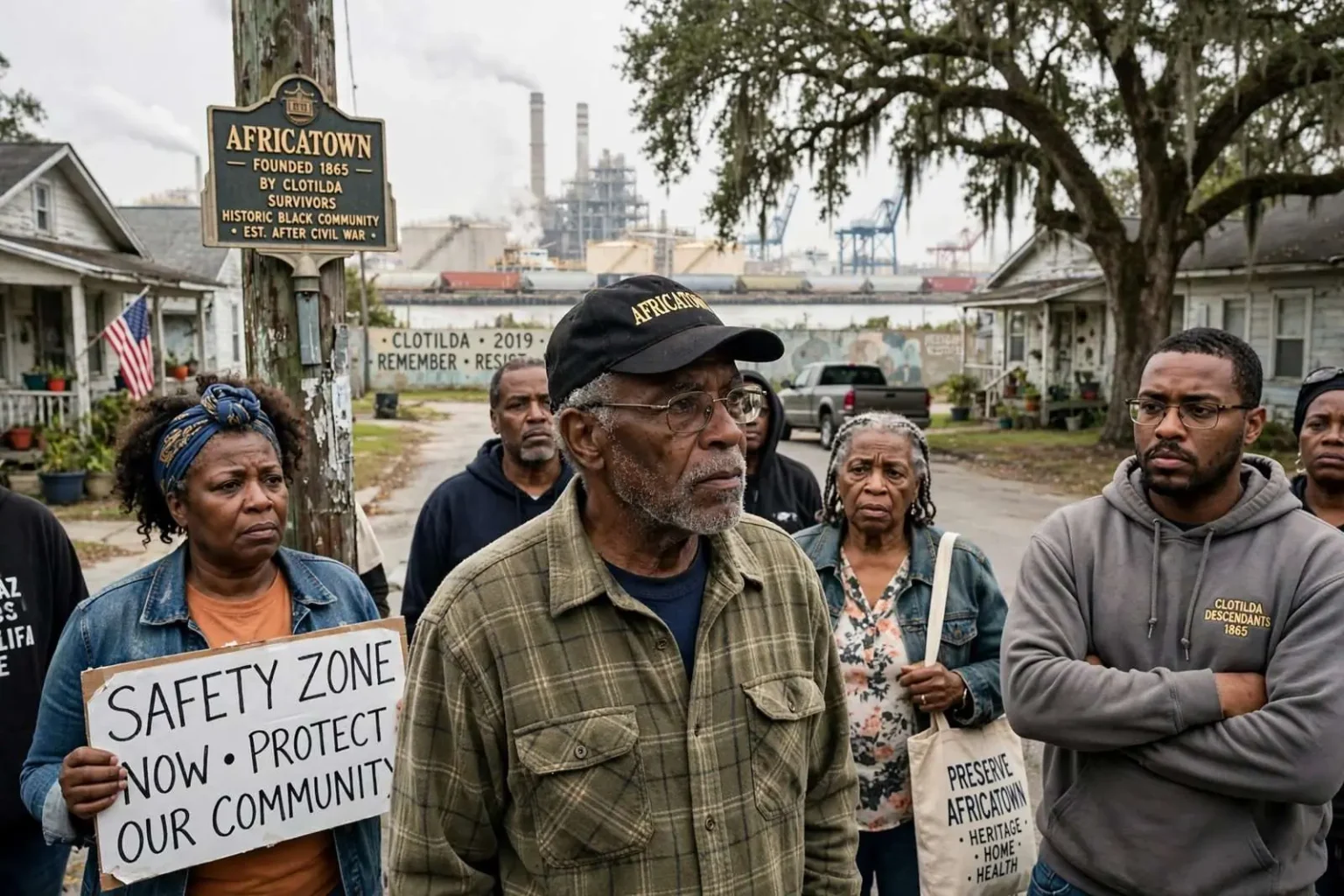
Africatown residents are pushing for the historic Mobile community to be designated a “safety zone” under the city’s updated zoning code, arguing that encroaching industrial development threatens both the health of residents and the neighborhood’s potential as a heritage tourism destination.
City officials began revising Mobile’s Unified Development Code several years ago, but the effort hit another snag when Africatown residents raised concerns about industrial activity moving closer to their residential areas. The proposed safety zone amendment would cover the entire perimeter of Africatown’s residential areas, creating a buffer between homes and the industries that ring them.
Resident Joe Womack said the industrial encroachment is becoming a real issue for the community’s health and well-being.
“If some industry wants to tell me why they don’t want to protect people, then maybe I’ll agree with them, but I can’t be convinced of that right now,” Womack said.
Residents also worry that industrial expansion will hinder Africatown’s growing tourism potential. Since the discovery of the Clotilda slave ship wreck in the Mobile River in 2019, the community has been part of multiple plans to attract visitors to a place whose history is unlike any other in America.
History beneath the surface
Africatown was founded after the Civil War by the survivors of the Clotilda, the last known ship to bring enslaved Africans to the United States, decades after the international slave trade had been outlawed. The community those survivors built — schools, churches, a cemetery — has stood in what is now north Mobile for more than 150 years, and its descendants remain there today. The 2019 confirmation of the Clotilda’s wreck transformed the neighborhood’s profile, drawing national media attention, state investment and a steady stream of visitors to a story that had long been underrecognized.
“We want something that rivals what’s going on in Montgomery,” Womack said. “They have a billion-dollar African American culture tourism business and we believe we can do that in Africatown, but we have to have those businesses stay away from us.”
The Montgomery comparison is pointed. Alabama’s capital has built a nationally significant heritage tourism economy around its civil rights landmarks and memorial sites, drawing visitors from across the country and anchoring hotels, restaurants and small businesses around that traffic. Africatown’s advocates see the same potential in their community — a destination for travelers following the story of the Clotilda and the people who founded the neighborhood — but argue that tourism dies where industry crowds in.
The community’s geography explains why the stakes are so high. Africatown sits in a bend of the Mobile River surrounded on multiple sides by heavy industry — paper manufacturing, port operations, chemical storage and rail lines — a pattern that took shape decades ago when the neighborhood had little political power to resist. Residents have long pointed to that industrial ring when discussing air quality, truck traffic and the neighborhood’s declining population, and the safety zone proposal is their most direct attempt yet to draw a legal line around what remains.
A difficult balance
The safety zone amendment would be added to the UDC, which has been debated on multiple city council agendas for years and represents the most wide-ranging revision to Mobile’s zoning law in at least 50 years. The push prompted the council to delay the UDC adoption vote by two weeks to allow further discussion — an unusual pause in a document that has already absorbed years of hearings, drafts and rewrites.
District 2 Councilman William Carroll, whose district includes Africatown, acknowledged the challenge of balancing industrial interests with community protection.
“We are close to some language that protects both the sovereignty of Africatown but also has a good use for industry in the vicinity,” Carroll said. “I don’t think anybody wants to stop heavy industry work. What people want to stop is the smothering of a community that’s been there since before the Civil War.”
The area generates billions of dollars annually through ports and industrial operations, making any zoning changes a complex negotiation between economic interests and the rights of a community with deep historical roots. Port-related businesses are among Mobile’s largest employers, and the corridor around Africatown is some of the most industrially valuable land on the Gulf Coast — which is precisely why residents say the pressure to build closer never stops.
What a safety zone designation would actually prohibit depends on the language the council adopts. Zoning tools can restrict the distance between industrial operations and homes, limit certain categories of land use, or require additional review before facilities that handle hazardous materials are permitted near residential boundaries. Carroll’s description of “close” language suggests negotiators are trying to calibrate a buffer strong enough to protect the neighborhood without freezing out the port economy entirely.
Environmental justice and the long view
The fight over Africatown’s zoning is part of a longer national conversation about environmental justice — the principle that no community should bear an outsized share of pollution and industrial risk because of its history or demographics. Neighborhoods like Africatown, founded by Black families on land nobody else wanted and then surrounded by industrial expansion, are the classic case study, and federal agencies have increasingly weighed environmental justice in siting, permitting and enforcement decisions. A local safety zone would give that principle the force of municipal law.
For residents, the health concerns are not abstract. Industrial operations bring truck traffic, noise, odors and emissions, and Africatown’s population has declined sharply over recent decades as homes were bought up and the community’s footprint shrank. The residents who remain argue that the city now faces a choice its predecessors never made: whether the last residential core of a historic community survives alongside the port economy or is absorbed by it.
The tourism argument gives the zoning fight an economic dimension that pure health advocacy sometimes lacks. Plans connected to the Clotilda discovery — exhibits, memorials, walking tours and visitor facilities — depend on a destination people want to visit and walk through. A neighborhood hemmed in by factories presents a very different experience than one with a protected residential heart, and Womack’s billion-dollar comparison is a claim about which kind of future pays better over the long run.
For the residents who filled council chambers during the UDC debates, the two-week delay represented a rare moment of leverage. A community that watched industry encircle it over generations now has the weight of the Clotilda story, the attention of heritage travelers and a seat in the city’s most significant zoning rewrite in half a century — a combination its advocates intend to use before the final vote comes.
The UDC rewrite itself is a massive undertaking for any city. A unified development code consolidates zoning, subdivision rules and development standards into a single legal framework, replacing the patchwork of ordinances a city accumulates over decades. For Mobile, revising that document for the first time in half a century means every neighborhood’s future land use is on the table at once — which is why Africatown’s advocates saw this moment as their best, and perhaps only, opportunity to lock in protections before the document is adopted and the political moment passes.
Zoning protections work differently from the promises industries make when they seek permits. A safety zone written into the UDC binds whoever holds office in the future and applies to whatever company arrives next, giving the neighborhood standing it currently lacks when new projects are proposed. Residents have learned through experience that individual permit fights are expensive and exhausting; a permanent buffer shifts the burden before the fight begins.
The perimeters of Africatown’s residential streets sit close to some of the busiest industrial infrastructure on the Gulf Coast, and residents describe the boundary as something they live against every day — heavy trucks on two-lane roads, sirens and machinery noise at all hours, and the constant awareness of what is stored and processed a few hundred yards from their homes. The amendment’s perimeter-wide approach is designed so that no single gap in the buffer becomes the avenue for the next encroachment.
City planners and council members must also weigh the precedent a safety zone sets for other neighborhoods. Mobile’s port economy touches communities across the city’s north side and along the waterways, and language that creates a strong buffer in Africatown could become the template other neighborhoods cite. That prospect is part of why the negotiations over the amendment’s wording have been so careful — and why Carroll’s insistence that “nobody wants to stop heavy industry work” frames the compromise as coexistence rather than containment.
For Africatown’s future residents and visitors alike, what the council writes in the coming weeks will shape the neighborhood for generations. The community survived the Clotilda’s voyage, Reconstruction, industrialization and decades of disinvestment; the question before the council now is whether its zoning code will finally give that survivor community room to live — and to be visited — in peace.