After 22 Years, Retired Mobile County JROTC Instructor Leaves a Lasting Legacy
First Sergeant Arties Roper retired this month after 22 years leading Mobile County's Junior ROTC programs, with former cadets crediting him as a mentor, teacher and father figure who shaped their lives long after high school.
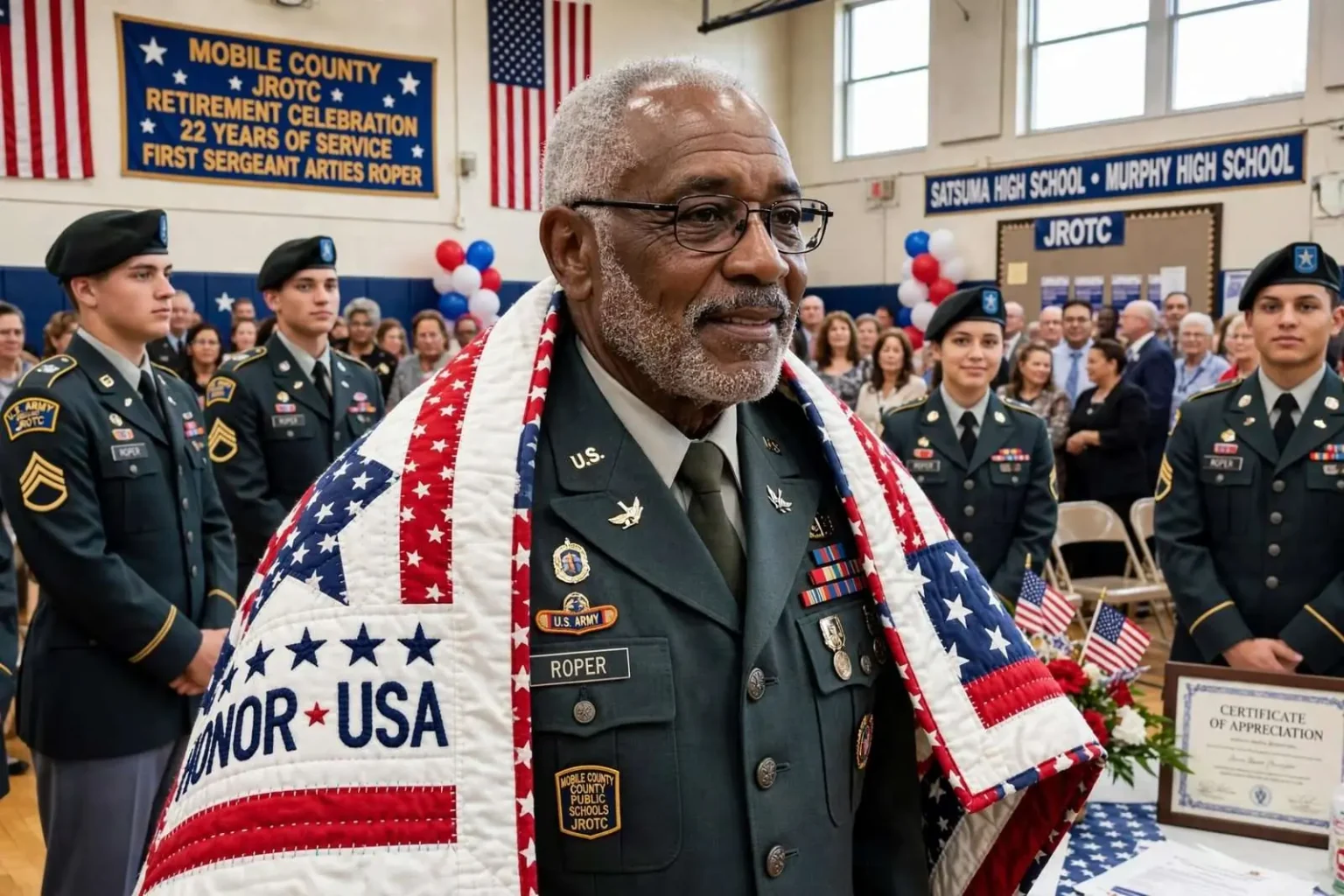
First Sergeant Arties Roper was honored earlier this month after retiring from the Mobile County Public School System, capping a 22-year career leading Junior ROTC programs and shaping generations of students along the way.
Roper began his JROTC career at Satsuma High School and Murphy High School before spending the last 12 years overseeing the JROTC program for the entire county school system. More than 100 people turned out for his retirement celebration, where he was presented a Quilt of Honor along with other tributes of appreciation.
“His passion for young people, to help them achieve the potential they had within themselves, he was so good at that,” said Robert Barrow, who also served as a JROTC instructor in Mobile County.
Former cadets reflect on his impact
Many of Roper’s former cadets who now serve in the military were unable to attend the retirement party in person but sent video messages of thanks.
“He’s been a great mentor, a great teacher, and also a father figure,” said Army Capt. James West III. “The impacts he’s had on me are still impacting me today.”
Sgt. Ashley Torrence credited Roper with lessons that have stayed with her well beyond the classroom. “He taught me leadership, guidance, and discipline,” Torrence said. “Every single thing he taught me has been embedded in my head, embedded in my heart, and I take it with me on my whole journey in the military, and as a civilian.”
U.S. Army Capt. Mike Miller echoed that sentiment. “I’m in this uniform right now because of a great leader like you,” he said.
The video tributes carried a common thread. Cadets who passed through Roper’s programs described an instructor who demanded standards and then stood beside them while they met them, and who treated the cadet corps less like a class roster and more like a family whose members he followed for years after graduation.
From recruiter to mentor
Roper’s path to JROTC began after he joined the Army out of Foley High School, with assignments that took him to Germany, Washington state and Oklahoma.
A turning point came when his commander ordered him to attend recruiting school — an assignment Roper initially resisted.
“My commander called me in and said, ‘you’re going to recruiting school,’ and I said, ‘no sir,'” Roper recalled. “I went kicking and screaming.”
What looked like an unwanted assignment turned out to be the making of his second career. Recruiting duty is, at its core, the work of finding young people, talking with them about their futures, and persuading them that a path exists for them in uniform. The skills it demands — patience, persuasion, an eye for potential that a résumé does not show — are the same skills that separate a memorable JROTC instructor from an ordinary one. Roper would carry the lessons of that assignment into every classroom and drill hall he ran for the rest of his service and then for two decades in the schools.
What JROTC asks of its cadets
The cadet side of the program is equally demanding. Students in JROTC balance their regular coursework with drill schedules, uniform inspections, community service hours and physical training, often starting their days earlier than their classmates and staying later. The program’s awards and promotions give structure to that effort, with cadets advancing through ranks based on performance, leadership and service rather than popularity, and the structure is precisely what many students say they were missing before they joined.
Parents and school administrators across Mobile County have long pointed to that structure as one of the program’s quiet strengths. Cadets learn to speak in front of groups, to plan and run events, to manage younger cadets, and to accept correction without sulking over it. Those are not military skills so much as life skills delivered with military precision, and they are what instructors like Roper spent their careers handing over.
What JROTC asks of its instructors
Junior ROTC instructors are retired service members who return to the classroom in uniform, and the role blends teaching, coaching and mentoring in a way few school jobs do. A typical program runs before-school drills, after-school practices, color guard appearances at community events, rifle team and physical training competitions, and the constant work of keeping a cadet battalion organized like the military unit it is modeled on.
In Mobile County, where the public school system is one of the largest in Alabama, JROTC units operate across high schools throughout the county, and the programs draw cadets from every kind of neighborhood. Some cadets go on to enlist, some compete for service academy appointments and ROTC scholarships, and some never wear a uniform again but carry the discipline into civilian careers. Instructors like Roper measure success across all three outcomes, not just the cadets who follow them into the Army.
The last 12 years at the county level
Roper’s final 12 years in the school system were spent overseeing JROTC for the entire county rather than a single school, a role that placed him above the individual units and made him responsible for the health of the program as a whole. In that position he worked with instructors across Mobile County’s high schools, coordinated the competitions and ceremonies that connect the units, and served as the point of contact between the school system and the military branches whose programs operate in the district.
His earlier assignments at Satsuma High School and Murphy High School grounded that countywide work in the classroom experience. Satsuma, north of Mobile, and Murphy, one of the city’s long-established high schools, gave him two very different cadet populations, and colleagues say the range showed in how he understood what instructors in every corner of the county were dealing with.
The Quilt of Honor
Among the tributes at the retirement celebration was a Quilt of Honor, a hand-stitched recognition presented to veterans and service members to honor their service. Quilts of this kind are typically assembled by volunteer groups who sew the panels, with each quilt meant to be used and cherished rather than stored away, and the presentations carry a simple message: the recipient’s service is seen and will not be forgotten.
Retirement celebrations like this one have become a tradition in school systems with large JROTC networks, where an instructor’s departure ripples through decades of alumni. Word of the event spread through the networks Roper built over 22 years, and messages arrived from cadets he had not seen since their graduations, a reminder that a teaching career ends the day the instructor leaves the classroom but its effects keep going for as long as the students do.
For a career soldier who spent his second career teaching young people, the quilt joined two halves of a life in uniform. The more than 100 guests who watched it draped over his shoulders included fellow instructors, retired colleagues, current and former cadets, and family members, many of whom had traveled to be there.
What his cadets carried forward
The military ranks in the video tributes told part of the story. A captain and a sergeant, both shaped in Roper’s programs, addressed him with the warmth reserved for someone who changed the course of a life. West’s line about impacts that are “still impacting me today” captured what instructors in the program often hear decades later from cadets who are now raising families and leading units of their own.
Torrence’s tribute pointed to the same legacy from a different angle. Leadership, guidance and discipline, she said, are embedded in how she serves — in uniform and as a civilian. That transfer into civilian life matters to JROTC instructors, whose programs exist not to fill the ranks but to build citizens, and the sentiment reflected what Roper preached to every class: the standards hold no matter what you wear to work.
Miller may have put it most directly. “I’m in this uniform right now because of a great leader like you,” he told Roper in his message, compressing a 22-year career into a single sentence of consequence.
A retirement, not an ending
Retirement celebrations in school JROTC circles tend to double as reunions, and Roper’s was no exception. Former cadets now stationed far away sent their greetings by video; those in the area filled the room; and fellow instructors traded stories of competitions won and lost, buses chartered at dawn, and the endless paperwork that keeps a cadet battalion running.
The Mobile County Public School System’s JROTC programs continue across the county’s high schools, carrying on the work Roper oversaw for his final 12 years, and the instructors he leaves behind inherit both the programs and the standards he set for them.
For Roper, the honors marked the close of a career that began with a reluctant assignment to recruiting school and ended with more than a hundred people standing to thank him. His cadets’ message, repeated in every tribute and every video, was simpler and harder to argue with: the program changed their lives, and he was the program.