After a Decade in Gulf Shores, Bleus Burger’s Owners Put Their Turnkey Burger Business Up for Sale
Bleus Burger owners Scott Keel and Susan Ellis have listed the acclaimed Gulf Shores gourmet burger restaurant for sale, offering a fully documented, turnkey operation while the restaurant continues running during the ownership transition.
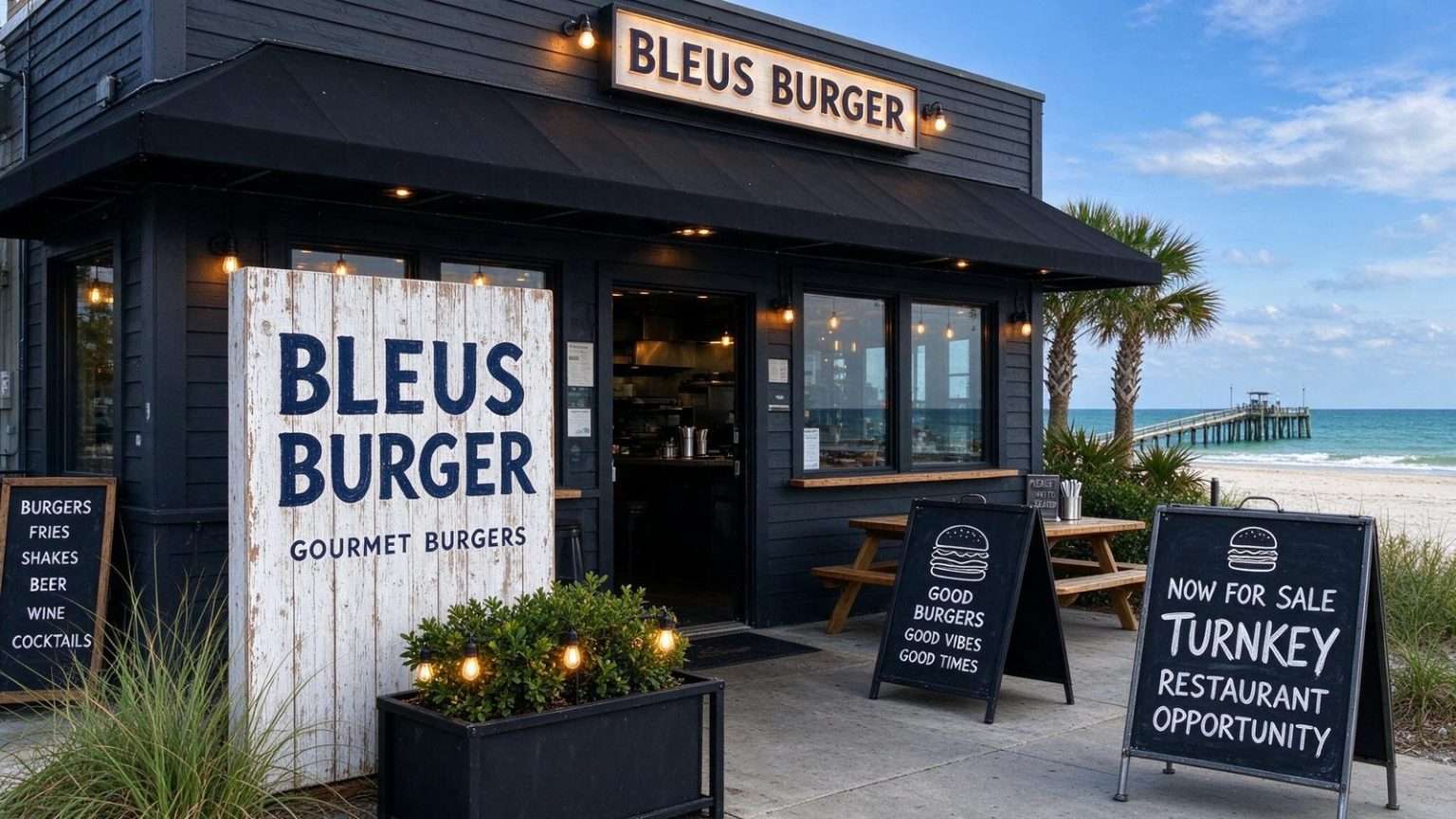
GULF SHORES, Ala. — A well-known name in Gulf Shores dining is up for sale. Bleus Burger, the gourmet burger restaurant that has anchored the city’s food scene for roughly a decade, has officially been listed for new ownership, putting one of the beach town’s most established kitchens on the market at the height of the region’s tourism economy. The restaurant will continue operating as usual while the sale process moves forward — regulars can expect the same menu, the same staff and the same operation while the changeover is negotiated.
Owners Scott Keel and Susan Ellis are marketing the business as a turnkey opportunity, complete with documented recipes, established inventory systems and an existing staff structure already in place. In the restaurant trade, “turnkey” is a claim most listings cannot honestly make: a buyer walking into Bleus Burger would inherit not just equipment and a lease, but the operating playbook of a restaurant that has survived ten years of Gulf Shores seasonality — the difference between opening a restaurant and opening a proven one.
What a buyer gets
The sale includes more than the restaurant’s physical storefront. The operation also functions as a commissary capable of supporting up to three mobile food units, along with a brand built over years of appearances at local festivals and events. The commissary element is the quiet asset in the listing — a licensed base kitchen that can prep, store and supply food trucks or mobile vendors is exactly the infrastructure that Gulf Coast food-truck operators struggle to find, and bundling it with an established restaurant gives a buyer multiple revenue paths under one roof.
The brand itself carries weight. Years of festival appearances along the coast have made the Bleus Burger name familiar to crowds far beyond Gulf Shores city limits, and festival vending is a business with its own economics: high-margin event weekends that pad the restaurant’s slower stretches. For an incoming owner, that means the purchase includes not just a dining room but a mobile presence in the region’s busy fair-and-festival circuit — from beach events to Baldwin County gatherings where a proven vendor can do brisk business.
Why the owners are selling
Keel and Ellis say the decision to sell is not driven by burnout but by a desire to pursue new opportunities after a decade of running the business themselves. Ellis said designing a revolving menu twice a year kept the job interesting throughout — a discipline that explains much of the restaurant’s longevity, since a burger spot that refreshes its offerings twice annually gives regulars a reason to return and tourists a reason to come back each season. Keel described the move as a chance to take on new challenges, travel and spend more time with family, the classic calculus of owners who have poured a decade into a business and built it to the point where someone else can carry it.
Restaurants rarely reach the market in this condition. The coastal dining scene is famously brutal — seasonal surges, a workforce that turns over with the school year, and rents that follow the tourist economy — and a gourmet burger concept that has lasted a decade in Gulf Shores has already passed through the filter that closes so many others. What Keel and Ellis have assembled is, by the standards of the trade, a going concern: documented recipes mean the menu does not leave with the chef, inventory systems mean the ordering does not depend on institutional memory, and a staff structure means the floor keeps running during ownership transition.
The Gulf Shores dining market
The timing and setting matter for any prospective buyer. Gulf Shores sits at the center of one of the country’s most reliable beach tourism markets, with a visitor economy that swells the city’s population every spring break and summer and a dining scene that has grown more ambitious as the town has matured. A decade of development along the coast has raised expectations across the board — visitors who once settled for fried baskets now look for craft concepts — and a gourmet burger operation with a decade of local goodwill stands squarely in that current.
Baldwin County’s growth adds another layer. The coastal strip from Gulf Shores to Orange Beach and Foley has been among Alabama’s fastest-growing areas, and year-round population growth steadily converts a seasonal restaurant market into a twelve-month one. A buyer who takes over an established name in that environment inherits both the tourist surge and the increasingly deep local base — a combination that, in restaurant terms, is the whole ballgame.
How the sale is structured
The owners have prepared a detailed prospectus for serious buyers and said landlords are willing to negotiate a lease transfer for the right candidate. The prospectus is where a turnkey listing earns its name: financial and operational documentation that lets a buyer evaluate the business as a business rather than a vibe. The landlords’ willingness to negotiate a lease transfer is the linchpin — a favorable assumption of an existing lease at an established location removes the single greatest obstacle to a restaurant sale, since relocating a proven operation means starting the customer-traffic clock over from zero.
They are hoping to find an operator, whether an established restaurateur or a first-time owner, who will carry the Bleus Burger brand forward. The openness to a first-time owner is notable. Many turnkey listings quietly target industry veterans, but Keel and Ellis’s pitch — complete recipes, systems and staff — is designed precisely to make the operation manageable for someone buying their first restaurant, with the existing team providing the continuity that most first ventures lack. An experienced operator, meanwhile, would find a base operation that already runs, free to grow the commissary side, the festival circuit or the dining room.
Interested buyers are encouraged to reach out directly to Keel and Ellis to review details of the sale. Direct-from-owner listings of this kind keep the process personal — the people who built the brand walk the buyer through it — and the owners’ stated preference that the brand move forward suggests they are screening for stewardship, not just the highest offer.
What the sale says about coastal restaurants
The listing is a case study in how a small coastal restaurant matures into an asset. Ten years of operation turn a startup into a set of systems: recipes written down, supply chains worked out, staff roles defined, a name recognized from the beach highway to the festival midway. Businesses that reach that stage are fundamentally different properties from the ones that open and close within a season — they carry documented value that survives their founders, and they attract buyers precisely because someone else already paid for the learning curve.
The commissary-and-mobile-units model also reflects where the industry has headed. Food trucks and mobile vendors have become a permanent part of the Gulf Coast food landscape — festival crowds, beach events, breweries and municipal gatherings all draw them — and a licensed commissary is the regulatory and logistical backbone any fleet requires. A buyer who sees Bleus Burger as a burger restaurant is reading half the listing; the other half is a catering-and-mobile operation with a decade of festival seasoning and room to grow to three units.
For Gulf Shores diners, the near-term picture is unchanged: Bleus Burger keeps cooking while the sale proceeds, with the menu — including the twice-yearly revolving selections Ellis credits for keeping the work interesting — still under the same kitchen. The longer-term question is who steps in. The listing offers a rare combination for the coastal market: an established brand, a dual restaurant-commissary operation, a cooperative landlord and owners willing to hand over the whole playbook. Whoever signs the lease will take over a business that has already proven it can last — a decade’s worth of proof, served on a bun.
The revolving-menu discipline deserves particular attention from any prospective buyer, because it is the engine behind the restaurant’s repeat business. Twice a year, the menu turns over with new creations alongside the staples, a rhythm that functions as marketing and craftsmanship at once: regulars return to see what is new, tourists find a menu different from their last visit, and the kitchen staff stays engaged with a project rather than a rut. Recipes for both the constants and the rotations are documented among the assets, meaning the buyer inherits the full creative history of the concept, not just its greatest hits.
The staff structure carries similar value in the current labor market. Coastal restaurants spend an enormous share of their energy each spring rebuilding crews for the tourist season, and an operation with a settled team and defined roles offers a buyer continuity that would otherwise take years to construct. In a sale like this, the staff is arguably the least replaceable asset on the list — training a kitchen and a dining room floor in the rhythms of a busy beach-town restaurant is the slowest, most expensive process in the business, and it is already done.
Festival vending, meanwhile, is a specialized craft of its own. Gulf Coast events — from seafood festivals to music weekends to holiday gatherings across Baldwin County — reward vendors who can scale production, move fast and feed long lines without collapsing quality, and a decade of appearances has tuned Bleus Burger’s mobile operation for exactly that environment. The permits, equipment habits, menu formats and logistics that make festival weekends profitable are part of the brand being sold, and the commissary backing them up is what allows the mobile side to expand to three units without reinventing its supply chain.
Keel’s and Ellis’s stated plans after the sale — new challenges, travel, family time — round out the picture of a business being passed on from strength rather than fatigue. Restaurants that hit the market exhausted tend to show it in the numbers; this listing’s framing is the opposite, an operation its owners still enjoy running, offered now because a decade is a natural chapter break. For the right buyer, the proposition is uncommon: a proven concept, a documented playbook, mobile upside, and a brand with a decade of Gulf Shores goodwill still on the bun.